


Summary of Perplexity vs Claude: Perplexity is stronger for finding and citing current information. Claude is stronger for writing, reasoning, and coding. Most individual users select one primary tool according to their dominant daily task.
Method: Tests on free and Pro accounts, verification of 40+ claims against linked sources, pricing and feature details taken from official pages in October 2026.
If you are comparing Perplexity vs Claude because you already use one (or both) and still find yourself switching tools mid-task, the mismatch is common. The two products are built for different jobs, and the difference only becomes clear once you look at free-tier limits, citation behavior, context-window size, and real daily workflows.
By the end of this article, you will know the current free-tier limits on both platforms, how their citations hold up when checked against original sources, the actual size of the context-window gap, and a clear decision rule for choosing one tool or using both based on 2026 feature tests and observed usage patterns rather than marketing claims.
The 30-Second Overview of Perplexity vs Claude
| Dominant daily task | Stronger tool | Main reason |
|---|---|---|
| Finding current information | Perplexity | Real-time web search + inline citations |
| Academic or market research | Perplexity | Live web retrieval + source-cited answers |
| Long-form writing | Claude | Instruction following + coherence |
| Document analysis | Claude | Larger context window |
| Coding and repository work | Claude | Claude Code terminal agent |
Free Plan Limits
Free plans support light testing. They impose clear daily restrictions.
Perplexity free
Unlimited basic search. Limited daily allowance of Pro Search and Deep Research. Full model picker and advanced models remain unavailable.
Claude free
Access to Sonnet with daily message caps. Web search is available but limited. Context window is usable but smaller than paid tiers.
A researcher running multiple current-event queries typically exhausts Perplexity’s advanced search allowance within a few hours. A developer iterating on code typically reaches Claude’s free message limit before finishing a multi-step task. Knowledge cutoff effects still appear on Claude free when web search is restricted.
Read More: https://aiblitzo.com/google-gemini-free-limits-2026/
Core Architectural Difference B/W Perplexity vs Claude
Both tools can access the web in 2026. Their design priorities differ.
Perplexity
Functions as an AI search engine. It performs live web retrieval on most queries, ranks sources, and returns source-cited answers with inline citations by default. Pro plans include a model picker that can route across multi-vendor models, including Claude Sonnet and Perplexity’s own Sonar models.
Claude
Functions as a reasoning-first large language model from Anthropic. Web search is available as an optional tool. Primary strengths are reasoning depth, extended thinking, and the ability to hold large amounts of user-supplied material in context.
Model routing
On Pro and higher plans Perplexity can route queries through Claude Sonnet while still applying its own retrieval and citation layer. The resulting output is not identical to native Claude because the system prompt, retrieval process, and context handling differ.
Read More: https://aiblitzo.com/chatgpt-rank-tracking-tool/
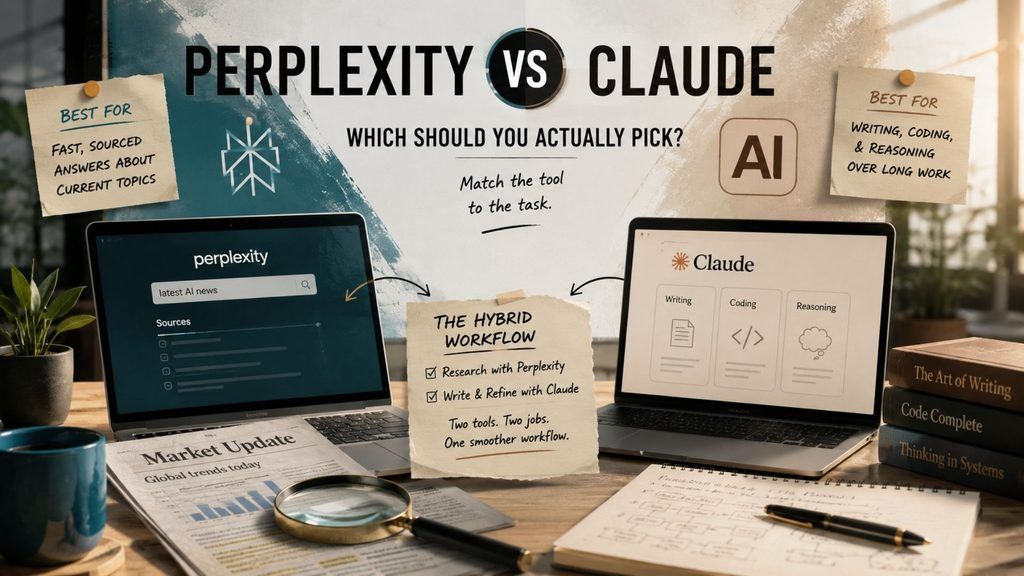
Specifications and Pricing (October 2026)
Feature comparison
| Feature | Perplexity | Claude |
|---|---|---|
| Primary orientation | Real-time web search + citations | Reasoning, writing, coding |
| Default web access | Always on | Optional |
| Inline citations | Present on most answers | Present when search is used |
| Context window | Smaller effective window | Up to 1-million-token context window |
| Model selection | Model picker (multi-vendor) | Anthropic models only (Opus, Sonnet, Haiku) |
| Coding capability | Lookups + Computer agent | Claude Code terminal agent |
| Organization features | Spaces | Projects + Artifacts |
| Agentic features | Perplexity Computer, Comet browser | Claude Code, Claude Cowork |
Table of pricing perplexity vs claude
| Plan | Perplexity | Claude |
|---|---|---|
| Free | Limited Pro Search & Deep Research | Limited messages + Sonnet |
| Pro | $20 per month ($17 annual) | $20 per month ($17 annual) |
| Max | $200 per month | From $100 per month (5×) / $200 (20×) |
| Education | Education Pro approximately $10 per month | No dedicated public student plan |
| Team / Enterprise | Enterprise Pro from approximately $34–40/seat | Team from $20/seat annual + usage |
Claude’s larger context window allows entire reports or multi-file codebases to remain coherent inside one conversation. Perplexity’s effective context is smaller because the system prioritizes retrieval. Token limits and rate limits on both Pro plans become noticeable during extended agentic sessions.
Research Comparison b/w Perplexity vs Claude
Citation behavior of Perplexity vs Claude
In checks of more than 40 claims against their linked sources, Perplexity more frequently pointed to primary pages and maintained higher citation density. Claude with web search can produce citations, but density is lower and some answers mix retrieved material with training data. Hallucination rates remain low on both tools when sources are present. Factual accuracy tests that emphasize live sources show stronger results for Perplexity’s retrieval approach.
Multi-step research of Perplexity vs Claude
Perplexity’s research mode emphasizes breadth and source collection. Claude’s extended thinking and research features emphasize depth and synthesis once material is loaded into context. When given the instruction “official sources only,” Perplexity follows the constraint more consistently.
Read More: https://aiblitzo.com/ai-detector-accuracy-truths/
Writing and Document Analysis
Claude produces more coherent long-form writing. Instruction following is more precise and tone control is more consistent across longer outputs. Perplexity outputs remain clear and fact-oriented but typically read as research synthesis rather than polished prose.
Claude handles large PDFs and multi-document analysis more effectively because of the larger context window. File upload support exists on both platforms. Claude maintains cross-section relationships better; Perplexity is faster at incorporating fresh external information around an uploaded file.
Coding and Agentic Features
Claude Code operates as a terminal agent capable of reading a repository, editing files, running commands, and explaining its steps. Extended thinking assists with complex refactors.
Perplexity Computer is an agentic feature designed for multi-step browser and web tasks. Credit consumption increases with heavier use; higher tiers supply larger credit pools. Comparisons of Perplexity Computer versus Claude Code, and Perplexity Computer versus Claude Cowork, show distinct orientations: the former focuses on browser and web workflows, the latter on repository-level and desktop development work.
Hybrid Research-to-Draft Sequence
A common observed sequence is:
- Collect current sources and cited summaries in Perplexity.
- Transfer the notes and key links into Claude.
- Request synthesis, drafting, or analysis with specified tone and structure.
- Optionally re-check specific claims in Perplexity.
This sequence appears when a user regularly moves from information gathering into finished writing or code within the same project.
Claude vs ChatGPT vs Perplexity
Perplexity is stronger for tasks that begin with finding and citing current information. Claude is stronger for reasoning, writing, and coding across large context. ChatGPT functions as a broad generalist that also supplies image generation, voice, and a large set of custom tools.
Direct writing comparisons between Claude and ChatGPT typically show tighter structure and more consistent instruction following from Claude. Live-research comparisons between Perplexity and ChatGPT typically show higher citation density from Perplexity. Three-way observations (Claude vs ChatGPT, Perplexity vs ChatGPT, and the combined ordering) follow the same pattern. Gemini and Grok can substitute for certain ChatGPT functions but do not match Perplexity’s default citation behavior or Claude’s sustained reasoning on long documents.
Related plan details for ChatGPT appear in the ChatGPT Plus vs Pro comparison.
Privacy Considerations for US Users
Anthropic states that consumer Claude conversations on paid plans are not used for model training by default and provides user controls. Perplexity’s published policy covers search logs and model routing. Team and Enterprise plans on both platforms offer additional retention controls and enterprise SSO. Current privacy documentation should be reviewed before uploading proprietary or client material. Training on user data remains a consideration on free tiers across most AI platforms.

Teams and Developer Features
Claude supplies API access to its model family, support for custom system prompts, Projects, and enterprise SSO on higher plans. Perplexity supplies API access focused on search and Sonar models together with Spaces for shared research. Teams building applications on models generally work with Claude’s API. Teams centered on shared cited research generally work with Perplexity Spaces. For teams weighing that API spend, the smallest model in the family is the natural starting point, and our Claude Haiku 5.5 pricing and benchmarks breakdown shows what it costs per million tokens and where it still performs well.
Variation in Published Comparisons
Published reviews reach different conclusions because the tools address different primary tasks. Evaluations focused on long-form writing rank Claude higher. Evaluations focused on citation density and real-time coverage rank Perplexity higher. Coding benchmarks such as SWE-bench favor Claude. Tests of factual accuracy that emphasize live sources favor Perplexity.
Decision Criteria of Perplexity vs Claude
Select Perplexity when the dominant daily activity is locating current information, verifying claims, market research, or academic literature review.
Select Claude when the dominant daily activity is writing, long-document analysis, complex reasoning, or coding that benefits from a terminal agent.
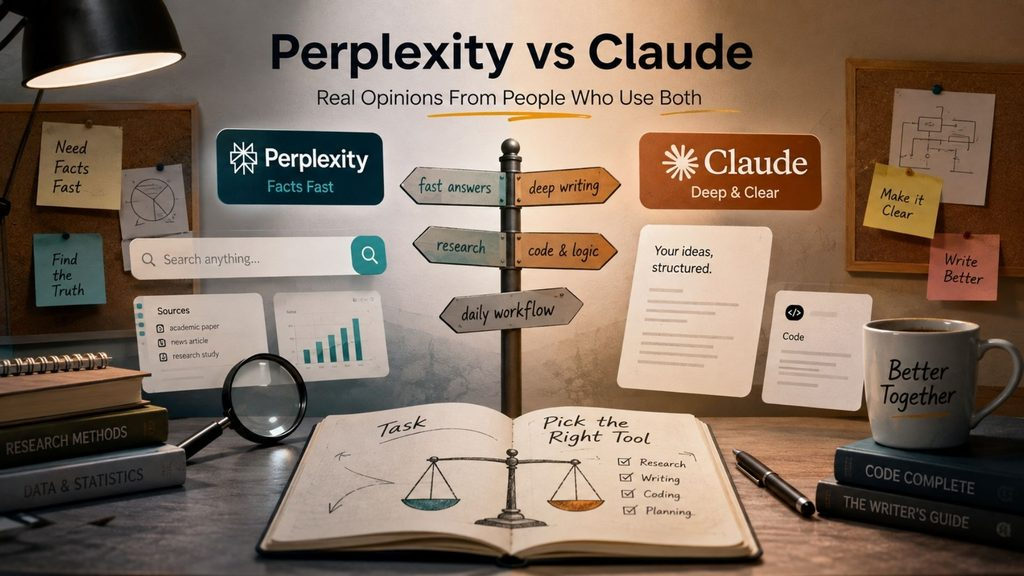
Use both when research and finished writing or coding occur regularly inside the same projects and the combined workflow measurably reduces total time.
Additional context for student use of Claude is available in Claude for students. Methods for improving visibility inside AI answer systems are described in how to rank in ChatGPT.
Frequently Asked Questions
Frequently Asked Questions
Is Perplexity better than Claude?
For research and cited answers, yes. For writing, reasoning, and coding, no.
Does Perplexity use Claude models?
Yes on Pro and higher plans. The model picker can route through Claude Sonnet while still applying Perplexity’s retrieval and citation layer. Output is not identical to native Claude.
Can Claude replace Perplexity for research?
Only when research volume is low. Default real-time coverage and citation density remain higher on Perplexity.
How effective is Claude’s web search?
It is functional and continues to improve, yet it is not the product’s primary design focus. Perplexity remains more consistent for pure research tasks.
How do the $20 Pro plans compare?
Entry price is identical. Relative usefulness depends on which task occupies the majority of working time.
Which free plan is more usable for daily work?
Claude free is generally more usable for writing and analysis. Perplexity free is generally more usable for quick cited lookups until the advanced search allowance is reached.
What is the difference between Perplexity Computer and Claude Code?
Perplexity Computer focuses on browser and multi-step web tasks and consumes credits on higher tiers. Claude Code focuses on repository-level coding as a terminal agent.
Method and Sources
Testing used free and Pro accounts in October 2026. Claims were checked directly against the linked sources. Pricing and feature details were taken from the official Anthropic and Perplexity sites on the same dates. Model availability, limits, and credit systems change; current figures should be verified on the vendor pages. Anthropic pricing, Perplexity
Questions about specific workflow configurations can be sent via the contact page.



-
-
-
-
-
-
-
-
-
-
-
-
-
-
-
-
-
-
-
-
Show Comments[…] Perplexity vs Claude: The Ultimate Simple Guide for 2026 […]
[…] Perplexity vs Claude: The Ultimate Simple Guide for 2026 […]
[…] Perplexity vs Claude: The Ultimate Simple Guide for 2026 […]
[…] Perplexity vs Claude: The Ultimate Simple Guide for 2026 […]
[…] Perplexity vs Claude: The Ultimate Simple Guide for 2026 […]
[…] between the two giants. Sound familiar? If you remember how crowded things got when I compared Perplexity vs Claude earlier, this month makes that look […]
[…] I tested three tools last month for a small client project. First, one handled scheduling. Then, one handled inbox sorting. Finally, one handled research. Honestly, the mix worked better than I expected. Still, not every tool fits every person. That’s why picking the right one matters so much.Read More: Perplexity vs Claude: The Ultimate Simple Guide for 2026 […]
[…] privacy angle matters more than most coverage admits. When we compared research tools in our Perplexity vs Claude breakdown, data handling was the angle everyone skipped. A locally run MIT model sidesteps the entire […]
[…] Search habits are shifting fast. So people still Google things, sure, but they also ask ChatGPT, Perplexity, and Gemini for answers. Then where does that leave your content strategy? Honestly, this shift […]
[…] deal with, since that changes your effective cost to zero. For a deeper side-by-side, check our Perplexity vs Claude and ChatGPT Plus vs Pro […]
[…] Read more: Perplexity vs Claude: The Ultimate Simple Guide for 2026 […]
[…] Perplexity vs Claude: The Ultimate Simple Guide for 2026 […]
[…] Perplexity vs Claude: The Ultimate Simple Guide for 2026 […]
[…] Perplexity vs Claude: The Ultimate Simple Guide for 2026 […]
[…] procedures, and deploy it where your data lives. If you are comparing hosted options instead, our Perplexity vs Claude comparison covers the API-first side of the market, while our guide to DeepSeek V4.1 Flash 1017 shows how […]
[…] configurable data retention. If your team is still choosing AI assistants for daily chat work, our Perplexity vs Claude comparison covers that side of the […]
[…] Overall, if your priority is the highest possible accuracy and you have the hardware budget, Qwen3.8 remains the stronger pick. But if you want a fast, free, laptop-friendly assistant for everyday coding tasks, Flint makes the better case. For a broader look at how we compare frontier models, see our Perplexity vs Claude guide. […]
[…] an agent on real calls within a week. If your team already compares AI platforms before buying, our Perplexity vs Claude guide shows how we test competing tools head to […]
[…] versions of one 10 second shot cost $4.25 at the launch rate and $17 at the regular rate. As our Perplexity vs Claude comparison showed for AI subscriptions, the headline price only matters after you multiply it by real […]
[…] confident first draft. Vendor claims deserve skepticism too. Apply the same skepticism you use when comparing AI models on self-reported […]