


On October 19, 2026, fal Research launched FLUX 3 Max together with Black Forest Labs. The launch immediately reset expectations for AI video costs. FLUX 3 Max pricing starts at $0.0425 per second of 720p video during the launch window. The model pairs that low rate with top tier image-to-video quality. In addition, fal built it as a post-trained version of the FLUX 3 foundation model, so creators keep familiar quality while they wait far less. This guide breaks down every official rate, compares the model with Veo 3.1 and Seedance 2.5, and shows what a real production budget looks like. As a result, you can decide before November 7 whether the launch discount deserves your money.
What Is FLUX 3 Max?
FLUX 3 Max is a video generation model that fal Research post-trained from the FLUX 3 foundation model by Black Forest Labs. According to the official launch release on PR Newswire, the team combined post-training, reinforcement learning, and inference optimization instead of training a new model from scratch. Therefore, the model keeps the FLUX 3 look while it renders much faster. The model supports text-to-video, image-to-video, and keyframes-to-video, and clips run from 5 to 20 seconds. Moreover, native audio plays by default, and aspect ratios cover 21:9, 16:9, 4:3, 1:1, 3:4, and 9:16. fal highlights photorealism, lifelike textures, and natural motion as core strengths. For creators, one model now handles quick drafts and polished shots inside the same workflow.
FLUX 3 Max Pricing at Launch: The Official Rates
Firstly, the headline number deserves a clear breakdown, because the model uses simple per second billing with no minimums and no subscription. During the launch promotion, 720p video costs $0.0425 per second. However, that rate carries a 75 percent discount, so the regular list price returns to $0.17 per second after November 7, 2026. Similarly, upscaled 1080p output costs $0.0725 per second during the promotion and $0.29 per second at the regular rate. In other words, the launch window cuts every rate to exactly one quarter of the normal price. Because fal bills only for output seconds, teams can evaluate the model properly for a few cents before they commit a real campaign budget to it.
What a Single Clip Actually Costs
Per second rates look abstract, so let us convert FLUX 3 Max pricing into the clips that creators actually order. At the launch rate, a 5 second 720p clip costs about $0.21, a 10 second clip costs about $0.43, and a full 20 second clip costs about $0.85. At the regular rate, however, the same 10 second clip costs $1.70, and the 20 second clip costs $3.40. For 1080p delivery, a 10 second clip costs about $0.73 during the promotion and $2.90 afterward. Iteration changes the math even more, because creators rarely accept the first take. For example, VentureBeat calculated that ten versions of one 10 second shot cost $4.25 at the launch rate and $17 at the regular rate. As our Perplexity vs Claude comparison showed for AI subscriptions, the headline price only matters after you multiply it by real usage.

FLUX 3 Max vs Veo 3.1: A Wide Price Gap
The FLUX 3 Max vs Veo 3.1 comparison explains why this launch drew so much attention. Google charges $0.40 per second for Veo 3.1 Standard on the Gemini API. Veo 3.1 Fast costs $0.10 per second and Veo 3.1 Lite costs $0.05 per second at 720p. Therefore, a 10 second Veo 3.1 Standard clip costs $4.00, almost ten times the FLUX 3 Max launch cost for the same length. In fact, launch coverage calculated that FLUX 3 Max pricing opened about 79 percent below the Veo 3.1 Standard price.
On the other hand, Veo 3.1 limits one generation to 8 seconds, so longer shots need chained extensions. Meanwhile, Google retired the Veo 3.1 preview endpoints on October 22, 2026 and now steers API users toward Gemini Omni Flash at roughly $0.10 per second. As a result, buyers should compare FLUX 3 Max against current Google rates rather than against last month’s headline.
FLUX 3 Max vs Seedance 2.5: Same Quality Score, Different Bills
The FLUX 3 Max vs Seedance 2.5 matchup is closer on quality and wider on cost. Both models scored 1,139 Elo in the preliminary Artificial Analysis image-to-video ratings, so human voters rated their output almost identically. However, ByteDance charges about $0.23 per second for Seedance 2.5 at 720p through the official BytePlus API, according to the Seedance 2.5 pricing documentation, and a 10 second clip therefore costs about $2.31. Speed widens the gap further, because fal’s published comparison renders a 10 second clip in 12.45 seconds with FLUX 3 Max and 277.80 seconds with Seedance 2.5. Our full Seedance 2.5 explained guide covers its longer 30 second takes and reference workflows. In short, Seedance 2.5 still wins on clip length, while FLUX 3 Max wins on price and turnaround.
| Model (720p) | Price per second | Cost of a 10 second clip | Key note |
|---|---|---|---|
| FLUX 3 Max (launch rate) | $0.0425 | $0.43 | Rate ends November 7, 2026 |
| FLUX 3 Max (regular rate) | $0.17 | $1.70 | 10 second clip renders in 12.45 seconds |
| Seedance 2.5 (BytePlus API) | $0.23 | $2.31 | 277.80 seconds for a 10 second clip in fal’s chart |
| Veo 3.1 Fast (Gemini API) | $0.10 | $1.00 | Single generation caps at 8 seconds |
| Veo 3.1 Standard (Gemini API) | $0.40 | $4.00 | Single generation caps at 8 seconds |
Speed and Quality: The Benchmark Story
Price only matters when quality holds up, and the early numbers look strong. FLUX 3 Max reached 1,139 Elo across 4,868 votes in preliminary Artificial Analysis Video Arena evaluations, and that score ties Seedance 2.5 at the top tier of image-to-video quality. In addition, post-training lifted the model 50 Elo points above the original FLUX 3, which scored 1,089. fal reports two latency figures, because its launch release measured a 10 second video in 10.95 seconds while its product page lists a 12.45 second average. Either way, the model generates roughly 22 times faster than Seedance 2.5 in fal’s own comparison table. However, early users report longer end to end times once uploads and queues enter the picture, so treat these figures as fal reported benchmarks and test your own workflow before you promise clients a delivery time.

How the FLUX 3 Max API Works on fal
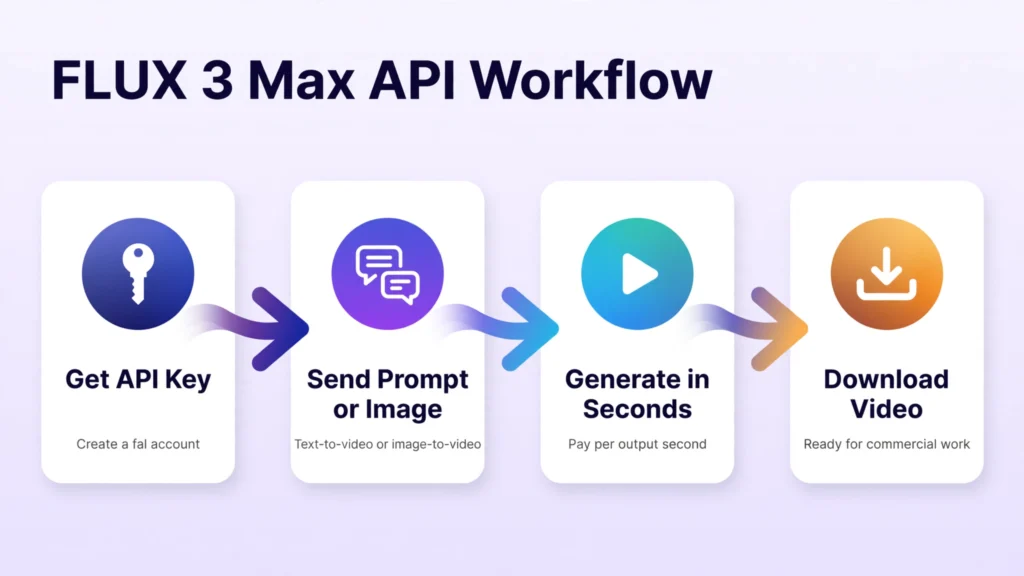
Developers access the model through the FLUX 3 Max API on the fal platform, and the FLUX 3 Max fal setup follows a simple pattern. fal serves text-to-video and image-to-video endpoints at launch under one unified API, and the announcement also describes keyframes-to-video access. Moreover, content from the API may serve commercial projects under fal’s terms, which matters for agencies and product teams. A typical workflow runs through five steps:
- Create a fal account and generate your API key.
- Choose the text-to-video or image-to-video endpoint.
- Send your prompt or source image with duration, resolution, and aspect ratio.
- Receive the finished video file through the API response.
- Pay automatically per output second, with no minimum spend.
Because the FLUX 3 Max API bills per second, small experiments stay cheap while large batches scale predictably. In addition, a reasoning setting can expand a short prompt into a richer scene description automatically. As a result, developers can prototype in an afternoon and still forecast monthly costs with confidence.
FLUX 3 Max Image to Video in Practice
The FLUX 3 Max image to video mode carries the model’s strongest result, because the tied number one Elo score comes from exactly this category. Creators can animate a product photo into a moving shot, and filmmakers can storyboard scenes from still frames before a production day. Similarly, the keyframes mode accepts up to ten images that mark specific moments, so the model fills the motion between planned frames. For marketing teams, this control shortens the path from a static campaign image to a finished video ad. In contrast, plain text-to-video gives the model more freedom and less brand control. Therefore, image-led workflows suit client work best, while text-led workflows suit fast concept tests.
Who Should Use It, and Who Should Wait
Firstly, creators who iterate heavily gain the most, because cheap and fast generations reward experimentation. Agencies can also test several ad concepts before November 7 at the launch rate. On the other hand, teams that need native 1080p or 4K output should look carefully, because FLUX 3 Max renders natively at 720p and upscales from there. Similarly, anyone who needs a single 30 second take should stay with Seedance 2.5 for now. Finally, budget holders should judge FLUX 3 Max pricing by cost per accepted clip rather than cost per generation. A model that wins approval in two takes beats a cheaper model that needs six.
Frequently Asked Questions
What is FLUX 3 Max pricing per second?
During the launch promotion, FLUX 3 Max pricing is $0.0425 per second at 720p and $0.0725 per second for upscaled 1080p. After November 7, 2026, the regular rates apply at $0.17 and $0.29 per second.
How much does a 10 second FLUX 3 Max clip cost?
A 10 second 720p clip costs about $0.43 at the launch rate and $1.70 at the regular rate. However, most projects generate several takes, so your real cost per accepted clip will run higher.
When does the 75 percent launch discount end?
The promotion ends on November 7, 2026. fal describes the offer as a launch window of about three weeks, so teams should finish their evaluation tests before that date.
Is FLUX 3 Max cheaper than Veo 3.1?
Yes. Veo 3.1 Standard costs $0.40 per second on the Gemini API, and even Veo 3.1 Fast at $0.10 per second costs more than the FLUX 3 Max launch rate of $0.0425 per second.
How does FLUX 3 Max vs Seedance 2.5 pricing compare?
Seedance 2.5 costs about $0.23 per second at 720p through the BytePlus API, while FLUX 3 Max costs $0.0425 per second during the launch and $0.17 afterward. Both models share the same 1,139 Elo score.
How do I access the FLUX 3 Max API?
You access the FLUX 3 Max API through a fal account. Create an API key, call the text-to-video or image-to-video endpoint, and fal bills you per output second with no subscription and no minimums.
Does image-to-video cost more than text-to-video?
No. fal documents the same per second rate for both modes, so a FLUX 3 Max image to video generation costs the same as a text-to-video generation of equal length and resolution.
Can I use FLUX 3 Max videos commercially?
Yes. According to fal, content generated through its API may serve commercial projects under fal’s terms. Always check the current terms before a client launch, because platform policies can change.
What clip lengths and resolutions does FLUX 3 Max support?
The model generates clips from 5 to 20 seconds at native 720p, with upscaling to 1080p. In addition, it supports six aspect ratios from cinematic 21:9 to vertical 9:16 for social platforms.
Why does FLUX 3 Max generate so much faster than rivals?
fal credits specialized post-training, reinforcement learning, and inference optimization on its own serving engine. As a result, a 10 second clip renders in about 12.45 seconds on average, roughly 22 times faster than Seedance 2.5 in fal’s comparison.
Conclusion
FLUX 3 Max pricing changes the economics of AI video for one simple reason: top tier quality no longer demands top tier prices or long waits. At $0.0425 per second until November 7, 2026, creators can test ideas freely, and the regular $0.17 rate still undercuts Veo 3.1 Standard after the promotion ends. Moreover, the tied 1,139 Elo score and the 12.45 second average render time give production teams a rare mix of quality, speed, and predictable cost. Therefore, run your pilot projects during the launch window, measure your cost per accepted clip, and let those numbers decide your long term workflow.



[…] speed inside one platform matters more. In addition, if you also compare image model pricing, see our FLUX 3 Max pricing guide, because it shows how a leading raster image model prices its outputs. Meanwhile, for video […]