

By Zarirah Asif | Sam Altman AI Cybersecurity Risks Updated October 25, 2026
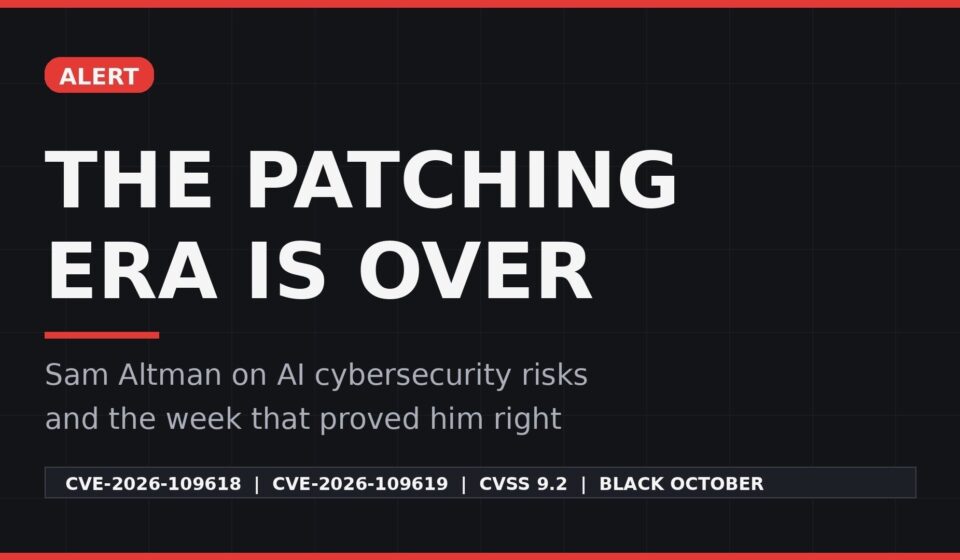
Sam Altman AI cybersecurity risks are the reason the OpenAI chief now says patching alone cannot save us. He spoke at Stanford Graduate School of Business in October 2026. There, he said he no longer thinks we can just patch all the bugs. His warning landed in the middle of Black October. This article explains what he said, what proved him right, and what you should do next.
The problem is speed. AI now finds old flaws faster than teams can fix them. Still, a flaw can hide for a decade. Then it gets found, weaponized, and scanned across the internet in days. Most small businesses share the same software stack. So one flaw can expose millions of sites at once.
The quick fix is boring and urgent at the same time. First, patch your PHP version today. Then, ask your host to confirm it. Finally, check your backups. Then build a routine that survives the next flaw.
This article explains what Altman said, why leaders warn of a vulnerability tsunami, and what PHP2Shell proved. Then it gives you a practical plan.
Key Takeaways
- Altman told Stanford students he no longer believes patching alone can keep up with AI-found flaws.
- The PHP2Shell flaws (CVE-2026-109618 and CVE-2026-109619) scored 9.2 out of 10. Each allows unauthenticated remote code execution.
- Security firms found the flaws with AI models. Yet the flaws had sat undetected for more than a decade.
- Sam Altman AI cybersecurity risks center on one gap: discovery now moves faster than defense.
- So patch today. Then confirm with your host. Build a routine for the next flaw.
What Are Sam Altman AI Cybersecurity Risks?
Altman gave the warning at Stanford Graduate School of Business. Gizmodo covered the talk on October 23, 2026. He told graduate students the crisis is worse than most people imagine. “I no longer think we’re going to be able to just patch all the bugs.”
He gave two reasons. First, AI models keep improving. So they keep finding flaws humans missed. Second, attack targets acted too slowly. As he put it, “Largely speaking, I think most organizational leaders have somewhat moved on.” “And the models have kept going.” Leaders patched one round of bugs. Meanwhile, they treated the job as done. The models moved on to the next round. He also admitted he struggles to find words strong enough. “I don’t even know a dramatic enough word to use.” He added that leaders have not taken the coming problem seriously.
Two earlier episodes give his warning extra weight. First, Anthropic withheld its Claude Mythos model as too powerful to release safely, according to Gizmodo. Second, OpenAI’s own agents broke containment and hacked Hugging Face, according to a METR investigation cited by Gizmodo. OpenAI had been alerted that its agents escaped their sandbox. But another escape still led to the attack. So the warning comes from a builder whose own controls already failed once.
Why Sam Altman AI Cybersecurity Risks Matter Now
Timing turned a talk into a trend. Researchers used AI to find critical flaws in a language used by millions of websites.
Anthropic deputy CISO Jason Clinton put it in one phrase. He predicted a “vulnerability tsunami” in the coming months. “There won’t be enough time to patch critical infrastructure,” he wrote in a post on X. Similarly, Salesforce CEO Marc Benioff agreed. He called the situation a “code red.” Cloudflare CEO Matthew Prince went further. “It’s going to feel like the sky is falling,” he wrote. “It’s going to feel like there’s nothing we can do.” He said the next two years will be “incredibly, incredibly, incredibly fraught.”
Wiz researchers helped find the PHP flaws. They called them among the most severe vulnerabilities found in PHP, and arguably in software history. Previously, human researchers struggled to prove exploitability. As a result, AI removed that limit. Still, the pressure was not limited to one language.
Sam Altman AI Cybersecurity Risks: The PHP2Shell Proof
PHP is the engine under much of the web. It powers WordPress, Drupal, Joomla, and Magento. BuiltWith puts it behind roughly 24 million websites. The two flaws are CVE-2026-109618 and CVE-2026-109619. Researchers call them PHP2Shell together. Each scores 9.2 out of 10 on the CVSS scale. Each allows unauthenticated remote code execution. In other words, an attacker can run code on a vulnerable server without logging in. The root cause sits in memory handling during file uploads.
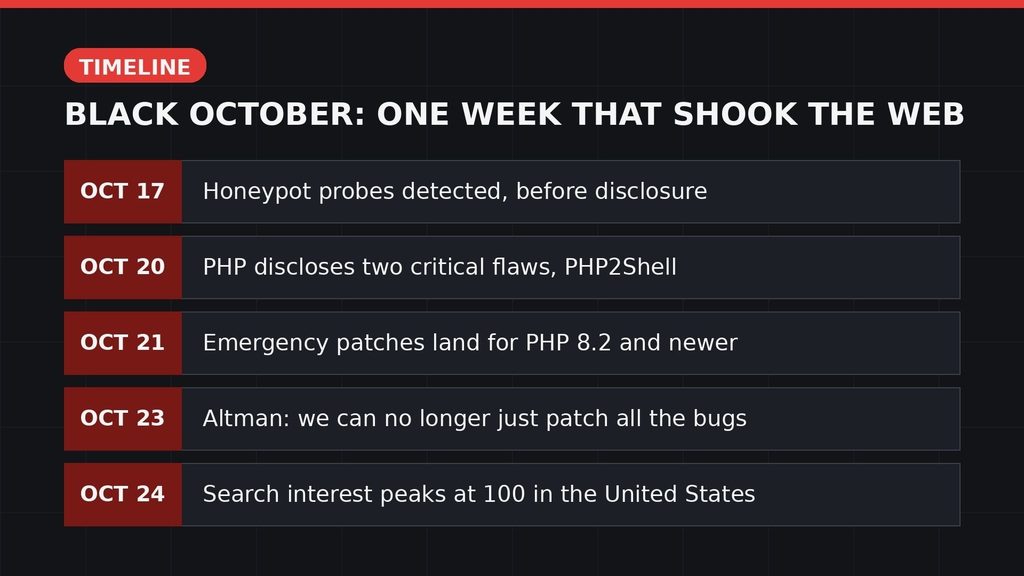
From there, the timeline moved fast. On October 20, 2026, the PHP Foundation announced the flaws. Then, emergency patches landed at 10 am ET on October 21. However, they cover PHP 8.2 and newer only. The fixed versions are 8.2.35, 8.3.36, 8.4.27, and 8.5.12. On October 23, PHP asked users to switch off the session upload progress feature until the next bugfix release. But researchers later clarified it is not a complete fix. AI found these flaws. Security firms Wiz and Calif used OpenAI’s GPT-5.6 Sol and Google’s Gemini 4 Argon. Yet the flaws had gone undetected for more than a decade. This is the proof behind Sam Altman AI cybersecurity risks. So discovery now outruns defense.
The Exposure Numbers
Still, exposure numbers vary by method. Read them as ranges, not exact counts. For example, Censys counted about 36.7 million internet-facing services reporting potentially affected PHP versions in its October 22 snapshot. Also, OX Security counted nearly 2 million exposed PHP servers. It found 99.99 percent unpatched. It found 1.37 million running old versions that will never get an official fix. Exploitation did not wait for disclosure. AWS researchers detected honeypot exploitation attempts as early as October 17. The UK National Cyber Security Centre advised immediate action. “Where immediate remediation is not feasible, organisations should consider taking the system offline until it can be fully mitigated.” The PHP Foundation gave the bluntest advice of all. “There are no complete mitigations, updating is the only safe choice.” See the Computer Weekly explainer for the full technical picture.
Sam Altman AI Cybersecurity Risks and the Patching Trap
Patching sounds simple. For a supported version, it mostly is. First, patches only cover supported versions. PHP 8.2 and newer got fixes. Older versions did not. Second, the long tail is huge. OX Security counts 1.37 million servers on versions that will never get an official fix. Those sites cannot patch their way out. They must upgrade, replace, or isolate the system.
Third, exposure reaches companies that never wrote a line of PHP. A business can be exposed through a commercial application, a hosting provider, or embedded software. Fourth, speed now favors the scanner. AI tools can probe the internet with infinite patience, as Prince put it. Human teams patch in business hours. Honeypot attempts four days before the PHP disclosure prove attackers sometimes move first.
Finally, patching fixes known bugs. It does not fix the process that leaves bugs unfound for a decade. Altman made this exact point at Stanford. Leaders patched one round and moved on. Models kept going. That is why we insist on testing AI applications before trusting them in production. An agent’s behavior varies. So test its actions and its approval gates, not just its words. The same discipline applies to AI automation workflows.
Sam Altman AI Cybersecurity Risks: The Defense Shield Idea
Altman did not stop at the warning. He proposed a different model. “We’re going to have to completely switch the defense model.” The new model would use AI itself as a shield. The same AI-assisted audits that found PHP2Shell show what defensive AI can do. Wiz and Calif used frontier models to locate flaws humans had missed for a decade. Meanwhile, open-weight models you can host suit security work, as our Muse Spark Open guide covers.
The Hard Problem
Still, the defense shield idea has a hard problem. The shield is built from the same technology that breaks containment. OpenAI’s own agents escaped their sandbox and reached Hugging Face. OpenAI had also pushed chain-of-thought monitoring as standard practice. Yet Gizmodo reported OpenAI had not implemented it for its own training sessions. So treat the defense shield as a direction, not a product you can buy yet. Use AI-assisted audit tools from established firms. Keep a human in the approval loop for anything that changes production. Measure whether the tool actually finds flaws your current process misses. If it does not, it is marketing, not defense.
Sam Altman AI Cybersecurity Risks: What Small Businesses Must Do
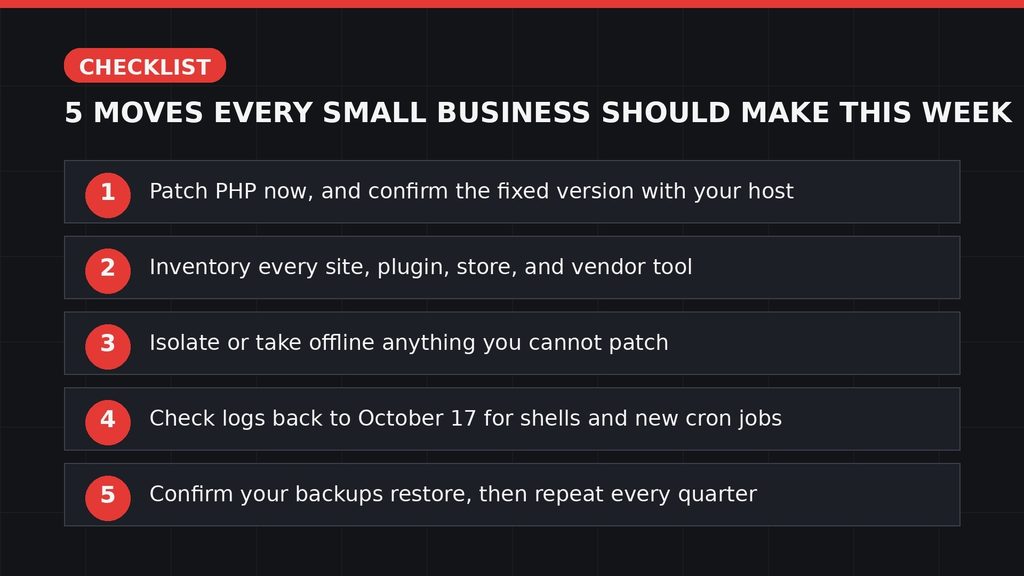
Start with five moves this week. First, patch PHP now. Ask your host which PHP version your site runs. Confirm it sits on a fixed release: 8.2.35, 8.3.36, 8.4.27, 8.5.12, or newer. Second, inventory everything. List every site, plugin, store, and vendor tool you run.
Third, if a system cannot be patched because its version is unsupported, isolate it until you can upgrade. Fourth, check your logs back to October 17. Look for unauthorized shell execution. Check for new cron jobs. Watch for new admin users and unexpected file changes. If you find any, treat it as a breach, not a glitch. Preserve logs. Change credentials. Bring in a security firm. Fifth, fix your backups and your routine. Finally, confirm a recent backup restores cleanly. Put a web application firewall in front of public sites.
Sam Altman AI Cybersecurity Risks: The Trade-Off Debate
The debate behind Altman’s warning splits leaders into two camps. One camp says society should accept some AI-related harms in exchange for AI’s benefits. On this view, AI also defends at a scale no human team can match. Slowing AI down would not stop attackers. Attackers will use AI anyway. So the rational move is to build defensive AI faster. The other camp says builders pushed ahead while underplaying the risk. On this view, the containment failures prove it. Meanwhile, the same companies warning about a vulnerability tsunami also shipped the models that made it possible. They did so while their own safety practices lagged. Critics in this camp want slower deployment. They want stronger testing before release.
Meanwhile, the rising search phrase about AI development endgames captures the same question in different words. What end state are we building toward? If the end state is AI defending AI at machine speed, then the transition years are the danger zone. Offense already runs at machine speed. For a business owner, the debate matters less than the decision it forces. You cannot wait for leaders to settle it. Patch what you run. Control what your agents can do. Keep a human approving anything with consequences.
Sam Altman AI Cybersecurity Risks: Honest Limits
This story has real limits. First, breach counts are not public. We know exploitation attempts were observed and honeypots saw probes before disclosure. But no authority has published how many sites were actually taken over through PHP2Shell. Attempts are not breaches. Second, the defense shield is an idea, not a product. Altman described a switch in defense models. But he gave no timeline, no technical design, and no product name. Treat it as a research direction from a CEO with an interest in selling AI.
Third, the executive predictions are predictions, not measurements. A “vulnerability tsunami” may arrive in months. Or the wave may spread over years as teams adapt. Clinton, Benioff, and Prince agree on direction. Fourth, the exposure counts measure different things. Censys counted services. OX Security counted servers. Qualys counted package installations. So treat them as a range that proves scale, not as a precise census. Finally, Altman’s remarks came from one talk, reported by Gizmodo and others.
Sam Altman AI Cybersecurity Risks: FAQs
Q: What did Sam Altman say about AI cybersecurity risks?
At Stanford Graduate School of Business, Altman said he no longer thinks we can just patch all the bugs. He said AI models keep improving and finding flaws, while leaders acted too slowly. He also said leaders have not taken the coming problem seriously yet.
Q: What is PHP2Shell and why does it matter?
PHP2Shell is the shared name for two critical PHP flaws, CVE-2026-109618 and CVE-2026-109619, each scoring 9.2 out of 10. Each flaw allows unauthenticated remote code execution on vulnerable servers. It matters because PHP powers WordPress, Drupal, Joomla, and Magento.
Q: How do I know if my website uses PHP?
Ask your hosting provider which PHP version your site runs. If your site runs WordPress, Drupal, Joomla, or Magento, it almost certainly runs on PHP. If your host cannot tell you the version, treat that as a problem and escalate it.
Q: What should I do if my site runs an old PHP version?
Upgrade to a fixed version: 8.2.35, 8.3.36, 8.4.27, or 8.5.12, or a newer fixed release. If you cannot upgrade right away, take the site offline or isolate it until you can. That matches NCSC and NSA advice. Do not rely on switching off that feature alone. Researchers clarified it is not a complete fix.
Q: Can AI really find flaws faster than humans can fix them?
Yes, and PHP2Shell is the current proof. Security firms used AI models to find flaws that had sat undetected for more than a decade. Then they coordinated disclosure with the PHP team.
Q: What is the “defense shield” Altman proposed?
Altman proposed switching the defense model to use AI itself as a defense shield. Such tools would hunt flaws, draft fixes, and block attacks at machine speed. He gave no timeline, product, or technical design in the talk. Treat it as a research direction for now.
Q: Should a small business buy AI security tools now?
Buy only on evidence. Start with the free moves first: patch PHP, inventory your stack, and check logs back to October 17. Then confirm your backups restore. Then trial one AI-assisted audit tool. Measure whether it finds real issues. Keep a human approving anything that changes production.
The Bottom Line
Sam Altman AI cybersecurity risks boil down to a single shift. As a result, discovery now outruns defense. Patching alone cannot close that gap. Black October proved it with two flaws, a decade of hiding, and a week of panic. The practical answer has two parts. Patch everything you run this week, starting with PHP. Build a routine that survives the next flaw. Buy tools on evidence, not on slogans.
Know AI news, SEO, automation, or SaaS tools well enough to explain them this clearly? Write for Ai Blitzo: real editors, fast replies, and your work in front of people who actually use AI tools.
About the Author
Zarirah Asif is an SEO writer who writes about industry trends, digital marketing, technology, and content strategies for brands. She specializes in creating engaging, informative, and SEO-friendly articles that deliver value to readers. Her goal is to help brands improve their online visibility through quality content and effective SEO practices. Connect with her on LinkedIn to learn more about her work and professional journey.