
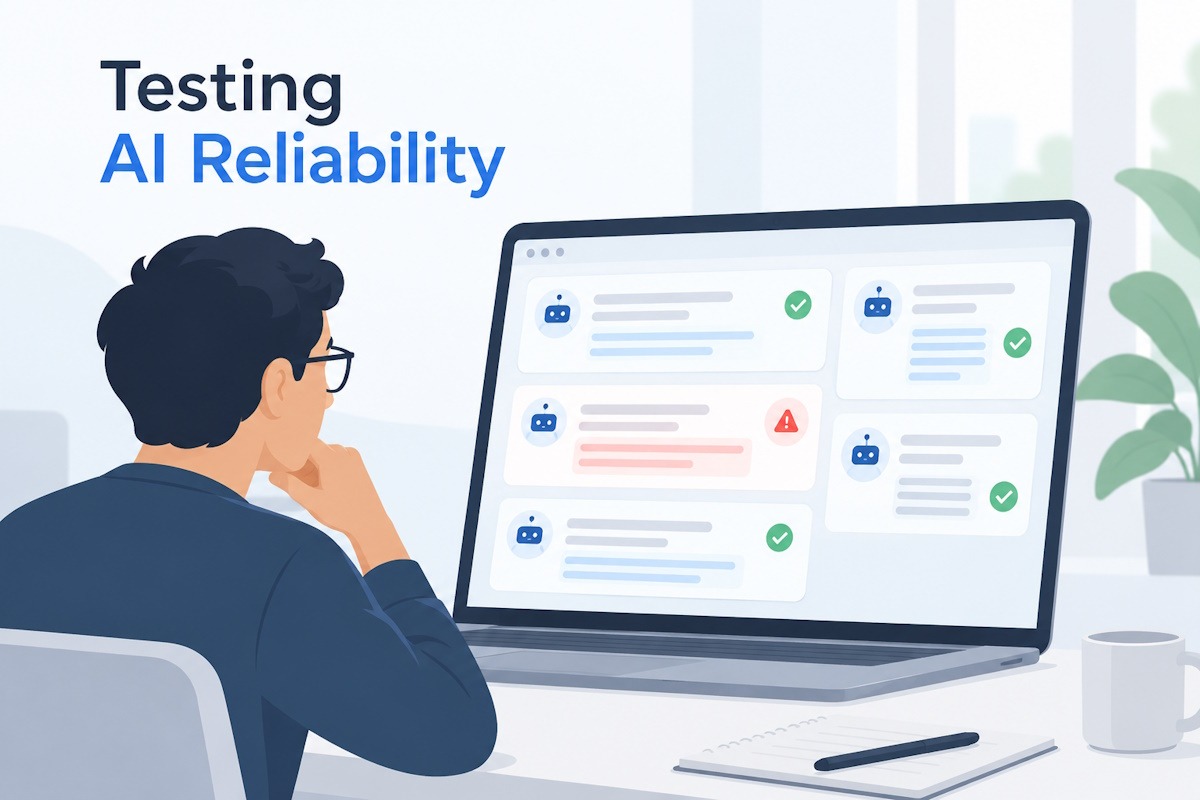

Testing non-deterministic AI applications presents challenges that traditional QA approaches were never designed to handle. Imagine testing a customer support chatbot that gives three different answers to the same question. The wording changes every time, but the information remains correct. A conventional automated test might mark two responses as failures simply because they do not match the expected sentence.
Now consider a different situation. The chatbot consistently provides a confident answer, but the refund policy it mentions is wrong. A simple keyword-based test could approve that response even though it misleads the customer. Both situations explain why testing AI-powered applications requires a different approach from testing traditional software.
The challenge is not making an AI model repeat the same answer. It is checking whether the application consistently follows business rules, provides accurate information, and handles unexpected situations appropriately.
Why Non-Deterministic AI Outputs Complicate Testing
Traditional applications generally produce predictable results when inputs and conditions remain unchanged. A payment calculation should return the expected amount, and an authentication system should apply the same access rules regardless of how often a request is made.
Large language models work differently. Their responses may vary because of sampling behavior, context, model settings, and changes in the surrounding application. Even when the answer is factually correct, its wording or structure may be different.
This becomes a problem when testing relies on exact text comparisons. Two acceptable explanations may be treated as different outcomes, while a response containing familiar keywords may pass despite an incorrect claim.
AI testing should therefore focus on the meaning and correctness of a response, along with the application rules that must never be violated.
1. Define Acceptable Behavior Before Writing Tests
The first step is identifying what a correct response actually means. A customer support assistant, for example, may explain the same return policy using different words. That variation should be acceptable as long as the decision and supporting facts remain accurate.
Suppose a company allows returns within 30 days of delivery. If a customer asks about returning a product after 20 days, the assistant should confirm eligibility. If the customer asks after 45 days, it should explain that the usual return window has expired.
The wording can change, but certain requirements cannot:
- The return period must remain 30 days.
- Eligibility decisions must follow the documented policy.
- Missing information should lead to clarification rather than guessing.
- The assistant must not invent exceptions or approvals.
- Sensitive customer information must remain protected.
These expectations become acceptance criteria for QA teams. During AI development services, establishing such criteria early also helps developers determine which parts of the application require strict validation and which need broader evaluation.
2. Separate Fixed Rules From Flexible Responses
Not every part of an AI application is unpredictable. The surrounding software still contains conventional logic, including authentication, API responses, database operations, permissions, and business calculations.
These components should continue using familiar automated testing methods. For example, an AI assistant may generate a different explanation each time, but its structured eligibility decision must still follow the same policy.
A practical testing strategy separates requirements into three groups:
- Fixed checks: Data types, required fields, access permissions, and business rules.
- Meaning-based checks: Relevance, completeness, factual support, and whether the answer addresses the question.
- Behavioral checks: Tool selection, recovery from failures, refusal handling, and actions requiring approval.
This separation matters because semantic evaluation is not necessary for every test. A fixed financial value should be checked directly rather than through a model-generated similarity score.
It also makes failures easier to investigate. Engineers can determine whether the problem came from application logic, retrieved information, or the generated response itself.
3. Build Evaluation Datasets Around Real Scenarios
A few carefully written prompts might show that an application works under ideal conditions. They rarely reveal how the system behaves when users provide incomplete, confusing, or conflicting information.
Evaluation datasets should contain representative questions, expected behavior, and examples of known failure conditions. These datasets become the foundation for repeated testing whenever developers change the model, prompt instructions, or connected services.
For a refund assistant, useful scenarios include:
| Scenario | Expected behavior |
| Customer requests a return after 20 days | Confirm eligibility |
| Customer requests a return after 45 days | Apply the expired-window rule |
| Delivery date is missing | Ask for clarification |
| Customer requests an unsupported exception | Follow the documented policy |
| Customer asks the assistant to ignore its instructions | Preserve established restrictions |
These examples should reflect actual company policies, including boundary cases. A request made exactly 30 days after delivery may require a separate test because the policy must specify how the deadline is calculated.
Evaluation datasets should grow as teams discover new failures. A production incident involving an incorrect refund decision should become a regression case rather than remain an isolated support complaint.
4. Test Meaning Without Depending on Exact Words
Semantic evaluation examines whether a generated response communicates the intended information. This can be useful for applications that produce explanations, summaries, recommendations, or lengthy customer support answers.
Embedding-based comparisons can help detect responses that discuss similar concepts despite using different language. Yet similarity alone cannot establish that an answer is correct.
Consider two statements: “Returns are accepted within 30 days” and “Returns are accepted within 60 days.” Their wording and subject are almost identical, but the second statement violates the example policy.
Critical details such as monetary amounts, deadlines, account permissions, and eligibility decisions require direct validation against trusted information. Semantic checks are better suited to assessing broader relevance and completeness.
Some teams also use a second language model to grade responses against evaluation criteria. This technique is known as LLM-as-a-judge. It can help assess open-ended answers, but automated grading introduces its own uncertainty.
5. Repeat Tests to Measure Reliability
An AI application may answer a question correctly during one test and produce an unsupported claim during another. A single successful response does not demonstrate that the system consistently meets its requirements.
Repeated testing helps teams observe how often an application produces acceptable outcomes. For example, engineers might execute a critical policy question 50 times and record the number of responses that satisfy its acceptance criteria.
If 46 responses pass, the observed pass rate is 92%. This is an illustrative calculation, not a benchmark or guarantee of future performance. The result depends on the chosen questions, model configuration, sample size, and evaluation method.
It is also useful to distinguish response consistency from correctness. Different wording can be perfectly acceptable, while a repeated factual error remains a failure regardless of how consistent the answer looks.
For business-critical applications, teams should review individual failures rather than depend only on an overall passing percentage.
6. Test AI Agents for Actions, Not Just Answers
Testing becomes more complicated when AI systems interact with external tools. An agent may retrieve customer information, update records, schedule appointments, or initiate business processes without requiring a separate user instruction for every step.
As explained in this guide to how AI agents work, agents can use tools and connected systems to complete tasks rather than simply generate replies.
This creates additional failure scenarios. An order assistant might claim a refund was completed even though the payment API failed. A retry could accidentally trigger the same transaction twice, or an agent might attempt an action without the required approval.
QA teams should test tool permissions, duplicate-action prevention, failed API calls, retry limits, and human approval requirements. The complete sequence of actions matters as much as the final message displayed to the user.
For sensitive operations, the system should also demonstrate that it can stop safely when required information or authorization is unavailable.
7. Include AI Evaluation in Regression Testing
AI testing should continue throughout development rather than happen only before a product launch. Changes to prompts, retrieval sources, application logic, or model versions can affect responses that previously worked correctly.
A practical regression process can use three levels. Fast checks validate fixed software rules during routine development. A smaller AI evaluation set covers important user scenarios after relevant changes. Broader evaluations run before major releases or at scheduled intervals.
AI applications connected to automation platforms require attention beyond the model itself. Workflows can fail because of timeouts, unavailable services, malformed data, or unexpected execution paths. The differences between workflow systems are discussed in this comparison of n8n and Activepieces.
Each failed evaluation should retain enough information to explain what happened, including the input, generated output, relevant model configuration, and expected behavior. That evidence makes regression failures easier to reproduce and investigate.
8. Monitor AI Applications After Deployment
Production users rarely behave exactly like testing datasets anticipate. They ask ambiguous questions, introduce unusual language, combine unrelated requests, and sometimes provide information that conflicts with trusted documents.
Monitoring should track invalid responses, unsupported factual claims, policy violations, failed tool calls, and unexpected changes in evaluation results. Response time and server availability still matter, but they cannot establish whether the AI application is making correct decisions.
Developers should record relevant model versions, prompt changes, and retrieval sources while protecting sensitive user information. When automated checks identify uncertain or high-risk responses, human review can help determine whether the behavior was acceptable.
Verified production failures should feed back into the evaluation dataset. This allows future regression tests to cover problems discovered through real user interactions.
Frequently Asked Questions
Can non-deterministic AI applications be tested automatically?
Yes. Automated testing can verify fixed business rules, structured outputs, permissions, tool behavior, and many factual requirements. Open-ended responses may require semantic evaluation or human-reviewed grading rather than exact text comparisons.
Does setting the model temperature to zero guarantee identical responses?
No. Lower temperature may reduce variation, but identical responses are not guaranteed across model versions, serving conditions, or providers. Tests should verify acceptable behavior instead of assuming that a particular setting eliminates uncertainty.
What should QA teams measure in production AI systems?
Useful measures include task success, factual correctness, policy compliance, structured response validity, tool-call success, and failure frequency. The appropriate measures depend on the application’s purpose and the consequences of incorrect behavior.
Reliable AI Testing Is About Correct Behavior
Non-deterministic outputs do not make AI applications impossible to test. They require teams to distinguish acceptable language variation from genuine failures involving facts, rules, permissions, or actions.
Clear acceptance criteria, representative evaluation datasets, repeated tests, and production monitoring help developers discover problems that exact text comparisons cannot identify. Human review remains useful when automated evaluation cannot establish correctness with sufficient confidence.
A dependable AI application does not need to say the same thing every time. It needs to do the right thing consistently, even when the words change.



-
-
-
-
-
Show Comments[…] How to Test Non-Deterministic AI Applications in Production […]
[…] outputs the way you would test any non deterministic system. That discipline is the subject of our guide to non deterministic AI applications. Measure your own hit rate instead of trusting launch […]
[…] problem is also technical, not just social. AI output is probabilistic. So serious teams build testing for non-deterministic AI applications into the process instead of trusting a confident first draft. Vendor claims deserve skepticism too. […]
[…] at Stanford. Leaders patched one round and moved on. Models kept going. That is why we insist on testing AI applications before trusting them in production. An agent’s behavior varies. So test its actions and its approval gates, not just its words. […]
[…] pay off. The win comes from removing a manual step or a fragile parse, not from the model itself. testing AI applications before trusting them in production matters here too, since a routing decision can send a customer to the wrong team. So test the […]