

By Zarirah Asif | OpenAI Impact on Mathematics Field Updated October 23, 2026
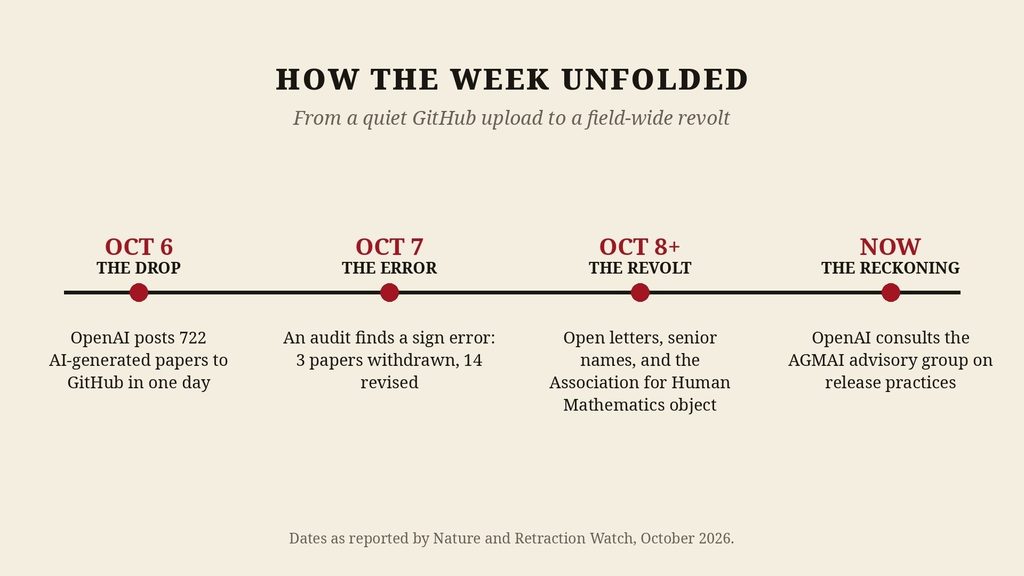
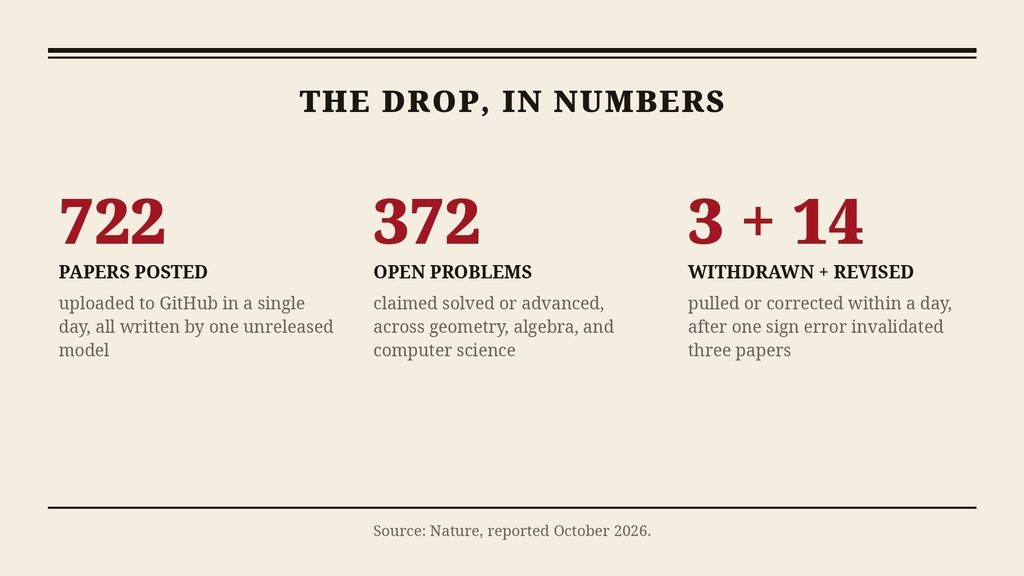
The OpenAI impact on mathematics field comes down to one week in October 2026. OpenAI posted 722 AI-generated math papers to GitHub in a single day. The papers claimed progress on 372 open problems, and then the world’s mathematicians revolted. OpenAI withdrew three of the papers within 24 hours after a sign error surfaced.
In fact, the backlash was never really about whether AI can do mathematics. It was about consent, credit, and verification. The drop scooped researchers on problems they had spent years solving. It also handed a small expert community 722 unreviewed proofs it never agreed to check.
The fix is simple to state and hard to skip. Verify before you announce. Then release at a pace experts can review, and credit the humans whose work your model touches. OpenAI skipped all three, in public, at record scale.
This article explains what OpenAI released and why senior mathematicians reacted so strongly. It covers the named reactions, from Terence Tao to Hugo Duminil-Copin, and the one major voice in favor. Finally, it draws out five hard truths for anyone building or using AI.
Key Takeaways
- OpenAI posted 722 AI-generated manuscripts on October 6, 2026, claiming solutions or progress on 372 open problems.
- OpenAI withdrew three papers and revised 14 within a day, after an internal audit found a sign error.
- None of the 722 papers claimed a solution to a Millennium Prize Problem.
- The revolt targeted conduct, scooping, verification burden, and zero consent, not the capability itself.
- One senior voice in favor, Levent Alpöge, called it possibly the most significant moment in mathematical history.
What Did OpenAI Release on October 6, 2026?
On October 6, 2026, OpenAI posted 722 AI math preprints to a public GitHub repository. An unreleased frontier model generated the OpenAI math papers (one report names it Astra). The papers claimed solutions to, or significant progress on, 372 open problems across geometry, algebra, and theoretical computer science. Nature reported the release first. Since then, the story has been building search volume.
Scale is the story. A strong research group publishes a handful of papers a year. OpenAI published a library in a day. It landed in a field whose quality system, peer review, assumes human-speed output. Other humans must check that output line by line. However good the individual proofs were, the delivery method broke the system they landed in.
The drop also contained no solutions to any of the five remaining Clay Millennium Prize Problems. It landed a month after OpenAI’s September preprint on Navier-Stokes, one of the original seven Millennium problems. That preprint had already put the community on edge about speed beating verification. Therefore, 722 papers at once read less like a publication and more like a land grab. That choice, more than the math itself, defines the OpenAI impact on mathematics field.
Why Did Mathematicians Revolt?
First, start with the working mathematicians. Alvaro Lozano-Robledo is a number theorist at the University of Connecticut. He called the volume “staggering” and asked the obvious question: “Why is OpenAI trying to solve hundreds of math problems to be released all at once?” Ursula Martin at Oxford said OpenAI was “tossing the community a messy first draft and expecting us to clean it up.” Columbia’s Michael Harris refused outright: “I will not be reading these papers,” calling the process illegitimate.
The senior tier reacted in the same way, too. Terence Tao said he was “deeply frustrated.” Hugo Duminil-Copin, a Fields medallist, said “the shock is immense. I am paralysed.” Fellow medallist Peter Scholze urged calm: mathematics “is a marathon, not a sprint.” A group of mathematicians put the structural objection in writing. “Releasing over 700 files at once is not a demonstration of scholarship, but a demonstration of power.” The Association for Human Mathematics went further, saying plainly that mathematicians did not ask for this work to be done.
The scooping problem (OpenAI Impact on Mathematics Field)
Priority is the currency of research. The first person to solve a problem gets the credit, the citations, and often the career. Researchers had spent years on problems inside the drop. Then a machine release pre-empted them overnight, without warning. Even if the AI proofs later fail review, the drop still devalues the human work. After all, who funds or publishes the second solution to a problem the world believes is already solved?
The verification burden (OpenAI Impact on Mathematics Field)
Every one of the 722 AI-generated proofs now needs expert hours to check. And checking a hard proof is skilled, slow labor. So the community never agreed to donate those hours. This grievance has the longest tail. Even a mathematician who welcomes AI assistance never volunteered to become the unpaid quality-control department for an unreleased commercial model.
The Sign Error That Proved the Point
Within a day, OpenAI withdrew three of the 722 manuscripts and revised 14 more. An internal audit had found a sign error. That error invalidated one proof and two papers built on it. Meanwhile, Retraction Watch documented the withdrawals as they happened.
Cornell’s Alex Townsend said OpenAI should have announced the formally verified manuscripts first. MIT’s Andrew Sutherland called the withdrawal “the responsible thing to do.” Still, he noted the community remains unhappy with how OpenAI behaved. One sign error in 722 papers is, honestly, a good error rate. That is also exactly why the field insists on checking before celebrating. Dropping unverified work at this scale was always going to end in public corrections.
The One Senior Voice in Favor
Still, the backlash was not unanimous. Levent Alpöge is a mathematician now working at Anthropic. He also predicted that mathematicians could solve a large share of mathematics within a decade. Still, he acknowledged the “sad stories” of researchers whose projects the drop had scooped.
He argued the opposite case in public: “it’s obviously the most significant moment in mathematical history.” He pointed to a field that tenure and publication committees defend.
Both things can be true at once: a historic capability jump, delivered in a way that maximized resentment. Alpöge’s argument is about what the model did. Everyone else’s argument is, instead, about how OpenAI handed it to them.
What OpenAI Says Now
OpenAI’s public position is simple. It evaluates its models “against difficult frontier problems in all sciences,” and mathematics is where the capability showed up loudest. Since the backlash, the company has begun consulting AGMAI. That body is the Advisory Group on Mathematics and Artificial Intelligence at the Institute for Advanced Study. The topic is best practices for releasing AI-generated research.
Reporting on The Verge’s Vergecast added a harder edge. An advisory group reportedly urged OpenAI to stop testing the model against the whole field. OpenAI kept going anyway. So treat that as reported, not confirmed. Either way, the sequence is now public record: release first, consult after. That sequence shapes the OpenAI impact on mathematics field more than any single paper in the drop.
What the OpenAI Impact on Mathematics Field Means Beyond Math
Every expert field runs on the same immune system. It has three parts: peer review, priority for whoever solves something first, and reputation earned over years. Meanwhile, AI can now produce expert-shaped output faster than any of those systems can verify it. Mathematics is simply the first field to get its 722-paper day. Medicine, law, and engineering will get theirs too. As a result, every lab doing AI in research is now on notice.
The business version of this failure is also familiar. We flag the same pattern in AI automation workflows whenever a company deploys a tool across a skilled team. The rollout starts before anyone checks its outputs or asks the people doing the work. The verification problem is also technical, not just social. AI output is probabilistic. So serious teams build testing for non-deterministic AI applications into the process instead of trusting a confident first draft. Vendor claims deserve skepticism too. Apply the same skepticism you use when comparing AI models on self-reported benchmarks.
5 Hard Truths About the OpenAI Impact on Mathematics Field
- Capability is not permission. The ability to generate 722 papers did not make publishing them all at once acceptable. The field has to live with them, and it never agreed to that.
- Verification is the real bottleneck. Generation, meanwhile, is now cheap and instant. Checking is still human, slow, and scarce, and any release plan that ignores that math will fail the same way.
- Credit is not optional. In fact, scooped researchers are the human cost of scale-first releases. Fields remember who treated their priority system as an obstacle.
- Scale reads as power. The mathematicians’ letter, for example, said it directly: 700 files at once is a demonstration of power, not scholarship. Size is a message, whether you intend it or not.
- The correction never catches the headline. Still, the 722 number is what the world will remember. The 3 withdrawals and 14 revisions will be a footnote. So the checking has to happen before the announcement, not after.
The Honest Limits of This Story
Still, four caveats keep this article accurate. First, most of the 722 papers are still unverified claims. Checking them will take months to years, and some will not survive review. Second, the model behind them is unreleased. So independent researchers cannot rerun it or audit how OpenAI produced the papers. Third, backlash is still not proof the mathematics is wrong: Alpöge’s point stands, and the capability jump may prove historic. Fourth, the counts in this article come from OpenAI’s repository and reporting by Nature and others. Readers should treat them as reported figures, not independently audited ones.
OpenAI Impact on Mathematics Field: FAQs
Q: What did OpenAI release on October 6, 2026?
OpenAI posted 722 AI-generated mathematics manuscripts to a public GitHub repository. An unreleased frontier model produced them. The papers claimed solutions to, or significant progress on, 372 open problems in geometry, algebra, and theoretical computer science. Within a day, OpenAI withdrew three papers and revised 14 after a sign error surfaced.
Q: Why are mathematicians angry at OpenAI?
Three reasons. First, the release scooped researchers who had spent years on problems inside the drop. Second, it dumped 722 unreviewed proofs on a community that now has to spend expert hours verifying them. Third, it treated publication as a show of scale rather than scholarship. The Association for Human Mathematics said the field did not ask for the work.
Q: Did OpenAI solve a Millennium Prize Problem?
Not in this drop. None of the 722 papers claimed a solution to any of the five remaining Millennium Prize Problems. Before this, OpenAI had released a Navier-Stokes preprint in September 2026, which had already drawn criticism about speed over verification.
Q: Which AI model wrote the 722 papers?
An unreleased OpenAI frontier model. OpenAI has not shipped it publicly, and one report names it Astra. Because the model is unreleased, independent researchers cannot rerun it or audit how OpenAI produced the manuscripts.
Q: How many OpenAI math papers were withdrawn?
OpenAI withdrew three papers and revised 14 within about a day of the release. An internal audit then found a sign error that invalidated one proof and two papers that depended on it.
Q: What is AGMAI? (OpenAI Impact on Mathematics Field)
AGMAI is the Advisory Group on Mathematics and Artificial Intelligence, based at the Institute for Advanced Study. OpenAI is consulting it on best practices for releasing AI-generated mathematical research, after the October 2026 backlash.
Q: Will AI replace mathematicians? (OpenAI Impact on Mathematics Field)
Nothing in this episode shows that. The 722 papers still need human experts to verify them. That need is the field’s core complaint and its strongest protection at the same time. AI produced claims at machine speed, but only mathematicians can decide which of them are true.
The Bottom Line
The OpenAI impact on mathematics field will not come from the 722 papers themselves. Most will fade, some will fail review, and a few may genuinely matter. The mathematicians’ backlash was the field’s immune system doing its job. Its real measure, instead, is what the episode taught every AI lab watching: expert communities are not audiences. They are the verification system, the credit system, and the reputation system, all at once. And they can refuse to cooperate.
OpenAI got its headline, but the field got its say. The next lab that tries a drop like this has two choices. It can verify, credit, and ask first. Or it will trend for exactly the same reasons.
Know AI news, SEO, automation, or SaaS tools well enough to explain them this clearly? Write for Ai Blitzo: real editors, fast replies, and your work in front of people who actually use AI tools.
About the Author
Zarirah Asif is an SEO writer who writes about industry trends, digital marketing, technology, and content strategies for brands. She specializes in creating engaging, informative, and SEO-friendly articles that deliver value to readers. Her goal is to help brands improve their online visibility through quality content and effective SEO practices. Connect with her on LinkedIn to learn more about her work and professional journey.