


On October 21, 2026, Recursive released the Flint coding model, a free open-weight model that its own automated research system helped build from scratch. The launch stands out because the Flint AI coding model claims best-in-class speed among mixture-of-experts models under 50 billion parameters, yet it runs on an ordinary laptop.
Meanwhile, if you write code for a living, or you manage developers who do, this release deserves your attention. In this guide, you will learn what the Flint coding model is, how it scores on coding benchmarks, how to download and run it, and how it compares with its strongest rival, Alibaba’s Qwen3.8.
What Is the Flint Coding Model?
First, the Flint coding model is a decoder-only mixture-of-experts transformer built for agentic coding work. Specifically, it investigates codebases, fixes bugs, implements features, and writes tests. The model supports reasoning and OpenAI-compatible tool calls, so it plugs into the same agent frameworks that developers already use.
Meanwhile, the architecture uses about 40 billion total parameters, but only roughly 2.5 billion stay active for each token. As a result, it stays light enough for a standard laptop while matching dense models of 25 to 40 billion parameters on coding quality, and the free Apache 2.0 license allows commercial use without fees.
Consequently, Recursive positions Flint as a local-first alternative to metered API calls: you keep your code private, you pay nothing per token, and you avoid network latency. For that reason, teams that care about cost control and data privacy will find that combination hard to ignore.

How the Eureka Machine Built Flint
However, the bigger story is how Flint came to exist. In fact, Recursive says its automated research system, the Eureka Machine, contributed to nearly every part of the build, from pre-training to inference. First, the system proposes ideas, writes code to test them, checks the results, and then decides what to try next, running many experiments in parallel.
To build it, the Eureka Machine first shaped the architecture by testing expert layouts until it settled on the 40 billion total, 2.5 billion active design. It also found a way to shrink the model to 4-bit precision while staying within 0.7 points of the full model on benchmarks. Furthermore, it wrote custom kernels tuned for Apple Silicon and NVIDIA RTX Spark chips, which explains the unusual speed.
Richard Socher, the You.com founder who runs Recursive, says a small team of people and agents built the Recursive Flint coding model from scratch in under four months. Meanwhile, the company has raised $650 million at a $4.65 billion valuation, from backers including Google Ventures, Nvidia, and AMD Ventures, according to TechCrunch’s launch coverage. The pitch is recursive self-improvement: AI that builds better AI.
Flint AI Model Benchmarks
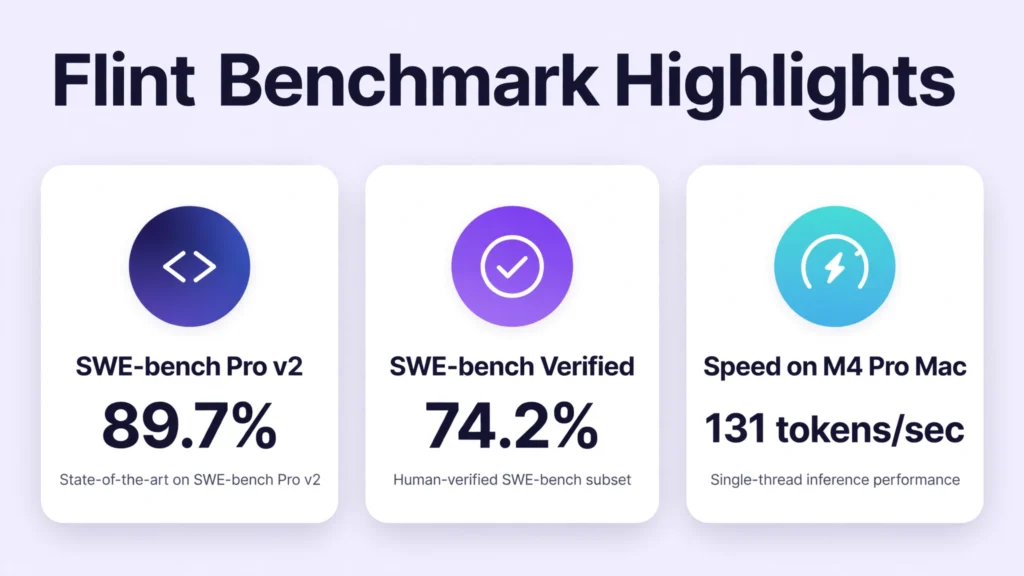
Of course, benchmarks tell the most useful part of the story, so let us look at what Recursive reports. On SWE-bench Pro v2, which tests whether a model can resolve real software issues from live repositories, the company reports 89.7% for Flint. On SWE-bench Verified, it reports 74.2%, and on Terminal-Bench 2.1, it reports 54.9%.
Recursive claims these numbers make the Flint coding model the leader among mixture-of-experts models under 50 billion total parameters on agentic coding tasks. However, these are company-run figures that independent testers have not yet verified, so treat them as a starting point. A detailed spec breakdown is available in MarkTechPost’s Flint benchmark analysis.
Flint Coding Model Benchmark Scores at a Glance
| Benchmark | Flint (Recursive) | What It Measures |
|---|---|---|
| SWE-bench Pro v2 | 89.7% | Resolving real software issues from live repositories |
| SWE-bench Verified | 74.2% | Fixing verified real-world software bugs |
| Terminal-Bench 2.1 | 54.9% | Command-line agentic coding tasks |
| IFEval | 95.1% | Following precise instructions |
| Speed (M4 Pro MacBook) | 131 tokens/sec | Generation speed on a laptop |
| Speed (NVIDIA RTX Spark) | 150+ tokens/sec | Generation speed on NVIDIA hardware |
Clearly, speed matters just as much as accuracy for a coding assistant. In Recursive’s tests, Flint generated about 131 tokens per second on a MacBook Pro with an Apple M4 Pro chip, roughly twice the speed of similar models on the same machine. On NVIDIA RTX Spark, it topped 150 tokens per second.
Flint vs Qwen3.8: The Closest Rival
Of course, every comparison needs a reference point, and the clearest one for the Flint coding model is Alibaba’s Qwen3.8 27B. On Recursive’s own average across six tests, only Qwen3.8 27B scored higher than Flint. In other words, the dense Qwen model still leads on raw accuracy, while Flint leads on speed and efficiency.
For example, the Terminal-Bench 2.1 results show the gap most clearly: Flint scored 54.9%, while dense Qwen 3.8 reached 73.0%. On the other hand, Qwen 3.8 is a dense model that needs more memory and compute, while Flint activates only 2.5 billion parameters per token and runs more than five times faster.
Overall, if your priority is the highest possible accuracy and you have the hardware budget, Qwen3.8 remains the stronger pick. But if you want a fast, free, laptop-friendly assistant for everyday coding tasks, Flint makes the better case. For a broader look at how we compare frontier models, see our Perplexity vs Claude guide.
Key Features That Make Flint Fast
Clearly, the Flint coding model’s speed comes from deliberate engineering choices rather than luck. Firstly, the mixture-of-experts design activates a small slice of the model per token, which cuts compute dramatically. Secondly, the 4-bit quantized weights shrink the model to about 23 GB, so it fits comfortably on machines with 48 GB of memory. Thirdly, custom kernels tuned for Apple Silicon and RTX Spark squeeze extra tokens per second out of the same hardware.
Meanwhile, the context window reaches up to 512K tokens, with 256K recommended for best results. That means you can load a large codebase into a single session and work across files without losing track. In addition, the text-only design keeps the focus squarely on coding tasks.
Nevertheless, one honest limitation deserves mention: Recursive acknowledges that Flint needs more guidance than the big paid coding assistants. The company recommends breaking large tasks into smaller steps with clear instructions, and early testers confirm that precise prompts produce much better results than vague ones.

Flint Coding Model Download and Setup
Getting started is straightforward. The weights are available for free download on Hugging Face under the Apache 2.0 license, so you can use them commercially without paying Recursive anything. You will need a 48 GB Apple Silicon Mac, such as an M4 Pro or M5 machine, or a 48 GB NVIDIA GPU to run the 4-bit version smoothly.
Firstly, download the 4-bit weights of about 23 GB. Then load them in your preferred local inference setup. Finally, connect the model to your coding agent through its OpenAI-compatible interface, and start with small, well-defined tasks.
Since the model runs locally, your code never leaves your machine. That makes the Flint coding model download attractive for teams with strict data policies, freelancers handling client code, and developers who simply prefer to work offline.
Is the Flint AI Free Coding Model Right for Your Business?
For many teams, whether the Flint coding model fits depends on what you value most. If you run an agency or a product team, the zero per-token cost changes the math: you can give every developer a capable coding assistant without a monthly API bill, so the total cost of ownership stays predictable.
Privacy is the second big argument. Regulated industries and client contracts often forbid sending code to third-party APIs, and a local model removes that problem entirely. In addition, the Apache 2.0 license means you can fine-tune the model on your own codebase and deploy it inside your own infrastructure.
On the other hand, Flint is not a drop-in replacement for Claude or Codex on the hardest tasks. The company itself says it needs clearer instructions than larger closed models for complex jobs. Therefore, businesses should plan for prompt engineering and task breakdown as part of adoption. For speed-focused context, our Mercury 3 speed guide.
Pros and Cons
Pros
- The Flint coding model offers free open weights under Apache 2.0, including commercial use
- Best-in-class speed among MoE models under 50B parameters: 125+ tokens per second on a MacBook Pro
- Runs locally on a laptop, so your code stays private
- Strong SWE-bench scores for its size class
- Large 512K context window for multi-file coding tasks
Cons
- Needs more guidance than big paid assistants on complex tasks
- Trails dense rivals like Qwen3.8 on raw accuracy
- Benchmarks are company-reported and await independent verification
- Text only, with no image or multimodal support
Frequently Asked Questions
What is the Flint AI coding model?
The Flint coding model is a free open-weight model that Recursive released on October 21, 2026. It uses a mixture-of-experts design with about 40 billion total parameters and 2.5 billion active per token, and it handles agentic coding tasks such as bug fixing and test writing.
Who built the Flint coding model?
Recursive, the AI startup run by You.com founder Richard Socher, built Flint. According to the company, its automated research system, the Eureka Machine, contributed to nearly every part of the build, which a small team finished in under four months.
Is Flint really free?
Yes. You can download the weights for free on Hugging Face under the Apache 2.0 license, which also permits commercial use. Because the model runs on your own hardware, you pay nothing per token.
What hardware do I need to run Flint?
You need a 48 GB Apple Silicon Mac, such as an M4 Pro or M5 machine, or a 48 GB NVIDIA GPU. The 4-bit weights take about 23 GB of disk space, so 48 GB of memory is the recommended minimum.
How fast is Flint compared to other local models?
In Recursive’s tests, Flint generated about 131 tokens per second on a MacBook Pro with an M4 Pro chip, roughly twice the speed of similar models on the same machine. On NVIDIA RTX Spark, it topped 150 tokens per second.
What is the Flint AI SWE-bench score?
Recursive reports 89.7% on SWE-bench Pro v2, 74.2% on SWE-bench Verified, and 54.9% on Terminal-Bench 2.1. However, these are company-run benchmarks that independent testers have not yet verified, so treat them as preliminary.
How does Flint compare with Qwen3.8?
On Recursive’s own average across six tests, only Alibaba’s Qwen3.8 27B scored higher than Flint. Qwen3.8 leads on raw accuracy, while Flint leads on speed and memory efficiency because it activates far fewer parameters per token.
What is the Eureka Machine?
The Eureka Machine is Recursive’s automated AI research system. It proposes ideas, writes code to test them, checks the results, and then decides what to try next. According to Recursive, it helped design Flint’s architecture, quantization, kernels, and training.
Can I use Flint for commercial projects?
Yes. The Apache 2.0 license allows commercial use, modification, and redistribution. In addition, local deployment keeps proprietary code off third-party servers.
Where can I download the Flint coding model?
Recursive publishes the weights for free on Hugging Face under the Apache 2.0 license. Find the official Recursive repository there, download the 4-bit weights, and load them in a compatible local inference setup.
Final Verdict
The Flint coding model arrives at exactly the right moment. October 2026 has become the month when local, license-free coding models turned genuinely practical, and Recursive’s release leads that wave on speed, with an 89.7% SWE-bench Pro v2 score and free Apache 2.0 weights.
It is not perfect. The accuracy gap behind Qwen3.8 and the need for careful prompting mean it suits developers who enjoy tuning their workflow. However, for teams that want a private, fast, and free coding assistant, the Flint coding model is the most exciting local release of the year. Download it, test it on your own codebase, and judge the benchmarks for yourself.



[…] because the right answer depends on your infrastructure as much as on raw scores. For example, our Flint coding model guide covered a laptop-class open release earlier this month, and Beam plays the same openness game at a […]
[…] and token cost matter to you, set reasoning_effort explicitly instead of accepting the default. Our Flint coding model guide covers a similar open coding model, and the same benchmark skepticism applies […]