


Mercury 3 arrived on October 19, 2026, and it rewrote the rules for fast AI. Inception Labs, the Stanford-founded startup behind it, claims its new diffusion language model generates 1,068 tokens per second while matching GPT-6 Luna and Claude Haiku 5.5 on quality. That is roughly 4 to 8 times faster than those rivals, at the same input price and 35 percent cheaper on output. However, every headline number comes from Inception itself, so treat these claims as vendor figures to verify, not settled facts.
Mercury 3 Diffusion LLM Explained: What Actually Changes
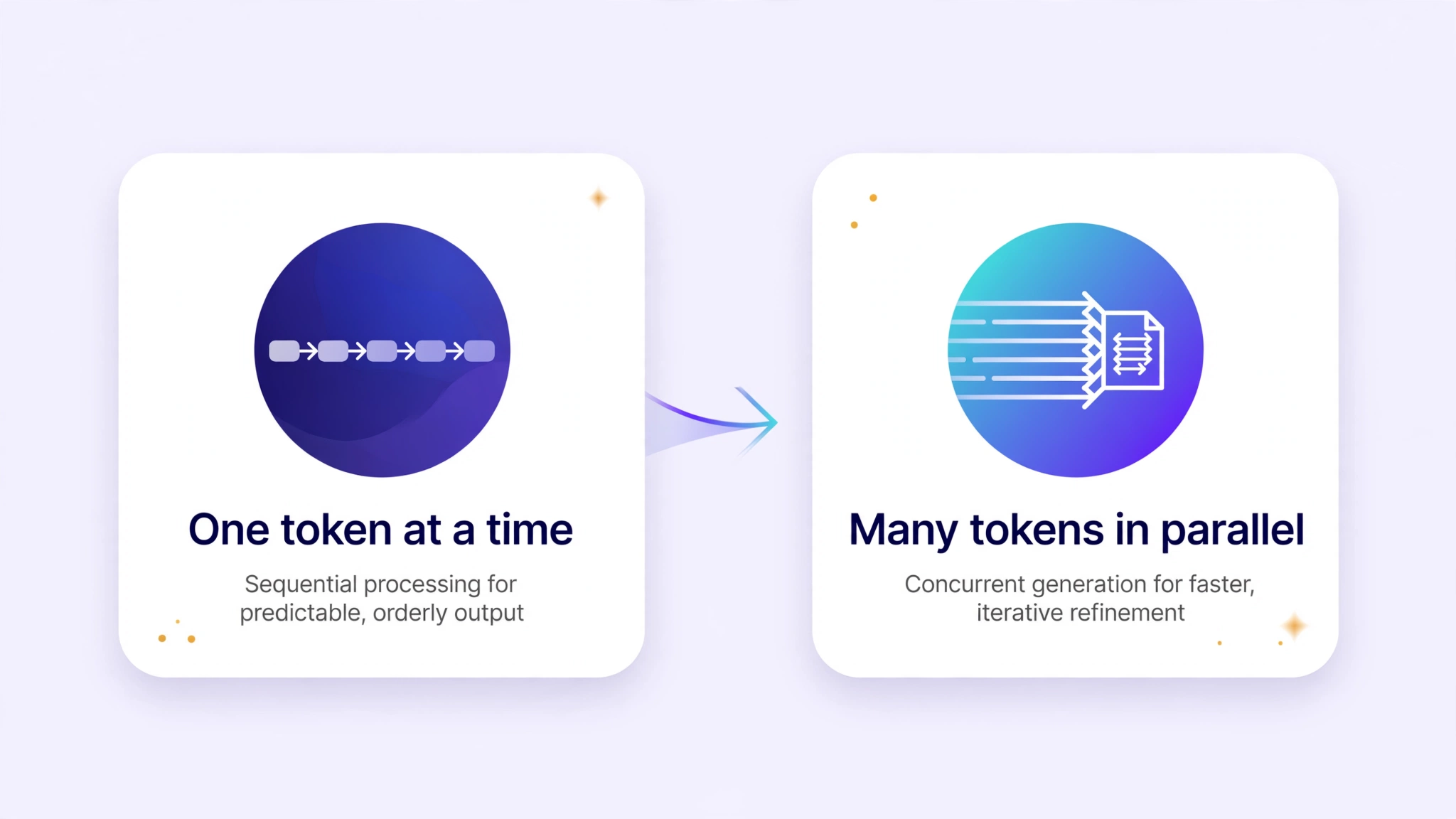
Most chatbots write one token at a time, with each new token depending on the ones before it. Diffusion takes a different route: it drafts many tokens in parallel and refines the whole draft at once. Think of an editor revising several parts of a draft at once. As a result, diffusion uses GPU parallelism far more efficiently, and that is where the speed comes from.
This is the same technology family behind leading image and video generators, but applying it to text is the breakthrough. Inception shipped the first Mercury in February 2025, then Mercury 2 in February 2026, then Mercury 2.5 on September 8, 2026. The new release landed just 41 days later with 40 times the parameters of Mercury 1, threefold higher aggregate intelligence, and throughput still above 1,000 tokens per second. In other words, the company claims diffusion scales like autoregressive models did, which would be a genuine milestone if independent testing confirms it.
The Headline Numbers: Speed, Context, and Price
Inception’s announcement packs a lot into a short spec sheet. The table below lists the figures from the company’s own materials.
| Spec | Detail |
|---|---|
| Release date | October 19, 2026 |
| Architecture | Diffusion LLM, text in and text out |
| Claimed speed | 1,068 tokens per second on NVIDIA GPUs |
| Claimed advantage | 4 to 8 times faster than GPT-6 Luna and Claude Haiku 5.5 |
| Context window | 1 million tokens, up from 260,000 on Mercury 2.5 |
| List price | $0.20 per million input tokens, $0.70 per million output tokens |
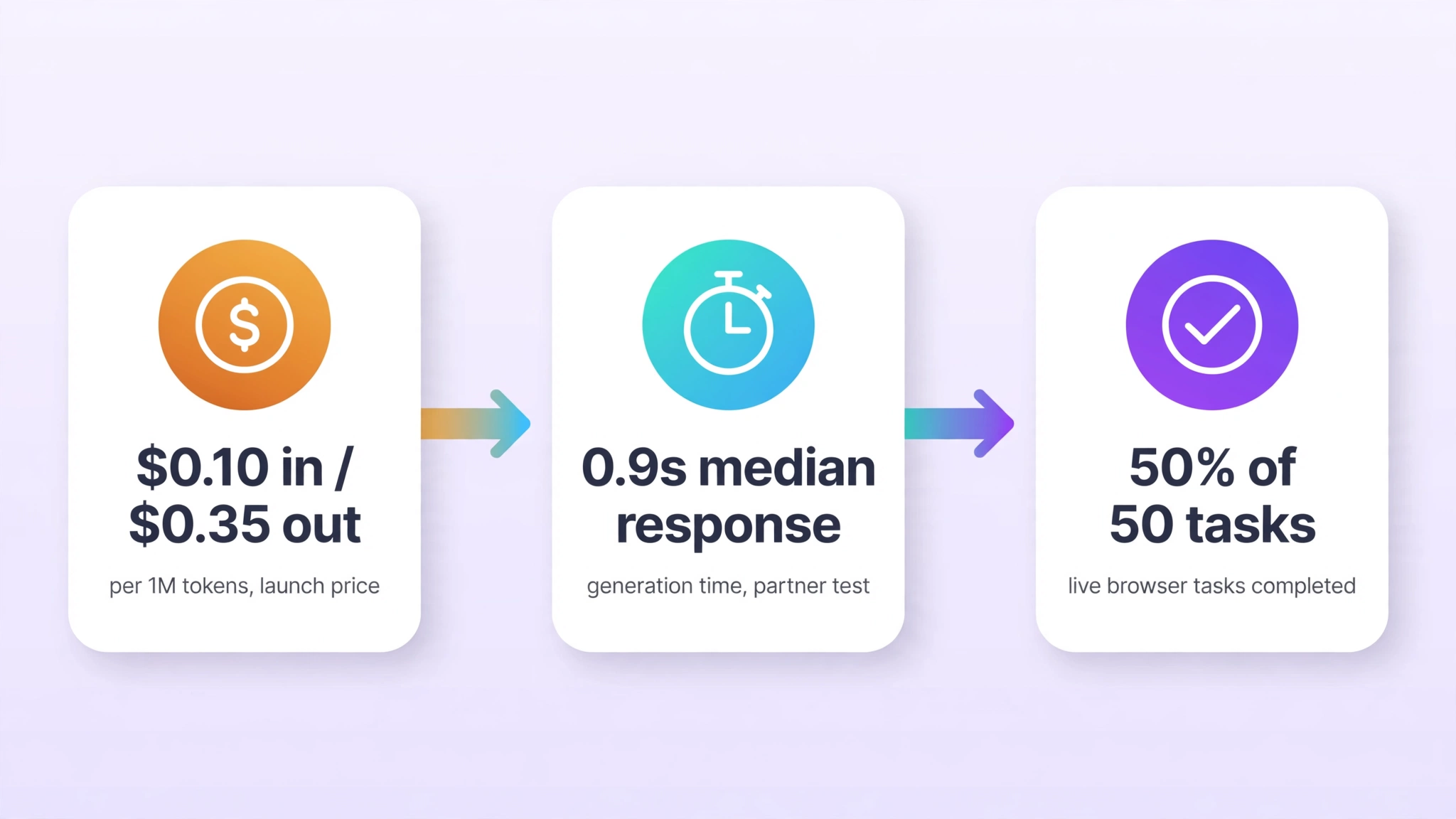
| Launch price | $0.10 input, $0.35 output (50 percent off, no published end date) |
| Cached input | $0.02 list, $0.01 during launch |
| Free tier | 100 million tokens for new API accounts |
| API | OpenAI-compatible, model string mercury-3 |
Two caveats matter. First, Inception has not disclosed an exact parameter count or named the GPU behind the 1,068 figure, so no independent lab can reproduce the headline speed yet. Second, the launch discount has no published end date. Therefore, plan your budget around the list price and treat the discount as a bonus.

Inception Mercury 3 Benchmarks: Reading the Claims Honestly
Inception’s published chart puts the model ahead of GPT-6 Luna and Claude Haiku 5.5 on 8 of 12 tests at medium reasoning effort. For example, it reports 76.8 on IFBench versus 61.8 for Luna and 54.7 for Haiku, plus 51.1 on SWE-Bench Atlas versus 33.3 and 32.3, and 55.18 on BrowseComp+ versus 50.50 and 45.78.
However, the same table shows clear losses. Haiku 5.5 still leads on DeepSWE v1 (51.6 versus 46.3) and MRCR v2 (78.4 versus 75.5), while Luna edges two Artificial Analysis evaluations by less than a point. In addition, the comparisons do not state which reasoning effort setting produced each score, and the API defaults to low effort when the parameter is omitted. Consequently, treat the chart as a vendor claim. Early third-party signals help: TinyFish AI completed 50 percent of 50 live Mind2Web browser tasks in production, reportedly more than GPT-6.1-Sol, and Octen AI measured 0.9-second median generation. The Neuron’s hands-on review ran eight tasks for about four cents and found excellent business math and strong first-pass coding. Still, none of this is a controlled study. Read the honest breakdown in The Neuron’s review and the launch specs in Unite.AI’s coverage.
Mercury 3 vs GPT-6 Luna and Claude Haiku 5.5
On paper the comparison looks simple: similar quality, much higher speed, lower output price. It matches both rivals at $0.10 per million input tokens and undercuts their $0.50 output rate with $0.35 at launch. Meanwhile, the 4 to 8 times speed advantage matters most where models get called repeatedly, because every agent step waits on the previous answer.
On the other hand, the rivals keep real advantages. Haiku 5.5 wins the two hardest coding and long-context tests in Inception’s own table, and Luna edges one long-context evaluation. In contrast to the promotional pricing, both rivals charge standard list prices with no discount cliff ahead. Similarly, Anthropic and OpenAI offer mature agent ecosystems and years of production hardening that a two-day-old release cannot match. So choose the new model when latency decides whether your product feels usable, and choose the incumbents for proven reliability. For context on the cheap-fast tier, see our DeepSeek V4.1 Flash 1017 guide from the same week.
Mercury 3 Pricing Per Million Tokens: The Launch Discount Math
Input pricing matches the budget rivals exactly, while output pricing undercuts them during the launch window.
| Model | Input per 1M | Output per 1M | Notes |
|---|---|---|---|
| Mercury 3 (launch) | $0.10 | $0.35 | 50 percent off, no end date |
| Mercury 3 (list) | $0.20 | $0.70 | Standard rate after launch |
| Claude Haiku 5.5 | $0.10 | $0.50 | Standard list price |
| GPT-6 Luna | $0.10 | $0.50 | Standard list price |
On a realistic agent workload, 10 million input tokens plus 1 million output tokens costs $1.35 at launch rates, $1.50 on either rival, and $2.70 at list price. In addition, cached input costs 90 percent less, which rewards agents that reuse context. New accounts also get 100 million free tokens.
The Launch Discount Catch
The discount is the best and the riskiest part of the pricing. Inception published no end date, and CEO Stefano Ermon told The Deep View the company is working to make the launch price permanent. However, “working on” is not a commitment. Therefore, model your unit economics at list price first. Read Ermon’s full comments in The Deep View’s interview.
What Agent Workloads Actually Cost
Agents do not make one call; they make dozens per task, so latency acts as a cost multiplier. A support bot that waits five seconds per step feels broken, while one answering in under a second feels instant. Octen measured 0.9-second median generation, and TinyFish completed more live browser tasks than a larger rival on the same token volume. Consequently, the real saving is fewer abandoned sessions and faster task completion, not just cheaper tokens. Still, these are partner-reported figures, so benchmark on your own traffic first.
Getting Started: Mercury 3 API on OpenRouter
Access is simple because the API is OpenAI-compatible. Firstly, create an account on the Inception API platform, which includes 100 million free tokens with no payment details required. Secondly, pick your route: the Inception API or a third-party host. The Mercury 3 API on OpenRouter is the quickest third-party route for testing without an Inception account. Thirdly, point your existing OpenAI client at the new base URL and set the model string to mercury-3.
One parameter deserves special attention: reasoning_effort, with instant, low, medium, and high settings. The API defaults to low when you omit it, while the older 2.5 defaulted to medium. Therefore, pin the effort level explicitly in your own benchmarks, or your numbers will not be comparable with anyone else’s. Temperature adjusts between 0.5 and 1.0, with tool calling and structured outputs supported. Finally, note that versions 2 and 2.5 are closed to new users, with existing access ending November 15, 2026.
Mercury 3 for Business Agents: Where It Fits
The business case comes down to one question: does latency limit your product? Browser agents, customer support automation, real-time search tools, tutoring platforms, and code review assistants are the sweet spot, because every step waits on the model’s answer. For example, tutoring company RevisionDojo reported instant student feedback, with answers returning in about a second.
On the other hand, hold off if your workload needs top-tier raw reasoning, precise constraint following, or long-horizon planning. Independent hands-on testing found the model entertaining but sloppy with strict creative constraints, and Haiku 5.5 still leads the hardest reasoning benchmarks. Regulated businesses should note that only enterprise deployments add compliance controls and configurable data retention. If your team is still choosing AI assistants for daily chat work, our Perplexity vs Claude comparison covers that side of the market.
The Sibling Models: Mercury Voice and Mercury Decide
The flagship does not ship alone. Mercury Voice targets low-latency voice agents, with time to first token under 170 milliseconds, at $0.40 per million input and $1.50 per million output at list ($0.20 and $0.75 promotional). Its sibling takes a different job: Mercury Decide handles high-volume classification with calibrated probabilities and human escalation for uncertain cases, at $0.04 per million input tokens ($0.02 promotional) and $0 output.
Mercury 3 vs Rivals: Quick Comparison
| Model | Released | Input / 1M | Output / 1M | Context | Access |
|---|---|---|---|---|---|
| Mercury 3 | Oct 19, 2026 | $0.10* | $0.35* | 1M tokens | Inception API, OpenRouter, Baseten, Vercel |
| Claude Haiku 5.5 | 2026 | $0.10 | $0.50 | Not disclosed here | Anthropic API |
| GPT-6 Luna | 2026 | $0.10 | $0.50 | Not disclosed here | OpenAI API |
| DeepSeek V4.1 Flash 1017 | Oct 17, 2026 | $0.15 | $0.60 | 1M tokens | API plus MIT open weights |
*Launch pricing is 50 percent off list with no published end date. All speed and benchmark figures are Inception’s own claims.
Frequently Asked Questions
What is Mercury 3?
It is Inception Labs’ flagship diffusion language model, released October 19, 2026. It drafts many tokens in parallel and refines them, which Inception says delivers 1,068 tokens per second with quality comparable to GPT-6 Luna and Claude Haiku 5.5.
How does a diffusion language model actually write?
It drafts the whole response at once and refines every part in parallel over a few passes. Think of an editor revising several parts of a draft simultaneously, which uses GPU parallelism far more efficiently.
How fast is it in real use?
Inception claims 1,068 tokens per second on NVIDIA GPUs, but no independent lab has reproduced that figure yet. Partner tests look promising: Octen AI measured 0.9-second median generation time.
What do the Inception benchmarks claim?
The company’s own chart shows wins on 8 of 12 tests, with leads on IFBench, SWE-Bench Atlas, and BrowseComp+. However, Haiku 5.5 still wins DeepSWE v1 and MRCR v2, and every score is vendor-reported.
How does the pricing per million tokens compare?
At launch, input costs $0.10 per million tokens and output $0.35, matching both rivals on input and undercutting their $0.50 output rate by 35 percent. The catch: this is a 50 percent launch discount with no published end date.
Can I try it for free before paying?
Yes. New accounts on the Inception API platform include 100 million free tokens with no payment details required. Mercury Chat offers a no-code first look.
Where can I call the API?
Use the Inception API directly, or OpenRouter, Baseten, or Vercel. The API is OpenAI-compatible, so point your existing client at the new base URL with the model string mercury-3.
Is it good for business agents?
Yes, when latency is the bottleneck. Browser agents, support bots, tutoring tools, and real-time search benefit most. Skip it for now if you need top-tier reasoning or regulated data controls.
What are the honest limits?
Every headline number is Inception’s own and unverified: the speed figure, the benchmark wins, and the partner results. The company has disclosed no parameter count and no end date for the launch discount.
Conclusion
Mercury 3 is the most credible challenge yet to the idea that serious language models must write one token at a time. The diffusion architecture is real, the speed claims are architecturally plausible, and the launch pricing is aggressive. However, the numbers that matter most are still vendor claims and the hardest reasoning benchmarks still belong to rivals. Therefore, claim the 100 million free tokens, benchmark the model on your own workloads with effort pinned, and let your own numbers decide.



[…] shapes how natural an agent feels, and our Mercury 3 speed guide showed the same pattern for text models. However, readers should treat these numbers with care, […]