


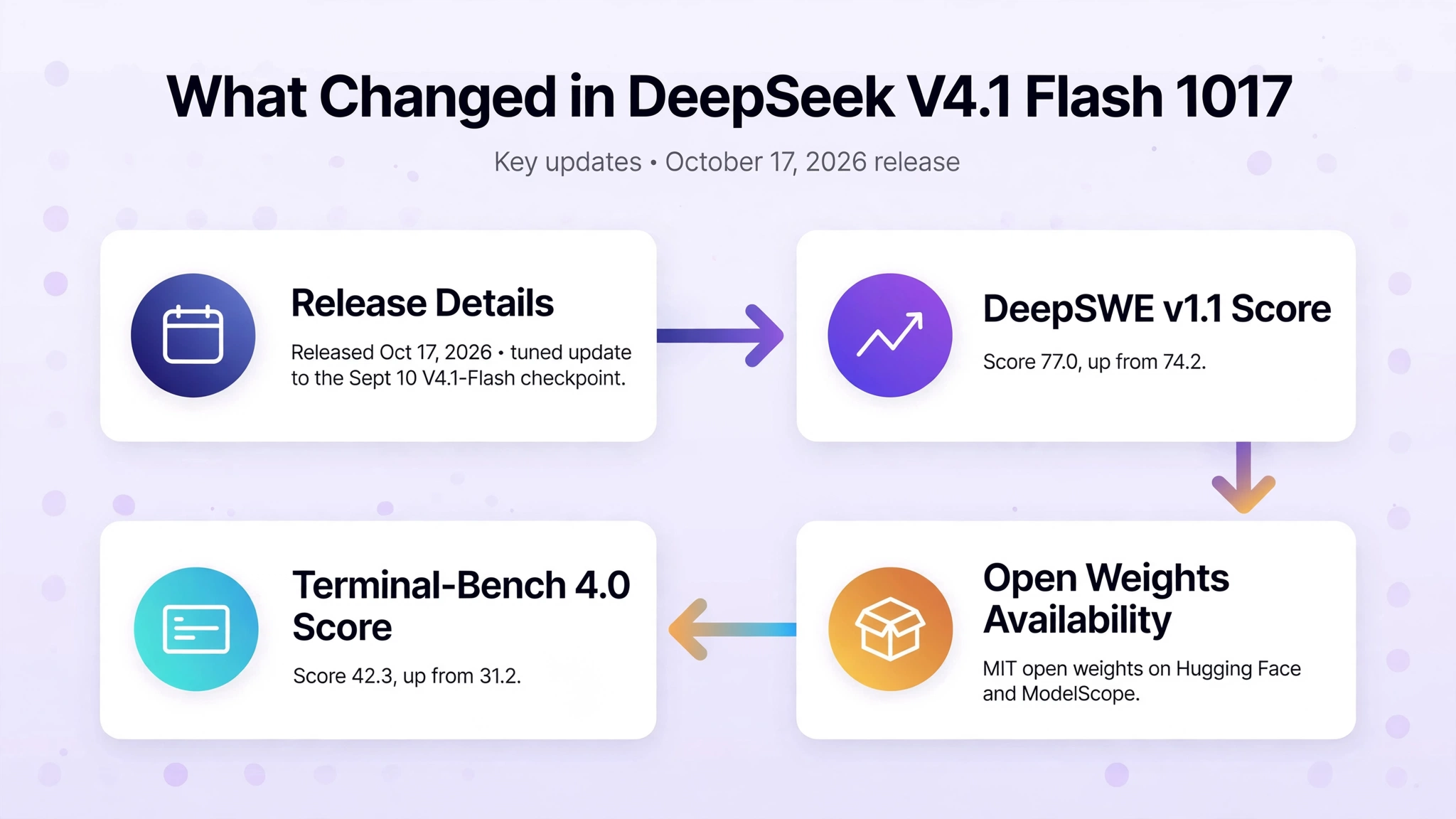
DeepSeek V4.1 Flash 1017 is the newest release from DeepSeek, and it arrived on October 17, 2026 with a clear pitch: stronger agentic performance, shorter outputs, and lower cost per task. However, this is not a brand new model. Instead, it is a tuned update to the V4.1 Flash checkpoint that launched on September 10, 2026. As a result, existing users received the upgrade automatically, because DeepSeek serves it under the same deepseek-flash API name at the same price. For example, if you already call the Flash API, you are already running the 1017 checkpoint.
So why does this release matter for your business? Because agentic AI workflows live or die on cost per completed task, not on raw intelligence scores. In addition, DeepSeek V4.1 Flash 1017 pairs its benchmark gains with MIT licensed open weights, which removes the usual tradeoff between cheap hosted inference and full control. Therefore, this guide explains what changed in the 1017 checkpoint, what the DeepSeek V4.1 Flash 1017 benchmarks claim, how DeepSeek V4.1 Flash 1017 API pricing affects your budget, how the DeepSeek V4.1 Flash 1017 download and open weights work, and where DeepSeek V4.1 Flash 1017 for business use actually makes sense.
What Is DeepSeek V4.1 Flash 1017?
DeepSeek V4.1 Flash 1017 is an updated post-training checkpoint of DeepSeek’s fast and efficient Flash model family. Specifically, DeepSeek announced it on October 17, 2026 in a series of posts on X, and the model went live the same day on the DeepSeek website, the mobile app, and the developer platform. Notably, the old model names still work: deepseek-v4-flash and deepseek-v4-flash-vision-exp now resolve to the new checkpoint, so nothing in your existing code needs to change. According to Bloomberg-sourced reporting on the release, DeepSeek describes the update as faster and leaner than the September version, with uses ranging from game creation to 3D modeling.
Under the hood, the model uses a causal encoder-decoder mixture-of-experts design. In particular, it combines a 552 billion parameter backbone with 196 billion Engram parameters, yet it activates only 8 billion parameters per token during prefill and 16 billion during decoding. Consequently, it stays fast even though the total model is huge. Meanwhile, the context window holds 1 million tokens with up to 384,000 output tokens, and vision input is native to the architecture rather than bolted on. Finally, a companion technical report titled “DeepSeek-V4.1-Flash: Pushing the Limits of KVETCH Cache Compression” explains the memory story: about 890 bytes per token, which keeps a full 1 million token context under one gigabyte of GPU cache. For background on how frontier models are built and why these architecture choices affect your bill, see our Muse AI explained guide, which walks through the key ideas in plain language.
DeepSeek V4.1 Flash 1017 Benchmarks: What the Numbers Actually Claim
Every benchmark number in this section comes from DeepSeek’s own published tables. However, none has been independently reproduced yet. In fact, Vals AI flagged that the headline coding score may be inflated by DeepSeek’s own test harness, and TECHi’s coverage of the update makes the same point: these are self-reported results on harnesses DeepSeek chose. Therefore, treat the numbers below as claims to verify, not settled facts.
With that caveat, the claimed gains are real on paper. For example, DeepSWE v1.1, a software engineering test that fixes real tasks in real open source projects, rose from 74.2 to 77.0. As a result, the new checkpoint sits ahead of Claude Opus 5 at 74.0 and GPT-5.6 Sol at 73.0 on that specific test. Similarly, Terminal-Bench 4.0 jumped from 31.2 to 42.3, a gain of 11.1 points. In addition, ProgramBench rose from 20.3 to 29.1, and Automation-Bench, which grades multi step business work across sales, support, finance, and HR, moved from 54.8 to 60.5, ahead of Opus 5 at 50.3.
On the other hand, the model still trails the biggest frontier models on raw reasoning. Specifically, Humanity’s Last Exam without tools rose from 36.8 to 42.6, yet Claude Opus 5 scores 56.3 on the same test. Meanwhile, DeepSeek’s full table covers 11 benchmarks and shows the new checkpoint beating the previous Flash on all of them, leading on 4, while Opus 5 leads on 6. Consequently, the honest read is this: DeepSeek V4.1 Flash 1017 benchmarks show leadership in agentic coding and business automation tests, but not in pure reasoning.
| Benchmark | Flash 1017 | Prev. Flash | Claude Opus 5 | GPT-5.6 Sol |
|---|---|---|---|---|
| DeepSWE v1.1 | 77.0 | 74.2 | 74.0 | 73.0 |
| Terminal-Bench 4.0 | 42.3 | 31.2 | 51.8 | 39.9 |
| Automation-Bench | 60.5 | 54.8 | 50.3 | 45.8 |
| HLE (no tools) | 42.6 | 36.8 | 56.3 | Not reported |
| Apex Bench v1.1 | 72.1 | 64.6 | 65.8 | 54.3 |
If you want independent confirmation, watch the Artificial Analysis leaderboards. For instance, search interest in “DeepSeek V4.1 Flash 1017 Artificial Analysis” is already rising on Google Trends, which suggests developers are waiting for third party scores before committing. Similarly, early community reports cite Enactra’s BuildingBench at 81.9, up from 72.9, although those figures come from posts on X rather than formal evaluations. Until independent runs land, the safest position is cautious optimism.
DeepSeek V4.1 Flash 1017 API Pricing: What It Costs Per Task
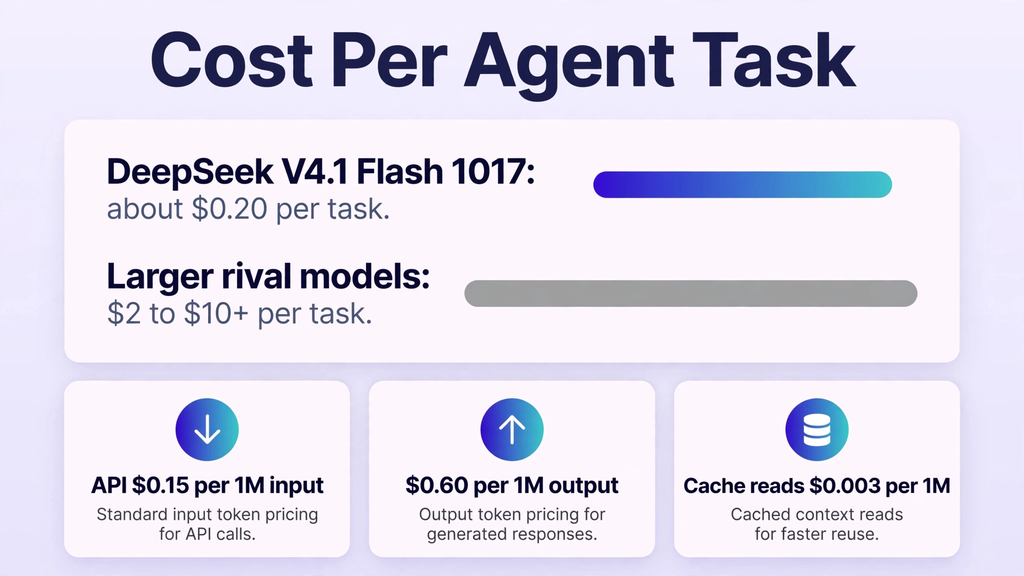
The headline news on DeepSeek V4.1 Flash 1017 API pricing is simple: nothing changed. Specifically, off-peak rates stay at $0.15 per million input tokens and $0.60 per million output tokens, with cached input reads at just $0.003 per million. During peak hours, each rate doubles to $0.30, $1.20, and $0.006. Meanwhile, peak hours run Monday to Friday from 01:00 to 04:00 and 06:00 to 10:00 UTC, excluding Chinese public holidays, so most of the week is off-peak.
| Per 1M tokens | Off-peak | Peak |
|---|---|---|
| Input (cache miss) | $0.15 | $0.30 |
| Input (cache hit) | $0.003 | $0.006 |
| Output | $0.60 | $1.20 |
However, the price per token is not the real story. Instead, the real story is cost per completed task. Because the 1017 checkpoint produces shorter outputs and finishes tasks faster, each agentic run consumes fewer tokens. For example, DeepSeek’s own chart plots DeepSWE scores against cost per task: the new checkpoint lands near $0.20 per task at its top setting, and about $0.10 per task at a lower effort setting that still scores above 72 percent. In contrast, rival models on the same chart cost between $2 and more than $10 per task. In addition, an independent 56 trial pilot found the model completing tasks at $0.0157 each, versus $0.0577 for GPT-6.1 Sol and $0.0653 for Claude Sonnet 5.5.
As a result, teams running thousands of agent tasks per day can see order of magnitude savings, even though the per token rate never moved. One honest nuance: outside analysts note that the lower cost per task comes from shorter outputs, not from a price cut, so your savings depend on the model staying concise on your workload.
The Peak and Off-Peak Trap
One detail can quietly double your bill: the peak window. Specifically, if your agents run heavy batch jobs during weekday morning hours in UTC, you pay the peak rate. Therefore, schedule large batch runs for off-peak hours whenever possible. In addition, cache reads cost almost nothing, so design your agents to reuse context aggressively. Consequently, the cheapest architecture is one that caches heavily and runs off-peak.
DeepSeek V4.1 Flash 1017 Open Weights and Download: What the MIT License Gives You
The DeepSeek V4.1 Flash 1017 open weights shipped on Hugging Face and Alibaba ModelScope under the MIT license. In other words, you can use them commercially, modify them, and redistribute them without the restrictions that come with research only licenses. For example, a startup can fine tune the weights for a niche workflow and ship the result inside a commercial product.
However, open weights do not mean it runs on your laptop. Specifically, the full weights are about 510 GB, and mainstream tools like llama.cpp cannot load the new architecture yet. Therefore, the DeepSeek V4.1 Flash 1017 download is realistic mainly for teams with serious GPU infrastructure. Meanwhile, DeepSeek also shipped deepseek-recipe, a Rust library with Python bindings for prompt conversion and output parsing, which smooths the path for developers building agents on the model.
Still, the MIT license changes the negotiation. Because the weights are open, you are never locked to one provider’s API. As a result, you can start on the cheap hosted API and move to self hosting later without rebuilding your stack.
How to Access DeepSeek V4.1 Flash 1017
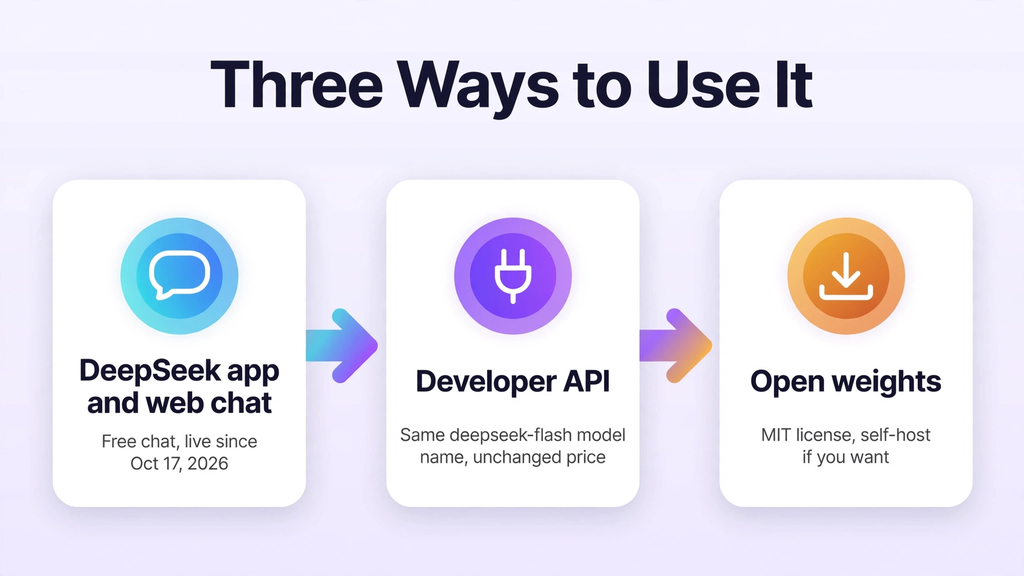
There are three practical routes. Firstly, use the DeepSeek app or web chat, which is free and already runs the 1017 checkpoint. Secondly, call the developer API with the same deepseek-flash model name you already use, at unchanged prices. Thirdly, use third party hosts such as OpenRouter, where the model appears as deepseek/deepseek-v4.1-flash-1017, although prices and privacy terms differ by provider.
In addition, DeepSeek opened its in-house Search and Fetch APIs to all developers on the same day. Specifically, each costs $0.75 per 1,000 successful requests, and the company says the engine indexes hundreds of billions of web pages. Calls made through DeepSeek Harness, Claude Code, or Codex stay free until November 1, 2026. As a result, you get a model plus a first party search layer behind one API key, which matters for agents that need live web data. For a detailed breakdown of the new search tooling, see the AI News Round coverage of the Search and Fetch APIs.
DeepSeek V4.1 Flash 1017 for Business: Where It Fits and Where It Does Not
DeepSeek V4.1 Flash 1017 for business use comes down to one question: does your workload look like agentic tasks? For example, coding agents, customer support automation, multi step office workflows, and data processing pipelines are the sweet spot, because that is where the benchmark gains and the cost per task advantage concentrate. In addition, the MIT license suits companies that need data control or custom fine tuning.
On the other hand, hold off if you need top tier raw reasoning, long horizon research, or the most polished agent ecosystem. Specifically, Claude Opus 5 still leads on reasoning tests, and DeepSeek’s reliability record has blemishes: the service suffered a roughly five hour outage earlier this month, which matters if your production pipeline depends on it. Meanwhile, the benchmark numbers remain self reported, so run your own evaluation before migrating critical workloads.
The business story extends beyond the model itself. For instance, Hong Kong listed AI shares fell when DeepSeek’s aggressive pricing signaled a price war, and CNBC reported a $12 to $15 billion funding round at around a $75 billion valuation ahead of a planned Shanghai IPO. Consequently, DeepSeek is scaling up fast, which is reassuring for long term bets. If your team is still choosing AI assistants for daily research work, our Perplexity vs Claude comparison covers the chat side of the market, while this guide covers the developer and automation side.
DeepSeek V4.1 Flash 1017 vs Rivals: Quick Comparison
| Model | Released | Input / 1M | Output / 1M | Context | License | DeepSWE v1.1* |
|---|---|---|---|---|---|---|
| DeepSeek V4.1 Flash 1017 | Oct 17, 2026 | $0.15 | $0.60 | 1M | MIT | 77.0 |
| DeepSeek V4.1 Flash | Sep 10, 2026 | $0.15 | $0.60 | 1M | MIT | 74.2 |
| Claude Opus 5 | 2026 | $5.00 | $25.00 | Not disclosed here | Closed | 74.0 |
| GPT-5.6 Sol | 2026 | $4.00 | $20.00 | Not disclosed here | Closed | 73.0 |
*Benchmark scores are DeepSeek’s self-reported figures, not independent results. Pricing shown is off-peak for DeepSeek and standard list pricing for rivals.
Frequently Asked Questions
What is DeepSeek V4.1 Flash 1017?
DeepSeek V4.1 Flash 1017 is an updated checkpoint of DeepSeek’s efficient Flash model, released on October 17, 2026. Specifically, it is a tuned post-training update to the V4.1 Flash that launched on September 10, 2026. It went live the same day on DeepSeek’s website, mobile app, and API under the existing deepseek-flash model name, and its weights were published under the MIT license.
What do the DeepSeek V4.1 Flash 1017 benchmarks show?
The DeepSeek V4.1 Flash 1017 benchmarks, as reported by DeepSeek, show gains on all 11 published tests. For example, DeepSWE v1.1 rose to 77.0, Terminal-Bench 4.0 to 42.3, and Automation-Bench to 60.5. However, these are self-reported scores and none has been independently reproduced, so independent verification is still pending. In addition, the model still trails Claude Opus 5 on raw reasoning tests such as Humanity’s Last Exam.
How does DeepSeek V4.1 Flash 1017 API pricing work?
DeepSeek V4.1 Flash 1017 API pricing is unchanged from the previous checkpoint. Off-peak rates are $0.15 per million input tokens and $0.60 per million output tokens, with cache reads at $0.003. Peak rates double to $0.30 and $1.20. Meanwhile, peak hours run on weekday mornings UTC, so most of the week is off-peak. Most importantly, the effective cost per completed task falls because the model produces shorter outputs.
Can I download DeepSeek V4.1 Flash 1017?
Yes, the DeepSeek V4.1 Flash 1017 download is available through the MIT licensed weights on Hugging Face and Alibaba ModelScope. However, the full weights are about 510 GB, and mainstream local tools cannot load the new architecture yet. Therefore, downloading makes sense mainly for teams with serious GPU infrastructure, while most users are better served by the hosted API.
What does the DeepSeek V4.1 Flash 1017 open weights license allow?
The DeepSeek V4.1 Flash 1017 open weights use the MIT license, which is one of the most permissive licenses available. Specifically, you can use the weights commercially, modify them, fine tune them, and redistribute your version. As a result, businesses can build products on the model without vendor lock-in.
Is DeepSeek V4.1 Flash 1017 good for business automation?
DeepSeek V4.1 Flash 1017 for business automation is strongest on agentic tasks: coding agents, support workflows, and multi step office processes. For example, its Automation-Bench score of 60.5 leads Claude Opus 5 at 50.3 on DeepSeek’s tables. On the other hand, you should pilot it first, because the benchmarks are self-reported and the service had a multi-hour outage earlier this month.
What does Artificial Analysis say about DeepSeek V4.1 Flash 1017?
As of this article, independent Artificial Analysis results for the 1017 checkpoint are still awaited. However, Google Trends shows rising search interest in “DeepSeek V4.1 Flash 1017 Artificial Analysis,” which indicates the community is watching for third party scores. Meanwhile, early community reports from trackers cite promising numbers, though those come from posts on X rather than formal evaluations.
Is DeepSeek V4.1 Flash 1017 better than Claude Opus 5?
It depends on the task. On DeepSeek’s own tables, the 1017 checkpoint beats Opus 5 on DeepSWE v1.1 and Automation-Bench, and it costs a small fraction per task. However, Opus 5 leads clearly on raw reasoning benchmarks such as Humanity’s Last Exam, 56.3 versus 42.6. Therefore, choose Flash 1017 for cost sensitive agentic work and Opus 5 for the hardest reasoning tasks.
How do I switch my API calls to DeepSeek V4.1 Flash 1017?
You do not need to change anything. Specifically, DeepSeek serves the 1017 checkpoint under the existing deepseek-flash model name, and the older deepseek-v4-flash names resolve to it as well. In addition, the price is unchanged, so your billing continues as before. If you use a third party host, select the 1017 version explicitly, for example deepseek/deepseek-v4.1-flash-1017 on OpenRouter.
Conclusion
DeepSeek V4.1 Flash 1017 is the rare update that is both better and cheaper to run. Specifically, you get stronger agentic scores, shorter outputs, and a lower cost per task at unchanged per token prices, plus MIT licensed weights if you ever want to leave the hosted API. However, the benchmarks are self-reported, the reasoning crown still belongs to bigger models, and production reliability needs watching. Therefore, the smart move is to pilot it on cost sensitive agent workloads, measure your own tasks, and keep a fallback ready. For most automation teams, that pilot will pay for itself within days.



[…] and choose the incumbents for proven reliability. For context on the cheap-fast tier, see our DeepSeek V4.1 Flash 1017 guide from the same […]
[…] 18.8 trillion tokens in seven days, according to coverage of the OpenRouter charts. Meanwhile, our DeepSeek V4.1 Flash 1017 guide shows the same pattern from the other side, because open weight models now dominate global token […]
[…] For more on competing models in this space, see our Muse Spark Open overview and DeepSeek V4.1 Flash breakdown. […]