


StepFun has turned Step 5 Preview pricing into the headline story of the autumn model race. The Shanghai lab charges $1.00 per million input tokens and $2.70 per million output tokens for a 600B parameter model. It released the open weights on October 15, 2026. As a result, developers now get near frontier intelligence at a mid tier API price. In this guide, we break down the full Step 5 Preview pricing, the benchmark evidence behind the price, and the real cost of running the model through an API or on your own hardware.
StepFun opened API access on September 20, 2026, and the model then reached OpenRouter on October 8, 2026. Then usage exploded within days. By October 15, the model ranked No. 2 on both the OpenRouter weekly and daily charts, and it consumed about 18.8 trillion tokens in seven days, according to coverage of the OpenRouter charts. Meanwhile, our DeepSeek V4.1 Flash 1017 guide shows the same pattern from the other side, because open weight models now dominate global token traffic week after week.
What Is StepFun Step 5 Preview?
StepFun Step 5 Preview is a sparse Mixture-of-Experts model with 600 billion total parameters. Yet it activates only 27 billion parameters per token. In other words, roughly 4.5 percent of the network does the work on any given token. This design explains the aggressive price. Moreover, the architecture stacks 92 Transformer layers in a narrow and deep layout. StepFun built it mainly for agentic work, software engineering, and finance tasks. In addition, the model reads a 1 million token context window, so teams can feed it entire codebases or long document sets in one request.
The model accepts text and image input, and the API adds video input as well. Furthermore, StepFun ships a Step Plan integration for Claude Code, so coding agents can call the model directly inside a familiar workflow. Indeed, Artificial Analysis measured output speed at 99.8 tokens per second on the StepFun API, which sits well above the industry average. Therefore, the model pairs its low price with fast generation, and that combination drives the current adoption wave.
Step 5 Preview pricing in full
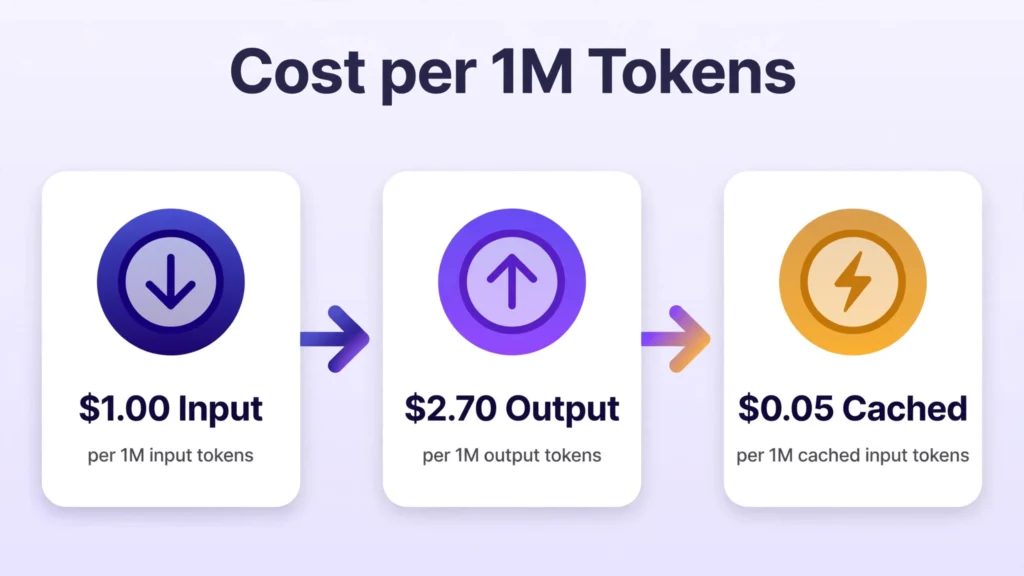
The official Step 5 Preview pricing uses a simple three part rate card, and every route charges the same list price:
- Input tokens: $1.00 per 1M tokens on a cache miss
- Cached input tokens: $0.05 per 1M tokens on a cache hit
- Output tokens: $2.70 per 1M tokens, and the price includes reasoning tokens
Developers also get low, medium, and high reasoning effort settings, plus tool calling and JSON Schema output. Because cached input costs only five cents per million tokens, agent workflows that reuse long system prompts save heavily. For comparison, Artificial Analysis puts the median prices for similar reasoning models at $1.88 per million input tokens and $10.00 per million output tokens. Consequently, StepFun undercuts the median input price by almost half, and it undercuts the median output price by almost three quarters.
The catch: verbose reasoning eats some savings
However, the sticker price tells only part of the story. Step 5 Preview reasons verbosely, and Artificial Analysis recorded 160 million output tokens during its index run, against a 92 million token median for rival models. Longer reasoning chains mean more output tokens per task, so real world bills shrink less dramatically than the rate card suggests. Still, the measured cost per completed task landed at $0.71, while Claude Opus 5 cost $5.86 per task on the same suite. In short, teams pay roughly one eighth of the premium rival cost per finished task, even after the verbosity penalty.
How Step 5 Preview pricing compares with rivals
The cleanest way to judge Step 5 Preview pricing is a direct table against its two closest open weight rivals, GLM 5.3 from Z.ai and Kimi K3 from Moonshot AI:
| Model | Input per 1M | Output per 1M | Cached input per 1M |
|---|---|---|---|
| Step 5 Preview | $1.00 | $2.70 | $0.05 |
| GLM 5.3 | $1.40 | $4.40 | $0.26 |
| Kimi K3 | $3.00 | $15.00 | Not published |
Z.ai publishes the GLM 5.3 rates on its official pricing page, and StepFun clearly priced against that card. Step 5 Preview costs about 29 percent less per input token and about 39 percent less per output token than GLM 5.3. Against Kimi K3, the gap widens sharply, because StepFun charges one third of the input price and under one fifth of the output price. For high volume agent products, those ratios decide the monthly bill.
Step 5 Preview benchmarks: what the scores say
Independent testing gives the price its context. Artificial Analysis scores Step 5 Preview benchmarks at 43.7 on its Intelligence Index, and the model reaches 88.3 percent on AA-LCR long context reasoning and 46.5 percent on Humanity’s Last Exam. Similarly, GDPval-AA lands at 54.3 percent, which signals solid professional knowledge work. Furthermore, StepFun published its own comparison chart, and the company ran its model at High effort while rivals ran at Max, so readers should treat these rows as vendor reported:
| Benchmark | Step 5 Preview | GLM 5.3 | Kimi K3 |
|---|---|---|---|
| DeepSWE v1.1 | 67.7 | 66.9 | 67.5 |
| Terminal-Bench 4.0 | 33.3 | 41.9 | 12.6 |
| FrontierFinance | 66.4 | 64.1 | 62.6 |
On balance, the model leads on software engineering and finance, yet it trails GLM 5.3 clearly on Terminal-Bench 4.0. MarkTechPost’s open weights report adds useful context here, since it gathers the Hugging Face card numbers and the independent scores in one place. Overall, the benchmark profile supports the price story: buyers get frontier tier coding and finance skill, with a known weakness in terminal driven agent tasks.

Step 5 Preview vs GLM 5.3
The Step 5 Preview vs GLM 5.3 choice comes down to workload shape. GLM 5.3 carries about 744 billion total parameters with 40 billion active, and it accepts text only input. In contrast, Step 5 Preview adds image input, and its API adds video. GLM 5.3 wins Terminal-Bench 4.0 by a wide margin, 41.9 against 33.3, so terminal heavy agent teams should benchmark it first. On the other hand, Step 5 Preview wins DeepSWE v1.1 and FrontierFinance by small margins, and it charges less for every token type. Therefore, coding and finance teams usually start with StepFun, while terminal automation teams start with Z.ai.
Step 5 Preview vs Kimi K3
The Step 5 Preview vs Kimi K3 comparison shows a size gap. Kimi K3 holds 2.8 trillion total parameters with 104 billion active, so it activates almost four times more compute per token. Nevertheless, DeepSWE v1.1 scores land nearly level, at 67.7 for StepFun and 67.5 for Moonshot. Kimi K3 does offer strong multimodal skill, yet its $3.00 input and $15.00 output prices punish high volume use. As a result, most teams route bulk agent traffic to StepFun and reserve Kimi K3 for tasks where its extra capacity proves itself in testing.
Step 5 Preview open weights and the licence
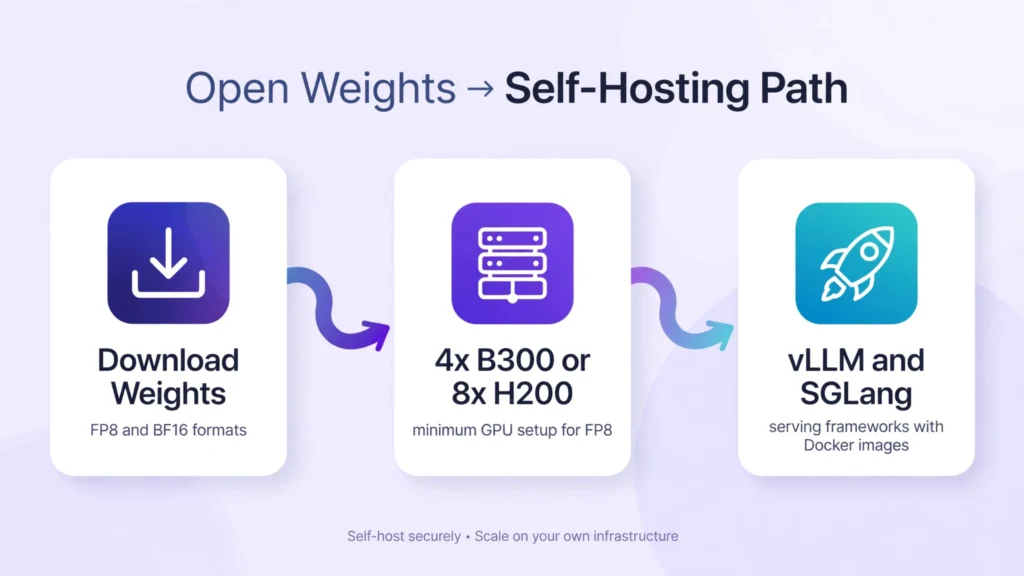
StepFun released the Step 5 Preview open weights on October 15, 2026, on Hugging Face and ModelScope. The release ships FP8, BF16, and NVFP4 formats, so Blackwell owners get a native option. However, the StepFun Model License 1.0 is not a plain Apache style licence. It reads like Apache 2.0 for most users. It adds commercial gates: device makers need a separate licence before shipping the model inside phones, cars, or robots. Model as a service providers above $20 million in annual revenue need one too. In addition, very large products must show a “Powered by StepFun AI” notice, and the licence treats models trained heavily on Step 5 outputs as derivative works. Our NVIDIA Nemotron 3.5 guide shows how rival labs handle open licences differently, so teams should compare terms before they commit.
Step 5 Preview download and self-hosting
The Step 5 Preview download is a data center scale job. The FP8 checkpoint alone fills about 650 GB, and StepFun lists 4 B300 GPUs with FP8, or 8 H200 GPUs, as the minimum self host setup on vLLM or SGLang. BF16 needs roughly 1.2 TB of GPU memory, which means 8 B300 GPUs on one node or 16 H200 GPUs across two nodes. Moreover, both frameworks ship Docker images with OpenAI compatible APIs, and StepFun recommends temperature 1.0 with top_p 0.95 for serving. Consequently, only well funded infrastructure teams should self host today, while everyone else gets better economics from the API.
Is Step 5 Preview pricing worth it for your team?
Overall, for agent products, coding assistants, and finance research tools, Step 5 Preview pricing currently offers one of the strongest value ratios in the market. The model pairs that price with a 1M token context, cheap cache hits, and top tier DeepSWE and FrontierFinance scores. However, the Preview label matters, because routes, limits, and licence enforcement may still shift. Similarly, verbose reasoning means finance teams should measure output tokens on their own workloads before they migrate fully. Our advice is simple: pilot the model on one bounded workflow, compare cost per accepted result against GLM 5.3, and then scale the winner.
Frequently asked questions
What is Step 5 Preview pricing per million tokens?
Step 5 Preview pricing is $1.00 per million input tokens, $0.05 per million cached input tokens, and $2.70 per million output tokens, with reasoning tokens included in the output price.
When was the model released?
StepFun opened API access on September 20, 2026. The model reached OpenRouter on October 8, 2026, and StepFun released the open weights on October 15, 2026.
Is the model open weights?
Yes. StepFun published FP8, BF16, and NVFP4 weights on Hugging Face and ModelScope under the StepFun Model License 1.0, which adds commercial gates for device makers and large hosted services.
How does the Step 5 Preview download work?
Teams download the checkpoints from Hugging Face or ModelScope, then serve them with vLLM or SGLang Docker images. The FP8 build needs about 650 GB of storage and at least 4 B300 or 8 H200 GPUs.
How does Step 5 Preview vs GLM 5.3 compare on price?
GLM 5.3 costs $1.40 per million input tokens and $4.40 per million output tokens on the Z.ai API. Step 5 Preview undercuts both rates, although GLM 5.3 scores higher on Terminal-Bench 4.0.
Is Step 5 Preview cheaper than Kimi K3?
Yes, by a wide margin. Kimi K3 charges $3.00 per million input tokens and $15.00 per million output tokens, while Step 5 Preview charges $1.00 and $2.70 for the same volumes.
What does Step 5 Preview pricing include for reasoning tokens?
The $2.70 output rate includes reasoning tokens, and the API offers low, medium, and high reasoning effort settings. Because the model reasons verbosely, teams should still track total output tokens per task.
How fast is the model?
In fact, Artificial Analysis measured output speed at 99.8 tokens per second on the StepFun API. The model also ranked No. 2 on the OpenRouter weekly and daily charts in mid October 2026.
Which context window does it support?
The model supports a 1 million token context window for input. It accepts text and image input directly, and the hosted API adds video input.
Conclusion
Step 5 Preview pricing resets expectations for frontier class models. StepFun charges $1.00 in and $2.70 out per million tokens, backs the price with a 43.7 Artificial Analysis Intelligence Index score, and still gives teams a download path through open weights. Finally, the licence gates and verbose reasoning deserve honest testing, but neither flaw erases the value. For most agent, coding, and finance workloads, Step 5 Preview pricing makes StepFun the first route to pilot this quarter.