


By Zarirah Asif | MiniMax M3.1 Flash Updated October 19, 2026
Every AI vendor promises faster and cheaper. Few publish the receipts. On October 19, 2026, MiniMax did something unusual: it revealed that the anonymous Space Bunny AI model, which had quietly processed 200 trillion tokens, was its new M3.1 Flash all along, and it released benchmark charts claiming the model beats Anthropoid’s Opus 5.5 on Automation-Bench at 70% lower cost.
By the end, you will know what MiniMax M3.1 Flash costs per task, where it wins and loses, and how to test it in about ten minutes.
We built this from MiniMax’s official announcement, cross-checked against independent coverage, including the numbers MiniMax would rather you skip.
Key Takeaways
- What happened: MiniMax launched M3.1 Flash on October 19, 2026, confirming the anonymous “Space Bunny” model was its early build after 200 trillion tokens in stealth.
- The claim: nearly 3x faster inference (200+ tokens per second) and 70% lower agentic task cost than M3, at $0.15/$0.60 per million input/output tokens.
- The headline score: 62.2 on Automation-Bench, topping MiniMax’s chart above Opus 5.5. All scores are vendor-reported.
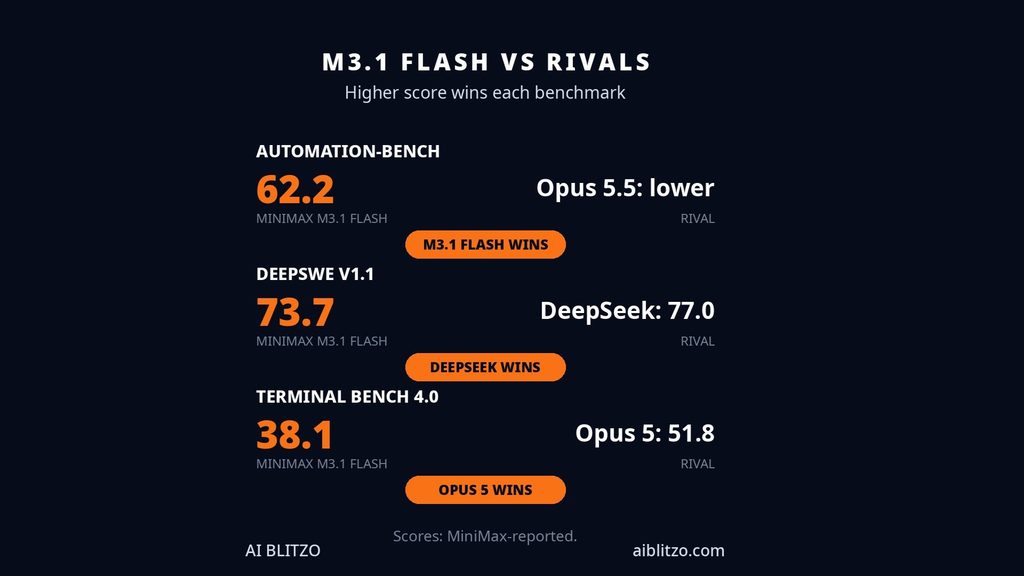
- The catch: it trails on terminal-heavy tasks (Terminal Bench 38.1 vs 51.8 for Opus 5) and on DeepSWE behind DeepSeek V4.1 Flash (73.7 vs 77.0).
- How to try it: live now via the MiniMax API, OpenRouter, and MiniMax Code; open weights arrive October 23.
What Is MiniMax M3.1 Flash?
MiniMax M3.1 Flash is a new AI model from MiniMax, the Chinese AI lab behind the M-series models. It launched on October 19, 2026, as the speed-focused sibling of the flagship M3 line.
Under the hood, it is a 428-billion-parameter mixture of experts (MoE) model with roughly 23 billion active parameters at any moment. That sparse design is the trick: most of the model stays asleep while a small expert subset handles your request, keeping it fast and cheap.
It ships with a 1-million-token context window and takes text, image, and video as input, making it a multimodal AI model. MiniMax positions it squarely for agentic work: AI systems that do multi-step jobs on their own, like AI coding agents, computer-use agents, business process automation, and security testing.
The “Flash” label puts it in a busy tier alongside DeepSeek’s V4.1 Flash and Z.ai’s GLM 5.3 Flash: near-frontier results without frontier bills. If you follow every major model launch, this is the current battleground.
Was Space Bunny Really M3.1 Flash All Along?
Yes, and the stealth run was unusual. In late September, a model called “Space Bunny Alpha”, the Space Bunny AI preview, appeared anonymously on OpenRouter, where labs often test models without a name.
Nobody knew whose it was for almost 26 days, the longest anonymous run on record, during which it processed more than 200 trillion tokens and shot to number one in daily token volume within three days.
On launch day, MiniMax posted a video of a carrot-shaped rocket lifting off with the caption “Welcome back, Space Bunny.” Mystery solved.
Why does the stealth story matter? Space Bunny was not a demo: it handled real developer workloads at scale for nearly a month before anyone knew its name, a stronger signal than any launch-day benchmark table.
How Fast Is MiniMax M3.1 Flash?
MiniMax claims inference speed nearly triples over the previous M3, with output above 200 tokens per second in everyday use and a median above 170.
In practical terms: a 2,000-token agent response arrives in about ten seconds, and for agents chaining dozens of steps, a four-minute M3 workflow finishes in closer to ninety seconds.
One design choice affects how you use it: there is no off switch for reasoning on this model. Instead you choose how hard it thinks, using five reasoning effort levels from Low to Max, and MiniMax suggests leaving it on Max. Higher effort buys better scores at slower speeds and higher cost; lower effort reverses the trade.
This matters if you are migrating from M3. Old calls that try to switch thinking off will fail outright, so update any integration that sets thinking to disabled or effort to none. It is a small breaking change, and exactly the kind of detail launch coverage skips.
M3.1 Flash Pricing: How Much Does It Cost?
Here is the official pricing per token, flat per one million tokens:
| Token type | M3.1 Flash | Previous M3 |
|---|---|---|
| Input | $0.15 | $0.30 |
| Output | $0.60 | $1.20 |
| Cached input | $0.015 | not offered |
Output at $0.60 per million tokens is half the price of M3. MiniMax says the total cost of running agentic tasks drops 70% versus its predecessor, because agentic workflow runs burn most of their tokens on long chains of intermediate steps, exactly where the per-token savings stack up.
As one developer put it: “$0.60 per million tokens just beat Opus 5.” Frontier-class automation scores at a price that used to buy a mid-tier model.
What Is the Real Cost Per Task?
Per-token pricing is the wrong way to judge an agent model. What matters is the cost of a completed job. MiniMax agrees, and its charts frame everything as cost per task. Here is what its own numbers show, translated into dollars.
On Automation-Bench, every one of the five effort levels lands under $0.05 per task, with scores ranging from 52.8 at Low effort to 62.8 at Max. On Agents’ Last Exam, a full 152-task run cost about $111, which works out to roughly $0.73 per task.
Now scale that to a real operation. Say your team runs 10,000 automation tasks a month, the kind of workflows that actually pay off: invoice processing, lead enrichment, support ticket triage.
- At $0.05 per task: about $500 a month
- At $0.73 per task (harder, longer tasks): about $7,300 a month
The same workload on a frontier model at typical flagship pricing would run several times higher. That is the gap MiniMax is selling: on its own charts, M3.1 Flash posts comparable scores at roughly one-twentieth the cost of Opus 5.5. Treat that ratio as MiniMax’s claim, not an independent finding.
This is the calculation most coverage skips: benchmark scores tell you what a model can do, but cost per finished task tells you whether automating the job is worth doing at all.

What Is the Automation-Bench Benchmark, and Why Should You Care?
Automation-Bench measures how well AI agents handle complex business process automation: multi-step office work with real economic value, not trivia questions or chat banter.
That distinction matters. Most famous benchmarks test what a model knows. Automation-Bench tests what a model can do across tools, documents, and applications, which is much closer to the work US teams want to automate.
M3.1 Flash scores 62.2 on Automation-Bench v1.0.6 in MiniMax’s table (its chart plots 62.8 at max effort, a small inconsistency worth noting). Either way, it tops MiniMax’s published table, ahead of Opus 5 and GPT-5.6 Sol. If your use case is agents doing office work, this is the single most relevant number in the launch.
M3.1 Flash vs Opus 5.5 vs DeepSeek V4.1 Flash: An Honest Comparison
Every score below is MiniMax-reported. No independent lab has replicated them yet. With that warning attached, here is the full picture, including the benchmarks where M3.1 Flash loses:
| Benchmark | M3.1 Flash | Best rival | Winner |
|---|---|---|---|
| Automation-Bench v1.0.6 | 62.2 | Opus 5.5 (lower) | M3.1 Flash |
| DeepSWE v1.1 (coding) | 73.7 | DeepSeek V4.1 Flash 77.0 | DeepSeek |
| BankerToolBench | 76.2 | Opus 5 (tied) | Tie |
| OSWorld V2 (computer use) | 61.7 | not disclosed | M3.1 Flash (claimed) |
| CyberGym (vulnerability discovery) | 82% | not disclosed | M3.1 Flash (claimed) |
| Agents’ Last Exam | 29.6 | not disclosed | M3.1 Flash (claimed) |
| Terminal Bench 4.0 | 38.1 | Opus 5, 51.8 | Opus 5, by a lot |
| SWE Refactor Bench | 23.0 | Opus 5, 31.0 | Opus 5 |
Read that table the way a buyer should. M3.1 Flash wins automation and holds its own on real-world coding. DeepSeek’s V4.1 Flash, launched two days earlier, beats it on DeepSWE and plots both higher and cheaper on MiniMax’s own cost chart. And it falls apart on terminal-heavy tasks: 38.1 on Terminal Bench 4.0 against 51.8 for Opus 5.
The honest summary: this is the best cheap model for business automation MiniMax has shown us, a strong but not leading coding model, and a poor pick for agents that live in the terminal. Anyone telling you it “beats everything” is reading the marketing, not the table. For more side-by-side model comparisons, that skeptical read of the fine print is where the real decision lives.
How to Try M3.1 Flash Today
You do not need to wait for the open weights. The model is live now through three routes:
- MiniMax API. Head to platform.minimax.io, create an account, and generate an API key. Point your OpenAI-compatible client at the MiniMax endpoint and set the model ID; if your code passes
thinkingparameters, set an effort level instead of disabling reasoning. - OpenRouter. Search for the MiniMax M3.1 Flash listing (the former Space Bunny Alpha entry). This is the fastest route if you already route through OpenRouter, and it lets you A/B the model against your current pick on identical prompts.
- MiniMax Code or M Plan. Download the MiniMax Code desktop app or subscribe to M Plan for a managed coding environment instead of raw API calls.
- Run one real task, not a toy prompt. Pick a single automation you already run, run it on your current model and on M3.1 Flash, and compare output quality, error rate, and the token bill.
- Check the effort dial. Run the same task at Medium and Max effort. If Medium clears your quality bar, your per-task cost drops further.
Model weights arrive October 23, turning it into an open weights AI model teams can self-host instead of calling MiniMax’s API. A larger Pro model is promised later with no date attached.
5 Things to Know Before You Switch
- 1. Every benchmark number comes from MiniMax. No independent lab has replicated these scores, so treat the numbers as a strong claim, not a settled fact.
- 2. MiniMax’s own documents disagree slightly. MiniMax’s table says 62.2 on Automation-Bench but its chart plots 62.8. Read vendor charts the way you would read a sales deck.
- 3. Reasoning cannot be turned off. If your pipeline disables thinking to save cost or latency, it will error. Budget a small migration: set explicit effort levels per task type.
- 4. Think about where your data goes. MiniMax is a Chinese company and API calls route through its infrastructure. For regulated data, client contracts with data-residency clauses, or security-sensitive work, check your obligations before routing production workloads through it. The October 23 weights release gives you a self-hosted AI alternative if you prefer your data never leaves your own servers.
- 5. Launch pricing is not a promise. The flat $0.15/$0.60 rates are today’s prices; the earlier preview had no pay-as-you-go price at all. Build with the assumption that pricing moves, and keep model calls behind an abstraction layer so switching stays cheap.
Should Your Team Switch to M3.1 Flash?
Use this as a decision checklist, not a verdict.
Switch, or at least pilot, if: you run high volumes of agent tasks and the bill hurts; your automation is office-style work (documents, tickets, enrichment, triage) rather than terminal-heavy engineering; you want to test whether a cheap model clears your quality bar before committing.
Hold off if: you handle regulated or client-confidential data you cannot send to a third-party API; your agents live in terminals and shells, where Opus 5 still leads by a wide margin; you need hard coding performance above all, where DeepSeek’s V4.1 Flash currently scores higher for less.
The smartest move for most teams is a two-week pilot on one workflow. As the cheapest AI model in its class right now, the experiment costs less than the meeting where you debate it.
MiniMax M3.1 Flash: FAQs
Who built MiniMax M3.1 Flash?
MiniMax, the Chinese AI lab behind the M-series models. M3.1 Flash is its 428-billion-parameter mixture of experts model, launched October 19, 2026 and built for agentic work like automation, coding, and computer use, with a 1-million-token context window and multimodal input.
Is Space Bunny the same as M3.1 Flash?
Yes. Space Bunny Alpha was the anonymous codename for an early M3.1 Flash build tested on OpenRouter in late September 2026. It processed over 200 trillion tokens before MiniMax confirmed its identity.
How much does M3.1 Flash cost?
$0.15 per million input tokens, $0.60 per million output tokens, and $0.015 per million cached input tokens. MiniMax says agentic task costs run 70% lower than the previous M3.
Does M3.1 Flash really beat Opus 5.5?
On Automation-Bench, MiniMax’s charts show it scoring higher than Opus 5.5 at a fraction of the cost, but all scores are vendor-reported. It loses to Opus 5 on terminal and refactoring benchmarks.
Can I run M3.1 Flash on my own servers?
Not yet. Model weights are scheduled for release on October 23, 2026. Until then, access is through the MiniMax API, M Plan subscription, MiniMax Code app, or routers like OpenRouter.
Is M3.1 Flash available in the US?
Yes. US businesses should still review data-residency and compliance requirements before sending sensitive workloads to any third-party API.
What is Automation-Bench?
A benchmark that measures AI agents on complex business process automation, multi-step office workflows with real economic value. It is more relevant than chat benchmarks if you are buying AI for automation.
Should I pick M3.1 Flash or DeepSeek V4.1 Flash?
For business automation tasks, M3.1 Flash leads on MiniMax’s numbers. For hard coding, DeepSeek’s V4.1 Flash scores higher on DeepSWE (77.0 vs 73.7) and plots cheaper. Match the model to the workload.
The Bottom Line
MiniMax M3.1 Flash is the most aggressive “cheap and fast” release of the month, and the Space Bunny stealth run gives its claims more weight than a typical launch deck. The verified facts: 3x faster inference, 70% lower agentic task cost, $0.15/$0.60 token pricing, chart-topping Automation-Bench scores, and real weak spots in terminal work.
The right response is neither hype nor dismissal: a ten-minute test on your own workload, watching the token meter. At these prices, the experiment is the cheapest part of the decision.
Know AI news, SEO, automation, or SaaS tools well enough to explain them this clearly? Write for Ai Blitzo: real editors, fast replies, and your work in front of people who actually use AI tools.
About the Author
Zarirah Asif is an SEO writer who writes about industry trends, digital marketing, technology, and content strategies for brands. She specializes in creating engaging, informative, and SEO-friendly articles that deliver value to readers. Her goal is to help brands improve their online visibility through quality content and effective SEO practices. Connect with her on LinkedIn to learn more about her work and professional journey.



[…] budget per approved clip and track your own hit rate. We apply the same per task honesty in our MiniMax M3.1 Flash cost breakdown. And if you sell AI video to clients, run this math before you quote. We give the same advice to […]