



By Zarirah Asif | Future of AI Updated November 12, 2026
The future of AI is not one breakthrough. Instead, it is a set of shifts already under way: agents that finish tasks, small models that run on phones, jobs that change shape, and rules that catch up late.
Vendors promise a revolution, headlines predict a golden age or a takeover, and buyers cannot tell which claims rest on evidence. So most people either over-trust the hype or dismiss the whole field.
The fix is a simple test. Ask three questions before you believe any AI claim: who measured it, what changed, and what it costs. What is the future of AI becomes clearer once you filter the noise this way.
This article covers agents, small models, jobs, business, healthcare, education, safety, and the 2030 outlook. Each claim cites a real source, because a forecast without numbers is just a guess.
Key Takeaways
- Agents are the 2027 shift: agentic AI acts across apps, while chatbots only answer.
- Small models travel: small language models run on phones, so AI assistants work offline.
- Jobs change shape: 170 million new jobs against 92 million displaced by 2030.
- Adoption lags hype: only about 21% of firms redesigned a workflow around AI.
- Power sets the pace: data center electricity use rises 175% by 2030 from 2023.
- Safety is now a product feature: ask for test results.
What Is the Future of AI?
AI future means systems that do the work, not just describe it. First, machine learning finds patterns in data, deep learning builds layers of those patterns, and neural networks are the wiring underneath. Natural language processing lets machines read and write, while computer vision lets them see. So the future is these pieces working together.
Start with the Three Speeds. Capability moves in months: new models arrive every few weeks. Then adoption moves in years: teams change slowly. Finally, rules move in decades: laws and standards lag behind. That gap explains most of the confusion about AI. Our guide to Muse Spark shows how fast one cycle moves.
Future of AI debates also split on one question: when does AI match human skill across most tasks? For example, Sam Altman expects useful artificial general intelligence (AGI) sooner than most experts thought, while Geoffrey Hinton warns that control gets harder as systems pass human skill.
The Future of AI in 2027: Agents Do the Work
Future of agentic AI starts with a simple change: you give a goal and the system plans the steps. Also, AI agents already handle customer orders, code reviews, and research. So 2027 is the year agents move from demos to daily work.
Agents differ from chatbots in three ways. First, agents act across apps instead of answering in one window. Second, they remember context across days. Finally, they check their own work before they report. For example, a travel agent can compare flights, book the hotel, and warn you about tight connections. Our guide to Muse AI explains how the newest models plan.
TABLE: AI agents vs chatbots: what each one does, who checks the work, where it runs, and what it costs
The catch is trust. An agent with your calendar and your credit card needs limits. Gartner expects over 40% of agentic AI projects to be canceled by the end of 2027, mostly over cost and weak risk controls. Also, agents fail in new ways. So the winning setup pairs an agent with a human check. However, most vendors skip the check, so ask for it before you buy.
Future of AI Examples: Small Models, Big Shift
Small language models are the future of agentic ai because agents must run cheaply, fast, and close to the user. Small language models run on phones, laptops, and cars, so AI assistants work offline and answer in milliseconds. Future of AI assistants follows the same split: assistants handle errands, people keep the risky decisions.
These future of AI examples are already live in 2026: on-device translation, offline voice notes, and cameras that describe a scene. The pattern is the same: the model shrinks and the device gets smarter. So the next billion AI users may never touch a data center. Meanwhile, big models keep the hardest work: research, coding, and science.
How the Future of AI Changes Work
AI and the future of work are tied together by automation of routine tasks: drafting, scheduling, data entry, and summaries. For example, developers already feel it: GitHub Copilot Fusion routes coding work to the right model, so coders review more and type less. So the job changes before the job disappears.
The World Economic Forum expects 170 million new jobs by 2030 against 92 million displaced. So the question is not whether work changes, but who gets time to learn the new skills. For example, China’s new AI job rules show one answer: our guide to China’s AI job displacement guidelines explains the guardrails Beijing set. Stanford economists also found entry-level hiring in the most AI-exposed jobs fell 13%.
Reskilling: The Practical Answer
The practical answer is AI reskilling and upskilling strategies for the future of work: short courses and new job ladders. Job displacement hits repetitive roles first, while reskilling and upskilling decide who moves into the new ones. So treat learning as part of the job, not a break from it.
AI in Business, Healthcare, and Education
Future of AI in Business
Future of AI in business means AI inside the tools teams already use, not a separate AI department. For example, McKinsey’s 2026 survey found 88% of organizations use AI. Our guide to business automation with AI shows where the redesign pays. AI adoption is now a workflow problem, not a buying problem. Read our Anthropic IPO coverage for the money side.
Future of AI in Healthcare
Future of AI in healthcare is already real in one place: reading scans and flagging disease early. Also, AI drafts notes and spots patterns a tired human can miss. The limits are data privacy and bias and fairness. A model trained on narrow data can misread patients. So hospitals will adopt what they can audit.
Future of AI in Education
Future of AI in education is personal tutoring at scale. For example, a tutor that knows what each student missed adjusts lessons. Teachers gain time for discussion. The risk is dependence, so schools must teach students to check the machine, not just copy it.
Future of AI in Finance
Future of AI in finance is quieter: fraud checks, risk scoring, and draft reports that a human still signs. So finance shows the pattern for every regulated field: adopt the checking first, then the deciding.
The Future of AI in Customer Service and Cybersecurity
Future of AI in Customer Service
Future of AI in customer service is the fastest visible change: chatbots that resolve refunds, track orders, and escalate hard cases to humans. For example, PwC’s 2026 survey found 88% of executives plan to raise budgets for autonomous AI this year. The best setups measure resolution, not chat volume. So the metric that matters is problems solved without a second contact.
Future of AI in Cybersecurity
Future of AI in cybersecurity cuts both ways. For example, defenders use AI to spot attacks in seconds, while attackers write convincing phishing at scale. Our guide to AI cybersecurity risks explains how discovery now outruns defense. AI in cybersecurity rewards the side that checks its tools.
What the Future of AI Means for Generative AI
Future of generative AI is a move from chat to workflows. Also, generative AI now writes code, drafts contracts, and builds videos, while large language models get cheaper every year. Multimodal AI joins text, image, and voice in one model. Prompt engineering is the new basic skill: clear instructions and a check on the output. Our Perplexity vs Claude comparison tests both on real tasks. Gartner expects 40% of generative AI solutions to be multimodal by 2027, up from 1% in 2023. So the text-only chatbot is already the old model. The honest limit is verification: a fluent answer can still be wrong.
Will AI Take Over Humanity?
Ask will AI take over humanity and you get two camps: the worried and the dismissive. The serious debate is about control, not conquest. For example, Geoffrey Hinton has warned that AI systems could become hard to control. Sam Altman agrees on defense: patching alone cannot keep up. Elon Musk warns about risk while shipping Grok.
Rules are catching up. First, the EU AI Act is the world’s first major AI law, and its rules already apply. The NIST AI Risk Management Framework gives companies a practical way to test. AI safety and AI alignment are now engineering jobs, not philosophy debates. So AI regulation is now a product requirement, not a policy debate.
Demis Hassabis of Google DeepMind and Dario Amodei of Anthropic debate AGI timelines at Davos 2026.
AI 2030: The Outlook in Numbers
The AI 2030 picture is numbers, not a mood.
- Jobs: 170 million created, 92 million displaced by 2030.
- Skills: 39% of core skills change by 2030.
- Economy: generative AI could add about 7% to global GDP.
- Power: data center electricity use up 175% by 2030 from 2023.
- Investment: US private AI investment hit $285.9 billion in 2025 (Stanford AI Index).
AI infrastructure decides how much of that happens: chips, power, and data centers set the ceiling. NVIDIA’s chips sit at the center of that ceiling. Robotics is the last piece: machines that move in the real world. Our AI bubble warning signs explain why investors still worry.

7 Shocking Truths About the Future of AI
- Agents will do the work, not just answer. Also, the chatbot era ends when delegation starts.
- Small models win the device. Still, big models keep the hardest jobs.
- Jobs change faster than job titles. So, skills matter more than roles.
- Adoption lags the hype. Also, only about 21% of firms redesigned a workflow around AI.
- Safety is now a product feature. Still, most buyers never ask for the test results.
- Power sets the pace. So data centers need energy, and energy needs years.
- Nobody knows the AGI date. So, plan for capability, not for a calendar.
Future of AI: Honest Limits
Five limits keep this article honest. First, AGI dates are bets: experts range from 2026 to 2047, so no single timeline is safe. Also, most adoption numbers come from vendor or employer surveys, not measured output. Still, job forecasts count whole economies, not your town or your trade. Meanwhile, model benchmarks change every few months. Finally, regulation is still moving: the EU rules are live and US rules vary by state. Our guide to testing non-deterministic AI applications explains why. So read predictions as directions, not destinations.
The Bottom Line
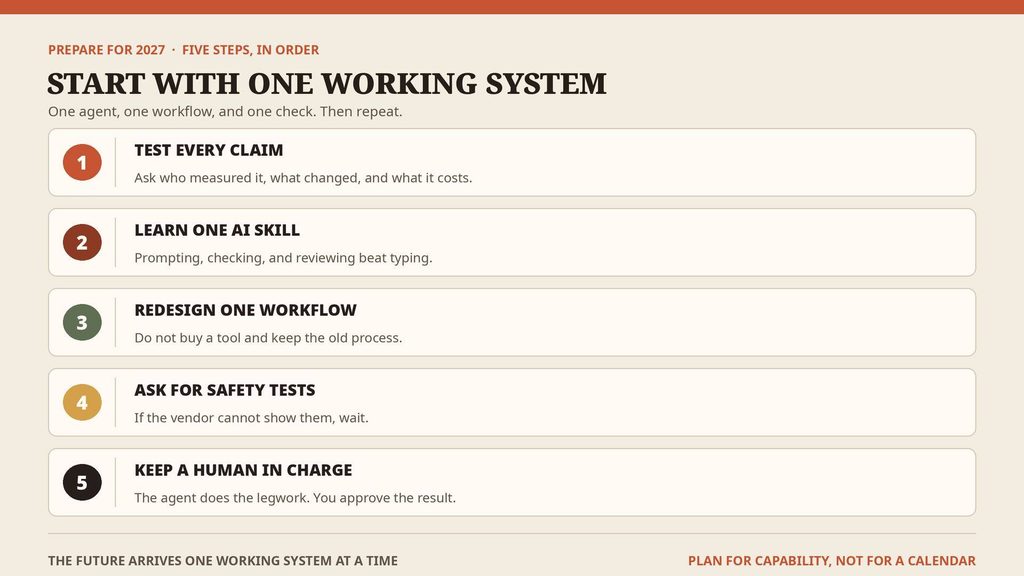
The AI future is not a single event. Instead, shifts are already under way: agents that act, small models traveling, jobs changing shape, and rules that catch up late. Winners test claims, learn new skills, and keep a human in charge. Start with one agent and one workflow, then write for us and share what you learn.
Future of AI: FAQs
Q: What is the future of AI?
Systems that do the work, not just describe it. Agentic AI already handles multi-step tasks like booking and coding, and small language models now run on phones without the cloud. The next step is artificial general intelligence (AGI), machines that learn new skills the way people do.
Q: Will AI take over humanity?
No, not on any timeline serious experts accept. The real risk is narrower: systems acting on bad instructions, or people misusing them. That is why AI safety research and AI alignment work keep powerful models under human control, with testing and AI regulation as guardrails.
Q: How will AI change the future of work?
AI and the future of work are tied together by automation of routine tasks: drafting, scheduling, data entry, and summaries. The World Economic Forum expects 170 million new jobs by 2030 against 92 million displaced. Job displacement hits repetitive roles first, while reskilling and upskilling decide who moves into the new ones.
Q: What is the future of AI in healthcare?
Faster, earlier, more personal care. AI already reads scans, flags disease early, and drafts notes, giving doctors more time with patients. The limits are data privacy and bias and fairness: a model trained on narrow data can misread patients it rarely sees. Hospitals will adopt what they can audit.
Q: What is the future of generative AI?
From text and images to full workflows. Generative AI is moving past chat into video, code, and agents that finish jobs end to end, while large language models get cheaper and faster. The winners will pair the models with real data and clear checks, not generate the most content.
Q: What does the future of AI look like?
In the AI future, assistants sit inside every app, AI copilots draft and check our work, and AI agents handle errands between apps. It looks less like a robot takeover and more like electricity: invisible, everywhere, until it stops. The visible change is how little time routine work takes.
Q: How is AI changing the future of education?
The future of AI in education is personal tutoring at scale: a tutor that knows what each student missed and adjusts the next lesson. Teachers gain time for discussion and mentoring while grading shrinks. The risk is dependence, so schools must teach students to check the machine, not just copy it.

