



By Zarirah Asif | AI Bubble Updated October 27, 2026
The bubble debate turned serious on October 26, 2026, as Anthropic filed its public IPO papers. Stocks wobbled, bond yields jumped, and investors asked one hard question. Is AI spending real growth, or is it a bubble about to pop? So this article gives you a straight answer, with evidence on both sides.
Most bubble talk mixes three different claims into one panic. First, some AI stocks may cost too much. Then, some data center projects may earn too little. Finally, some AI tools may promise too much. You need to separate those claims, because each one needs a different response.
First, check the spending numbers against revenue. Then, check who funds the spending, and with what kind of money. Finally, check what a small business should actually change. This order keeps you calm, because it replaces headlines with checks you can run.
This article explains what an AI bubble means, the 7 warning signs, the case against a crash, and a practical plan. You will see the CoreWeave test, the circular money chain, and the dotcom comparison. Then you will get clear steps for your own business.
Key Takeaways
- This debate is really three debates: stock prices, data center spending, and AI tool hype, and they do not all point the same way.
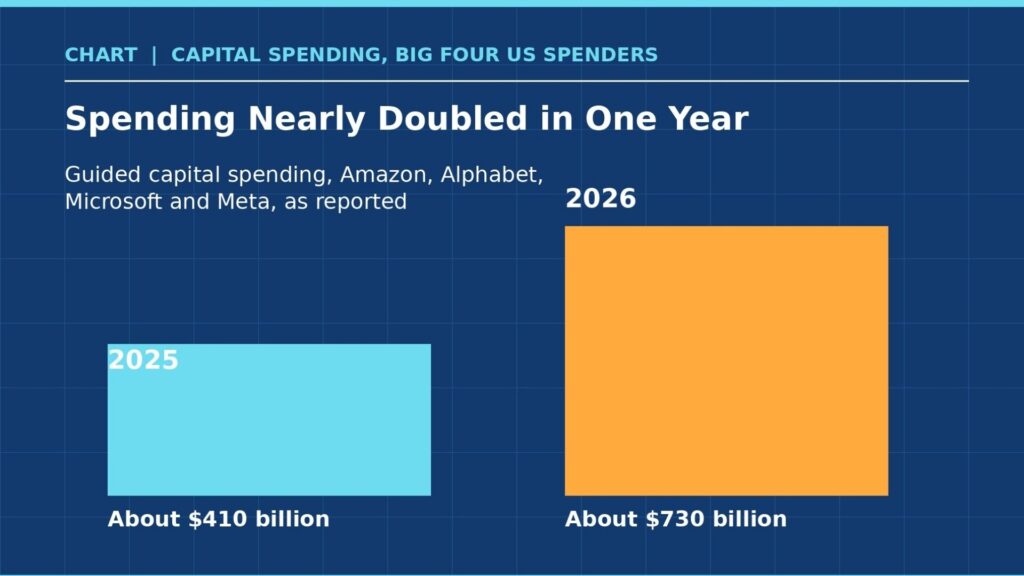
- The four biggest US spenders guided to about $730 billion in capital spending for 2026, up about 78 percent from about $410 billion in 2025, according to recent coverage.
- CoreWeave, a debt-funded neocloud, saw borrowing costs rise past 15 percent in October 2026, which tests whether its model can pay its debts.
- Anthropic reported $16.3 billion in first-half 2026 revenue and committed over $500 billion in compute deals, which shows both growth and fixed-cost risk.
- The case against a dotcom-style crash is real cash: today’s AI leaders earn large profits from search, software, retail, and cloud, unlike many 2000 firms.
- For small businesses, the smart move is to cut single-vendor risk, measure cost per finished task, and avoid long AI contracts you cannot exit.
What the AI Bubble Debate Really Means
A bubble means prices depend on a future that may never arrive. So a high price alone does not prove a bubble. You also need a gap between price and cash flow, plus a trigger that forces a reset.
First, stock prices can run ahead of earnings. Then, spending can run ahead of customer revenue. Finally, lenders can fund projects that only work if growth never slows. When all three line up, risk rises fast. When only one appears, the picture stays mixed.
Also, a bubble pop does not mean AI disappears. The dotcom crash killed weak firms, but it left Amazon, Google, and the modern internet standing. So the right question is not whether AI survives. The right question is which firms, projects, and prices survive a reset.
That framing changes the action plan. Do not quit AI tools because stocks wobble. You should avoid bets that only pay off if AI growth never slows. That rule guides every section that follows.
AI Bubble Warning Sign 1: Spending Ahead of Revenue
Start with the biggest number. The four biggest US spenders, Amazon, Alphabet, Microsoft, and Meta, guided to about $730 billion in capital spending for 2026. That total compares with about $410 billion in 2025, a jump of about 78 percent. So spending nearly doubled in one year.
That spending buys data centers, chips, power, and cooling. It also arrives before AI revenue catches up. One analysis puts hyper scaler AI infrastructure spending above $750 billion in 2026, with returns on AI clusters possibly falling below a 15 percent hurdle by 2028. So the payback window stretches further out each year.
Anthropic shows the same pattern at company level. It reported $16.3 billion in first-half 2026 revenue, yet it committed over $500 billion in compute deals over about a decade. So even a fast-growing lab now carries fixed costs many times its current revenue. That gap is the core of the AI bubble worry.
Still, spending alone does not prove a bubble. Railways, telecom networks, and cloud data centers all overbuilt before demand caught up. Some of that capacity later paid off, and some of it went bust.
AI Bubble Warning Sign 2: Circular Money
Next, follow the money in a circle. Amazon and Google invest in Anthropic, and Anthropic then buys cloud capacity from Amazon and Google. Microsoft sells capacity too, and it also holds AI stakes. So money flows from cloud giants to AI labs, then back to cloud giants as revenue.
That loop inflates both sides at once. First, an investment announcement lifts the lab’s valuation. Then, a cloud deal lifts the seller’s revenue. Finally, both sides cite each other as proof of demand. So reported growth may overstate outside customer demand.
Ramp data adds a sharper point. One analysis notes that just 1 percent of firms account for 80 percent of spending at OpenAI and Anthropic. Also, many heavy users are other AI companies, building AI with AI revenue. So the customer base looks narrow, and it depends on venture funding that may slow.
That narrow base does not kill the AI story. It does mean a funding slowdown would hit twice: once as less investment, and again as less customer revenue. So treat circular deals as a risk flag, not as proof of fraud.
AI Bubble Warning Sign 3: Debt and the CoreWeave Test
Debt turns a slowdown into a crisis, and CoreWeave now serves as the test case. CoreWeave rents computing power to AI companies, and it funds that business with heavy borrowing. In October 2026, its long-term borrowing costs passed 15 percent, and some reports put the figure above 16 percent. That rate sits far above normal corporate borrowing.
That cost matters because CoreWeave must earn more than it pays to borrow. If its return on rented GPUs falls below its borrowing cost, the model breaks. Also, its shares fell as investors questioned its prospects, and other neocloud shares wobbled too. So the market now prices real doubt into this corner of AI.
CNN reported the same pattern: traders grew nervous about AI balance sheets, bond yields moved, and investors rechecked debt levels across the sector. That reaction shows how one weak link can shift sentiment for the whole trade.
Still, CoreWeave may prove an outlier. Its model differs from cash-rich hyperscalers, which fund data centers from search, software, and retail profits. So a CoreWeave failure would hurt neoclouds first, and it would warn hyperscalers second. It would not, by itself, prove that all AI spending fails.
AI Bubble Warning Sign 4: Concentration and Bond Yields
Concentration adds a second trigger. The 10 largest stocks in the S&P 500 now account for nearly 40 percent of the index and about half of its returns this year, according to analysis cited in recent coverage. So a small set of AI-linked names now drives the whole market.
That concentration means a repricing in AI hits pensions, index funds, and household wealth at once. Also, retail investors now hold more AI exposure than they did a year ago. So a sharp AI correction would feel broader than a single stock drop.
Bond yields add pressure from the other side. As governments borrow more and bond yields rise, capital costs more for everyone. Tech firms that borrowed to build data centers now face higher refinancing costs. Also, higher yields give investors a safer alternative to risky growth stocks. So the AI trade must now beat a better-paying safe option.
Together, concentration and yields explain the October wobble. Traders did not just doubt AI. They also faced a market where AI names carry the index, and bonds now pay more. That mix turns small doubts into large moves.
AI Bubble Warning Sign 5: The Dotcom Comparison, Done Honestly
The dotcom comparison helps, but only if you use it honestly. US tech spending on plants and equipment reached 6.3 percent of GDP, above the 6 percent peak seen during the dotcom bubble, according to recent analysis. Also, cumulative global AI investment could more than double to $6 trillion by 2030. So the scale matches past bubble peaks.
Citadel CEO Ken Griffin said in October 2026 that an AI bubble is almost certainly happening in some form. Jeff Bezos called AI an industrial bubble earlier, while stressing that AI itself is real and transformative. So even AI optimists now accept bubble-like behavior in parts of the market.
Still, one big difference cuts against a repeat of 2000. Today’s AI leaders earn enormous real profits. Nvidia posts record revenue, and the hyperscalers fund spending from operating cash, not just from new share sales. Also, AI tools already serve paying customers in coding, support, search, and marketing. So the technology has revenue, even if some prices run ahead of it.

The honest verdict is a split one. Parts of the market look bubbly: debt-funded neoclouds, circular deals, and sky-high private valuations. Other parts look like normal infrastructure buildout: cash-funded data centers, real enterprise use, and falling model costs. So a selective repricing looks more likely than a total collapse.
What an AI Bubble Pop Would Mean for Small Businesses
A pop would not switch off your AI tools overnight. It would change prices, vendors, and support first. Weak AI startups could fold, merge, or raise prices. Data center projects could pause, which could slow new capacity. Also, venture funding for new AI tools could dry up for a year or two.
That shift helps buyers in one way. Model prices already fall fast, and a shakeout could push them lower. Also, open-weight models you can host give you an exit from any single vendor. So a business that owns its fallback keeps running even if a vendor stumbles.
Still, a pop would hurt in other ways. If you built a workflow on one startup’s API, a shutdown could break it. So test any replacement before you trust it in production, using the same checks in our guide to testing AI applications before trusting them in production. If you signed a long AI contract at peak prices, you could overpay for years. So the risk sits in lock-in, not in AI itself.
Use this simple test before you expand AI use. First, can you switch vendors in a week without rebuilding everything? Then, can you run the job by hand or with a cheaper tool for a month? Finally, does the tool save more than it costs per finished task? If any answer is no, fix that gap before you scale. Our guide to AI automation workflows that pay off uses the same test.
AI Bubble: Honest Limits
This story has real limits. First, no one can time a bubble pop, and this article does not try. Market timing claims would mislead you, so this article sticks to warning signs and actions.
Also, spending totals differ across sources. Some counts cover four hyperscalers, while others cover five, and some mix capital spending with total AI investment. So treat the $730 billion figure as a reported guide, not as an audited total. Check the source scope before you cite it.
Finally, private valuations stay opaque. Anthropic, OpenAI, and other private labs disclose only what they choose, plus what filings force out. So the valuation debate will stay noisy until more labs list publicly. Reuters laid out what the Anthropic filing does confirm, including revenue, losses, and compute deals, and that filing gives the debate its first hard anchor.
AI Bubble: FAQs
Q: What is an AI bubble?
An AI bubble is a period when AI stock prices, data center spending, or AI tool hype run far ahead of the cash those assets can earn. Prices then depend on future growth that may arrive late, or never arrive at all.
Q: Is a bubble pop coming soon?
No one can say when, or even whether, the bubble will pop. Warning signs are real, including heavy debt, circular deals, and concentrated stocks, but real revenue and cash-funded spending argue against a dotcom-style collapse.
Q: What sparked the bubble debate in October 2026?
The debate flared in October 2026 when Anthropic filed its IPO papers, CoreWeave borrowing costs passed 15 percent, Meta spent more cash than it produced in the third quarter, and bond yields rose. Together, those events forced investors to recheck AI balance sheets.
Q: How does this differ from the dotcom bubble?
This bubble differs from the dotcom bubble because today’s AI leaders earn large real profits and serve paying customers now. Many dotcom firms in 2000 had no revenue at all, while today’s hyperscalers fund much of their spending from search, software, retail, and cloud cash.
Q: Who gets hurt first if it pops?
Debt-funded neoclouds, weak AI startups, and overvalued private labs get hurt first if it pops. Cash-rich hyperscalers and firms with real enterprise revenue would feel pain later, and likely less severely.
Q: Should small businesses stop using AI over bubble fears?
No, small businesses should not stop using AI over bubble fears. Keep tools that save more than they cost per finished task, avoid single-vendor lock-in, and skip long contracts you cannot exit.
Q: What should I watch to judge the bubble?
Watch AI revenue growth per dollar of capital spending, neocloud borrowing costs, venture funding for AI startups, and quarterly cash flow at the hyperscalers. If revenue growth stalls while spending and debt keep rising, the case for a bubble gets stronger.
The Bottom Line
The AI bubble debate ends in a split verdict, not a slogan. Spending, debt, and concentration all flash warning signs, yet real revenue, real profits, and real tools argue against a total collapse. So the likely path is a selective repricing: weak, debt-heavy bets fall, while useful AI keeps getting cheaper and better. For your business, that path points to one rule: use AI where it pays per finished task, keep a fallback for every critical workflow, and never let one vendor hold your whole operation hostage. That rule survives a boom, a pop, or anything in between.
Know AI news, SEO, automation, or SaaS tools well enough to explain them this clearly? Write for Ai Blitzo: real editors, fast replies, and your work in front of people who actually use AI tools.


[…] the Moon’s surface during the flyby, and they saw the lunar far side with their own eyes. The AI bubble debate separates hype from measured evidence, and the same test applies here: the distance record is […]
[…] the center of that ceiling. Robotics is the last piece: machines that move in the real world. Our AI bubble warning signs explain why investors still […]