



Robots moved from demos to real work this week, and the change is clear. Open models, chip factories, and hospital robots all advanced at once, so this week matters more than most. That is the short answer in this robotics ai news roundup. I read the announcements, the benchmarks, and the fine print for you.
By the end, you will know which robot stories matter and which ones are only show. Also, you will know how to spot a vendor claim and how to judge a benchmark. For a wider view, start with our latest AI updates, then follow the sections below in order.
Robotics AI News: Runway Opens the Robot Brain
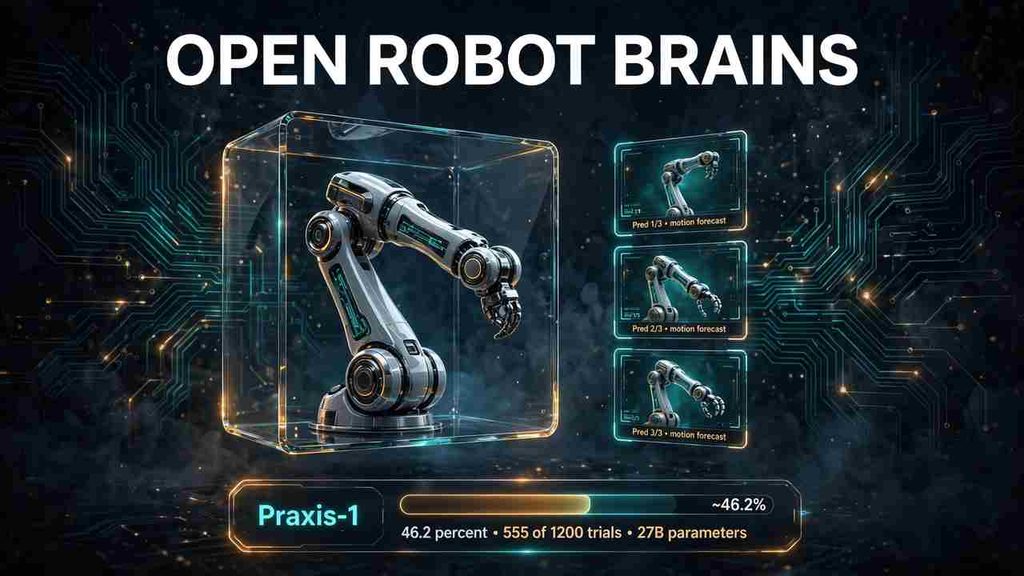
Runway released Praxis-1 with open weights on 11 November, and it changed the open robotics race. The 27-billion-parameter model predicts video and robot actions together, so it learns from ordinary video. For example, web video can now train a robot policy, and that cuts the need for costly robot demos.
This is the biggest robotics news story of the week for builders, in my view. Machine learning news often moves fast, and this release shows why open weights matter.
Runway reports 46.2 percent success on RoboLab-120, across 1,200 episodes. That means 555 wins out of 1,200 tries, so the model still fails more than half the time. On a Franka FR3 arm test, Praxis-1 scored 88 out of 100, while FLUX 3 Action scored 80.
Treat both numbers as vendor claims, because no independent group has yet repeated them. The open weights let anyone check, and that is the real news here.
Also, the release covers weights, inference code, and fine-tuning code under Apache 2.0, including commercial use. For the source, see Runway on Praxis-1.
The model also runs on a single RTX 5090 in a smaller form, according to Runway. That matters for small labs, because they can now test a leading world action model at home. In addition, the code supports full fine-tuning and LoRA, so teams can adapt it to their own robot, cameras, and tasks. This is gen ai news with a physical twist, and I think it will age well.
Atlas Leaves the Car Plant: Robotics AI News
Boston Dynamics will test Atlas in Global Foundries chip factories from early 2027. Global Foundries is the first customer outside carmaking to join the Atlas test program, and the first chip-maker in it. This is manufacturing robotics news at its clearest, because a humanoid now enters a fab. For context, see our manufacturing AI news coverage.
Atlas has no fixed job in the fab yet. First, the two firms will find tasks the robot could do, check what the fab needs, and train Atlas for those tasks. That slow start is honest, and it beats a flashy demo with no work behind it.
Hyundai plans 25,000 Atlas robots across its car plants over the next few years, and a US factory that can build 30,000 robots a year.
The same week brought a second Atlas story. Hyundai Motor Group now owns 100 percent of Boston Dynamics, after it bought SoftBank’s remaining 9.65 percent stake. The deal closed in mid-November, and it gives Hyundai full control as Atlas moves toward production. Gemini Decision 1 shows a different kind of AI decision, but here the decision is about ownership and scale.
Spot, the four-legged robot, moves faster than Atlas. GlobalFoundries will add more Spots in New York, Vermont, Dresden, and Singapore. In Singapore, two Spots have already walked about 900 km through the sub-fab and run at least 90,000 inspections. That is real work, done in a live plant, not a lab.
Humanoids Go Public
Figure 03 wears a race jersey
Figure and T-Mobile brought Figure 03 humanoids to the Formula 1 Las Vegas Grand Prix on 19-21 November. The robots wore magenta and grey jerseys, and they posed for photos at the T-Mobile Zone at Sphere. This is the most public robotics ai news moment of the week, in my view. For the wider car tech picture, see our autonomous vehicles news.
The robot has 5G built in, with T-Mobile as its main connection. Figure handles movement and safety on board, while the network carries data, updates, new skills, and live status checks. However, neither firm has said how many robots were there, how teams controlled them, or what work they did on site. So treat this as a showcase, not a work trial.
XPENG IRON steps on stage next
XPENG will put IRON on stage at its AI Day in Guangzhou on 25 November. The robot will interact live with the audience, according to XPENG. Mass production starts on 1 January 2027, and the first batch will trial in some XPENG stores in the first quarter of 2027. External customers follow in the second quarter.
That is a firm date, not a vague promise, and it raises the stakes for the stage show. For the business side, see our AI and business coverage.
IRON stands 1.78 m tall and weighs 70 kg, according to XPENG figures. It has 76 degrees of freedom across its body, and 21 in each hand. Three Turing AI chips give it 2,250 TOPS, and its VLA 2.0 model can remember returning buyers and switch languages. Still, XPENG has confirmed no price, and no independent test has yet checked those claims.
A boxing belt, and real factory work
A Unitree humanoid won a boxing belt in Xiongan on 21 November, in a bout against an EngineAI robot. The bout ran for about six minutes in a real ring, with a real referee. Yet the firms have not said which robot models fought, or how teams controlled the robots. So enjoy the show, but don’t read it as proof of autonomy.
AgiBot put dozens of G2 robots on Lens Technology smartphone test lines in China. The robots load and unload phone test stations, and they work with test gear. That is a quieter story than boxing, and it matters more. AI workflow automation moves forward when robots do dull, repeatable work well. However, the reports give no numbers for speed, uptime, or human help, so we cannot yet judge the scale.
For a week-by-week source, see ELiA Robotics Week 47.
China Sets the Rules: Robotics AI News
China issued five humanoid robot standards on 16 November, and they took effect the same day. The standards cover training sites, training data, drive joints, dexterous hands, and a six-level capability scale from L0 to L5. This robotics news matters for buyers, because it gives them one shared yardstick. For where this leads, see our future of AI coverage.
The scale grades four things: perception and cognition, decision-making and learning, execution, and working with people. L0 means preset actions only, while L5 means high autonomy and self-improvement. In addition, results show as a radar chart, a basic level, and a comprehensive level. That mix helps buyers compare robots, instead of trusting each maker’s own grade.
The reports I read do not spell out L1 to L4 in full, so I will not invent those definitions here. The full text should guide any buying choice, not a short summary. Still, the direction is clear. China now treats humanoid skill as something to measure, not just to show off.
Nvidia Builds the Platform Layer
Nvidia expanded its Isaac platform at GTC Berlin on 21 October. It added Isaac OS, an open-source runtime, and Isaac Lab 3.0, now generally available. The SimReady library now holds more than 2,000 simulation-ready assets. This robotics ai news is about tools, not one robot, and tools shape every robot that follows. For the coding side, see our agentic AI coding tools.
Agile Robots announced Agile ONE SN, a humanoid reference platform built on Isaac GR00T and Jetson Thor. It stands 1.40 m tall, weighs 40 kg, and has 31 degrees of freedom, with a 3 kg payload per arm.
It should reach labs in early 2027, and Stanford and ETH Zurich have shown interest. That is a research machine, not a shop-floor worker, and Nvidia frames it that way. For the source, see Nvidia on Isaac.
Isaac OS connects AI, sensors, controls, and hardware for real-time work, according to Nvidia. Isaac Lab 3.0 trains robot policies with reinforcement learning and physics simulation. Together, they cut setup time from weeks to days, Nvidia claims. That last claim is a vendor claim, so test it on your own stack.
The open part still matters, because open-source ai agents and robot tools now share the same building blocks. For the basics, see our AI agents explained guide.
Robotics AI News: Money, Medicine, and Dexterity
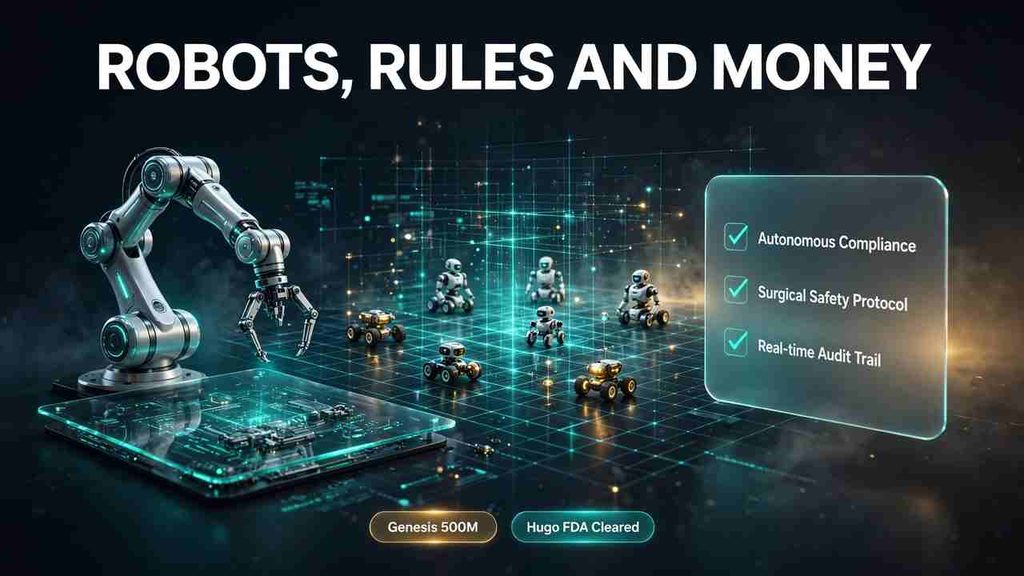
Genesis AI raised 500 million dollars in Series A funding on 17 November, at a 3.5 billion dollar post-money value. The money will fund data, training, and production of Eno, its general-purpose robot. This robotics news is a bet on hands, because Eno learns from glove data worn by more than 100 workers. Its GENE model turns that hand motion into robot skill.
For the source, see Genesis on the raise.
Eno is a wheeled robot with two arms, not a legged humanoid. Genesis has built only 30 to 40 units so far, according to TechCrunch. Its hands last only a few weeks of regular work, the same report says. That limit matters for buyers, because hands are the part that wears out first. Funding is a vote of trust, not proof of durability.
Medtronic won a wider FDA clearance for Hugo on 17 November. The Hugo surgical robot can now assist in general surgery, after its first US clearance for urology in December 2025. The new label covers upper abdominal work, including gallbladder removal and gastric bypass, plus hernia repair and appendix removal below.
Medtronic says the procedures add up to about 3.5 million US surgeries a year. Yet Medtronic has disclosed only one US hernia trial, with 193 patients, so ask which data backs each procedure.
The Big Labs Change Course
OpenAI folded its standalone robotics team into general research on 13 November, Fortune reports. Researchers moved to the main research group under Mark Chen, while applied robotics and hardware moved under Greg Brockman. The firm says general models can now run robots directly, so it needs no separate stack.
That is the latest ai model updates twist in this field, and it is a bet, not a settled fact. For the model at the centre, see our GPT-6 Astra coverage.
The claim rests on a simulation test, so read it with care. In an Nvidia study, GPT-6 Astra hit 74.8 percent on simulated robot tasks, against 51 percent for the best dedicated model. However, each attempt cost about 36.40 dollars in tokens and took 18.56 seconds per call. That is too slow and too dear for most factory floors today.
OpenAI still plans a first public humanoid demo in 2027. Claude Fable 5.2 shows the rival side of the same race, with Anthropic also pushing robot research.
Tesla has begun early Optimus production at its Fremont plant. Outside customers should get robots around late 2027, according to Elon Musk. That date has slipped before, so treat it as a guide, not a promise. Musk also says Tesla needs about 10,000 to 20,000 robots just to gather training data.
That delay is the biggest robotics ai news lesson here: production dates slip, while training data stays the real bottleneck. If you want to build with these models, start with our how to create an AI agent guide, then test on a small task first.
What This Means for You?
Read benchmarks as clues, not verdicts. A 46.2 percent score on a simulated test is progress, and it is also a model that fails most episodes. Real work needs uptime, safety, and cost per task, and few launch posts give those numbers. This robotics news week rewards the careful reader, because the gap between demo and deployment is where the truth sits.
When you search for the next update, AI for SEO 2026 explains how AI search surfaces news now.
Ask three questions before you act. First, what exact task would the robot do, and who owns the result? Second, what data trains it, and how do you check its work? Third, what happens when it fails, and how fast can a person step in? If a vendor cannot answer those three, wait.
The best AI tools for SEO follow the same rule, in my view: clear task, clear data, clear fallback.
My take is simple. I watch deployments, not demos. Factories, hospitals, and standards tell me more than a boxing ring or a race track. That is my opinion, and it shapes how I pick stories for you each week. If you write up a robot story yourself, keep it human and plain. An AI humanizer free check can help you hear where your own voice slips into robot speak.
FAQs
Readers ask the same five questions after every robot week. Here are my honest answers, in plain words.
Is AI going to take over the world?
No, not in the way films show it. Today AI handles narrow tasks, and robots handle narrow jobs. They need data, power, and human care. That is a long way from world rule.
Is AI taking over the world?
No, it is taking over some tasks, not the world. It writes drafts, sorts data, and moves boxes. People still set goals, check work, and own the results.
Could AI take over the world?
In theory, people debate it, and in practice, no current system shows that path. The real risk today is narrower: bad data, weak safety, and jobs that change fast. Fix those first.
How is technology changing the world today?
It changes work task by task, not all at once. Robots test phones, inspect fabs, and assist in surgery. Also, AI now writes, codes, and plans beside people. That slow shift adds up.
Is artificial intelligence taking over?
No, it is spreading into more tools, and people still steer it. The firms that win will pair AI with human checks. The firms that lose will trust it blind.
The Bottom Line
This week, robots got open brains, new jobs, new rules, and big money. The demos were loud, but the deployments were louder. This robotics news week will age well if you remember one thing: proof beats promise. Watch the factory floor, the hospital, and the next test, and you will see the real story first. At aiblitzo, we follow these shifts every week, so you can keep up without chasing every launch yourself.


