

This is how AI for SEO works: Think of large language models as speed tools, not decision makers. Use them for research, clustering, briefs, and first drafts, then apply strict human oversight and fact-checking before anything goes live. That single rule prevents the ranking drops most teams experience.
US marketers and site owners face a clear problem: competitors ship content faster with AI while Google continues to reward depth, accuracy, and experience. Resource-limited teams worry they will either fall behind or publish thin pages that get devalued. The fix is a disciplined workflow that keeps AI inside clear boundaries.
This guide shows the exact sequence a solo operator or small team can follow in 2026. You will learn where AI helps, where it actively hurts, the prompts that work, how to measure both classic rankings and AI visibility, and the hard limits that protect long-term results.
What AI for SEO Actually Means in 2026
AI for SEO means using artificial intelligence to accelerate traditional search engine optimization tasks such as research, content creation, and analysis. It is distinct from seo for ai (also called GEO or AEO), which focuses on making your content visible inside AI-generated answers.
It’s important to understand what is seo, because AI tools are just an amplification of the basics, they don’t replace clean technical foundations and clear search intent. Large language models and natural language processing (NLP) enable analyzing SERPs, clustering topics and quicker drafting. In practice, ai and seo (or seo and ai) work together: the same content that ranks in classic Google results is more likely to earn citations in generative search experiences and AI Overviews.
Zero-click searches rise when AI Overviews answer the query completely. Pages that only chase traditional rankings lose traffic even if they still appear in the blue links. The practical response is to structure content so both classic search and generative engines can extract clear, citable answers.
The real problem with “ai for seo” searches
US marketers and site owners search for this phrase because they’re constrained by resources, and they’re afraid of being outpaced by the competition that uses AI to ship content faster, and they’re scared of creating low-quality pages that Google will devalue. Many are also considering whether to outsource to ai seo services or an ai seo agency versus building internal capability.
The big question is how to go faster without losing control. Workflow automation is great, but only if humans stay in the loop. Brands that omit the human layer tend to grow volume in the short term, but then rank with volatility. For a practical starting point on building internal capability, see our guide to AI Tools for SEO: 7 Costly Mistakes Beginners Make.
Where AI Helps Most (and Where It Actively Hurts)
AI accelerates research, drafting, and auditing while exposing clear failure points that can tank rankings if ignored.
It shines at scale tasks. Keyword clustering that once took hours now finishes in minutes. Blank Page Paralysis-Free Content Briefs and First-Drafts. Tools to optimize on-page and score content can identify missing terms and structural gaps faster than a manual inspection. Technical SEO audits catch schema markup errors and Core Web Vitals issues at volume. Internal linking suggestions and meta titles and descriptions can be produced in batches.
The risks are equally concrete. Large language models hallucinate statistics, misattribute sources, and invent non-existent schema properties. When those errors reach the live site, Google’s systems detect thin or inaccurate pages. E-E-A-T signals erode because AI has no lived experience; it rewrites away the specific details that originally made content trustworthy. Zero-click searches rise when AI Overviews answer the query entirely, so pages optimized only for classic rankings lose traffic even if they still rank.
A practical example: a blogging team used AI to expand 20 posts in one week. Traffic rose briefly, then dropped 18 % after an algorithm update. The posts contained fake statistics and generic advice that were not fact-check able. Performance was restored by humans, with each claim verified and original data added.
The pattern is identical. AI does pattern recognition and volume. Humans own judgment, verification, and final voice. Treat every AI output as a draft that must pass fact-checking before publication. Google’s official guidance makes the same point: it is critical to manually fact-check and review all AI-generated content (including titles, meta descriptions, and structured data) for accuracy and trustworthiness before publishing. Google Search’s guidance on generative AI content.
The Practical AI-for-SEO Workflow (Start Here)
This workflow prioritizes realistic resource constraints over enterprise tool stacks. It works whether you use free LLMs, specialized ai seo tools, or a mix of both. seo ai tools speed the process; they do not replace the sequence. For deeper tool comparisons that include AI visibility features, see our Ahrefs vs Moz 2026 honest comparison.
Step 1 – Keyword Research & Clustering with AI
Feed a seed topic into an LLM and ask for long-tail keywords grouped by search intent. Request People Also Ask style questions and content gaps competitors ignore. Export the list, then validate volumes and difficulty in a traditional keyword tool. Keyword clustering by intent (informational, commercial, transactional) prevents thin pages that target overlapping queries.
Step 2 – Competitor Content Analysis and Gap Identification
Copy the top five ranking URLs and paste them into an AI tool and ask for a competitor content analysis. Ask them specifically about missing subtopics, SERP features the current results under-use, and opportunities to build topical authority. Focus on angles the existing pages treat superficially. This step surfaces the differentiates that let a weaker domain compete.
Step 3 – Creating Content Briefs and First Drafts
Use AI prompts to generate a content brief that includes target search intent, required H2s, questions to answer, and original data points you already possess. Then generate a first draft. Prompt engineering matters: include your unique examples, data, and constraints in the prompt so the output is not generic. Never publish the draft as-is. For related AI writing and automation ideas, check AI Workflow Automation.
Step 4 – On-Page Optimization and Internal Linking
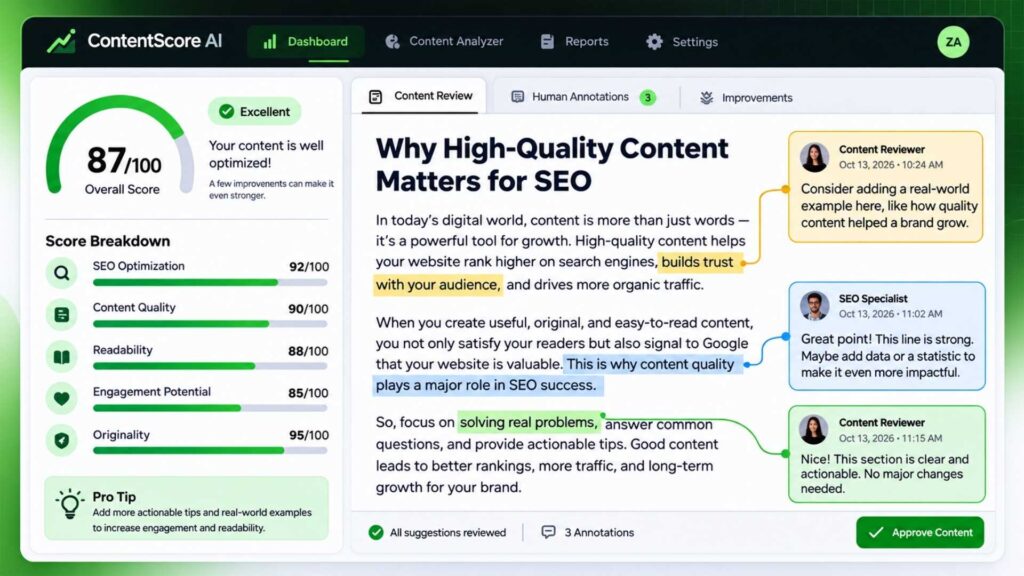
Use a content scoring tool such as Surfer SEO to receive on-page suggestions for the draft. Adjust meta titles and descriptions, streamline headings, and add internal links to relevant pages on your website. The last word on titles, structure and anchor text is still human. Strong internal linking helps crawlers and users alike and is also helpful for topical authority.
Step 5: Use AI to Conduct Technical SEO Audits
Tell AI to analyze a crawl export or page source for schema markup errors, missed Core Web Vitals opportunities and common technical issues. Verify every suggestion against official documentation at schema.org. AI is useful for surfacing candidates; it remains unreliable at writing correct schema from scratch. Cross-check findings against practical tool guidance in our Best AI Tools in 2026 roundup.
Exact AI Prompts That Work (and the Ones That Fail)
Strong prompts constrain the model and demand evidence. Weak prompts produce fluent but empty text.
Working example for keyword clustering:
“Act as an SEO specialist. Seed topic: [topic]. Generate 25 long-tail keywords grouped by search intent. Include People Also Ask questions and note likely content gaps. Do not invent search volumes.”
Working example for briefs:
“Create a content brief for [primary keyword]. Target search intent: informational. Add required H2s, 5 questions the page must answer and placeholders for original data I will provide. Flag any statement that would require fact checking.”
Patterns that fail:
- Write a full SEO article about AI for SEO (Generates generic filler and hallucinations.)
- Prompts that do not include fact-checking instructions or original source material.
- Requests for schema without requiring validation against schema.org.
Always follow generation with a fact-checking pass. Remove or replace every statistic, name, and claim you cannot verify.
Measuring What Matters: Rankings + AI Visibility
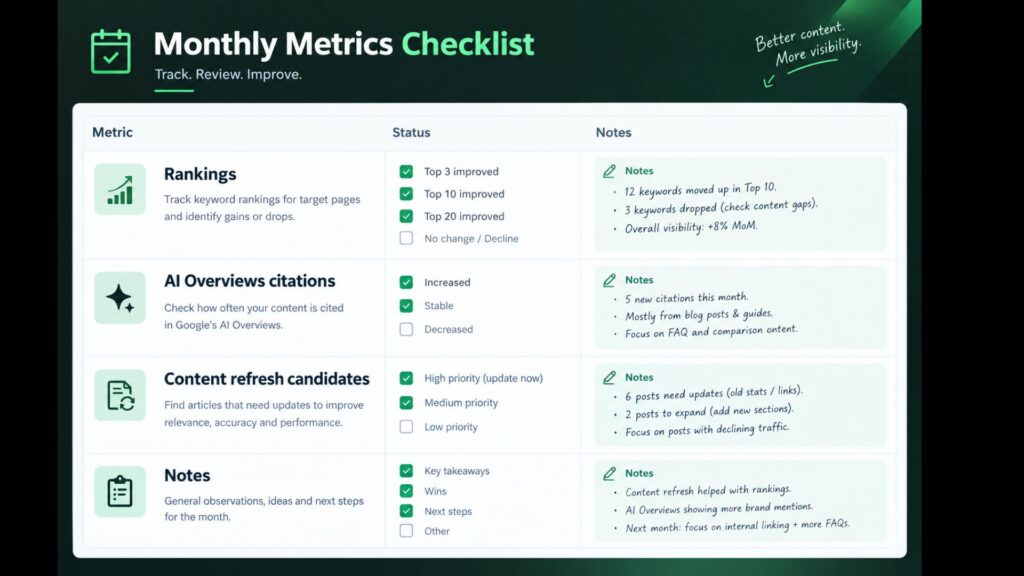
Track classic rankings in Google Search Console and a rank tracker. At the same time measure AI visibility and citation rate how often your pages appear as sources inside Google AI Overviews and other generative answers. This is the practical side of ai search seo and seo for ai search engines.
Set a simple monthly review: ranking movement, AI Overviews citations, and pages that need content refresh. Pages that lose citations or traffic after an update often need stronger original data or clearer answer formatting. For dedicated tracking approaches, see our ChatGPT Rank Tracking Tool Guide.
Best Practices and Hard Limits
Keep human oversight on every published page. Fact-check statistics, examples, and technical recommendations. Build topical authority through consistent coverage rather than one-off AI spikes. Set up regular intervals to refresh the content of the older pages.
Hard limits:
- Do not publish outputs from AI without human review.
- Never use AI generated schema without validating.
- Avoid scaling thin content even if volume looks attractive in the short term.
- Treat AI as a research and drafting assistant, not an author of record.
Teams that respect these limits gain speed without the ranking volatility that follows unchecked AI use. For small-team automation ideas that pair well with this approach, explore AI and Automation for Small Business.
Frequently Asked Questions About AI for SEO
Q: How to use AI for SEO?
Treat AI as a speed tool for research, clustering, briefs, drafts, and audits. Always add human review and fact-checking before publishing.
Q: How to SEO for Google AI Overview?
Lead with clear answers, use strong headings, add original data or experience, and build E-E-A-T. Well-structured pages rank better and get cited more often.
Q: What AI Overviews means for SEO?
AI Overviews increase zero-click searches by summarizing answers above traditional results. Ranking still matters, but earning citations inside the Overview is now an extra goal.
Q: How is AI Overview affecting SEO for blogging?
Informational posts face more zero-click traffic. Quick, experience-based answers get cited more. Thin AI content loses visibility faster, so raise quality and refresh regularly.
How to adapt SEO budget for AI search optimization?
Shift a portion of the budget from pure volume production toward quality control, original research, measurement of AI visibility/citation rate, and content refresh. Reduce spend on unedited AI drafts. Increase investment in tools or time for fact-checking, structured data validation, and tracking both classic rankings and AI Overview citations.
The difference is simple. You now have a workflow that uses AI for speed while protecting the quality signals Google and generative engines reward. Apply the five steps to your next cluster of pages and measure both rankings and citations after 30–60 days.
Ready to put this into practice? Explore practical AI tools, SEO strategies, and automation guides at aiblitzo.com.