


AI model updates this week follow one clear pattern: labs are getting more work out of the same weights, instead of only building bigger models. Cognition doubled a coding score with more reinforcement learning, Z.ai ran the same 28 layers twice, and Thinking Machines Lab looped a small model three times per pass. Open weights moved too, with a 124 billion parameter model from China and a 26 billion parameter model that fits on one machine.
That is the story in one line. The rest of this article gives you the date, the price, the access route, and the honest limit for each launch, so you can tell what you can use today from what is still only a promise. Every price below comes from the vendor that set it, and every benchmark claim is labelled as company reported unless an independent source checked it.
Key takeaways
- Cognition released SWE-2.1 on November 24. Its Terminal-Bench 4.1 score rose from 24.2 to 50.0 in Cognition’s own tests, and it stays inside Devin, with no API and no weights.
- Z.ai released GLM-5.4 on November 23. It loops 28 layers twice, claims intelligence comparable to models with 2 to 3 trillion parameters, and publishes no benchmark table for the full model yet.
- Ant Group open-sourced Ling-3.2-air on November 23 under MIT, with 124 billion total parameters and 5.5 billion active. Thinking Machines Lab released Inkling 2 Mini on November 20, a 26.4 billion parameter model that loops its middle layers three times.
- Anthropic reported more than 700 million monthly downloads for its Model Context Protocol tools. Tasks and Elicitation reached general availability.
- Gemini 4 Neon, from November 18, is still the price reference for the middle tier: $3 per million input tokens and $15 per million output tokens, with a 1 million token context window.
AI model updates at a glance: November 19 to 25, 2026
| Date | Update | What it is | Can you use it today? |
| Nov 18 | Gemini 4 Neon | Google mid-tier model, 1M context, $3/$15 per 1M tokens | Yes, API, Gemini app Pro and Ultra, Antigravity |
| Nov 19 | GPT-Live-1.1 | OpenAI voice model, standby mode at $0.02 per idle minute | Yes, API |
| Nov 20 | Inkling 2 Mini | Thinking Machines Lab, 26.4B looped model, 3.4B active | Yes, open weights |
| Nov 23 | GLM-5.4 | Z.ai loop transformer, about 750B, 28 layers run twice | Yes, Coding Plan only, no API yet |
| Nov 23 | Ling-3.2-air | Ant Group, 124B MoE, 5.5B active, MIT licence | Yes, Hugging Face |
| Nov 23 | Claude Ship | Anthropic GitHub pull request review and fixes | Yes, GitHub |
| Nov 24 | SWE-2.1 | Cognition coding model, pure reinforcement learning on Kimi K3 | Yes, Devin only |
| Nov 24 | Shirudo | OpenAI and Cisco open-source eBPF runtime for Linux | Yes, open source |
| Nov 24 | SenseNova U1.6 | SenseTime unified visual model, 8B open model | Yes, open sourced |

Timeline: the densest days were November 23 and 24, with three launches each in the gen ai news cycle.
SWE-2.1: a coding model doubles its score and stays inside Devin
Cognition released SWE-2.1 on November 24, 2026, as a major upgrade over SWE-2. Like its predecessor, it is trained with pure reinforcement learning on Kimi K3, Moonshot AI’s open-weight base model. Cognition reports Terminal-Bench 4.1 rising from 24.2 to 50.0, FrontierCode 2.0 rising from 24.1 to 41.3, ExploitBench at 80 percent, and ExploitGym at 27.3 percent of intended flags captured. Those are Cognition’s own numbers, and no independent evaluation exists yet, so treat them as the vendor’s case rather than a verdict.

Chart: Cognition’s own scores for SWE-2.1 against SWE-2. No independent run exists yet.
Three variants arrived with it. SWE-2.1 Cyber has more permissive safeguards and rolls out to Devin Security for defensive security work. SWE-2.1 Ultrafast runs the same model at 10 times the speed through a partnership with Cerebras, at a reported 600 tokens per second against 60 for the standard model. Speed matters here because the model keeps improving the longer it works, so throughput decides how much it can finish in a short fix.
Access is the limit to note. SWE-2.1 is available in Devin Desktop, Devin Cloud, and Devin CLI, with no API, no model weights, no self-hosting, and no per-token price published. Cognition offers it free on Desktop and CLI through December 8, 2026, and at a discounted price until January 30. If you already work in Devin, test it on a real task from your own workflow before you judge the benchmark jump. If you do not use Devin, this launch changes nothing for you this week.
GLM-5.4: china ai news leads with a loop transformer
Z.ai released GLM-5.4 on November 23, 2026, and it is the clearest china ai news story of the week. It is Z.ai’s first flagship built on a Loop Transformer, an architecture that reuses the same block of layers more than once instead of stacking new ones. The model runs 28 layers of the GLM-5 base twice per forward pass, at about 750 billion parameters, with a 1 million token context window and a maximum output of 128,000 tokens.
In plain terms, GLM-5.4 rereads a hard paragraph instead of reading a longer one. Each pass refines the hidden state from the last pass, so the model gains depth without adding another set of weights. Z.ai says this reaches intelligence comparable to models with 2 to 3 trillion parameters, and reports streaming speeds of 70 to 80 tokens per second under peak load, up to 200 off peak.
Read the evidence with care. Z.ai published no model card and no benchmark table for the full 750 billion parameter model at launch, and its strongest published evidence comes from a controlled test on a separate 30 billion parameter model, not the flagship. Z.ai also notes that the model can fall into overly long reasoning loops, which adds time to a task. The honest position is that the engineering idea is real and the headline comparison is still unverified.
Access is subscription only for now. GLM-5.4 is available through the GLM Coding Plan, in ZCode and Z.ai Chat. API access is listed as coming soon, after a safety assessment, and open weights are promised after safety hardening, with no date given. That makes it a model to watch for coding teams, not one to build a product on this week.
Ling-3.2-air and Inkling 2 Mini: open weights get smaller and cheaper to run
Two open-weight releases show the other side of this week’s machine learning news: smaller active sizes, lower running costs, and real files you can download today.
Ant Group’s inclusionAI lab put Ling-3.2-air on Hugging Face on November 23. It is a native multimodal mixture-of-experts model with 124 billion total parameters and 5.5 billion active, under an MIT licence, with day-one support in SGLang and a vLLM fork. Only 5.5 billion parameters run per token, so the running cost stays far below the headline size.
Thinking Machines Lab released Inkling 2 Mini on November 20. It is an open-weights 26.4 billion parameter mixture-of-experts model with 3.4 billion active parameters, and it loops its middle layers three times per forward pass. The model fits in about 20 GB of memory, with GGUF builds for smaller machines and Ollama support for larger Macs. That puts a looped model within reach of a single good machine, which is the practical point for students and small teams.
Baseten added to the same trend on November 20 with bison-1 and groundhog-1, open-weight decision models built on Gemma 4, with 128,000 token context and image input. Bison-1 scores 76 on the AA Decision Index v2.1, according to Baseten. Decision models are less glamorous than chat models, and they are the ones that route, classify, and verify work inside real products.
Anthropic MCP passes 700 million downloads, and agents get infrastructure
Anthropic reported on November 23 to 24 that its Model Context Protocol developer tools are now downloaded more than 700 million times per month, two years after the protocol launched as an open standard. Tasks and Elicitation reached general availability after public testing in October. Tasks let an agent work in the background, and Elicitation lets it ask the user for missing input in a structured way.
This is infrastructure news, not a new chatbot. The protocol is the layer that lets agents reach files, tools, and services in a standard way, and the download count shows how widely that layer is now used. Google Cloud made a related move the same week with managed ingestion and SearchDocuments in Agent Retrieval, which collapses a custom retrieval pipeline into a single API call.
Anthropic also launched Claude Ship on November 23 for GitHub pull request review and fixes. It bundles Code Review, PR Steward, and Claude Approvals, so a pull request can be reviewed, fixed, and approved in one place. For teams that already review code in GitHub, that is a workflow change, not a model change, and it is worth testing on one small repository first.
Shirudo, SenseNova, and GPT-Live-1.1: smaller updates worth knowing
OpenAI and Cisco released Shirudo on November 24, an open-source eBPF runtime for Linux under a BSD licence. It lets operators load signed eBPF shields on live Linux hosts while patches roll out, without a reboot. The two companies tested it with a Codex-generated shield for a Java shell exploit on Elasticsearch. This is a developer and operations story, and it matters because agents now write the shields that protect live systems.
SenseTime released and open-sourced SenseNova U1.6 on November 24, a unified visual model whose 8 billion parameter open model adds native image self-correction. That means the model can spot and fix its own image errors, which is useful for product and design work where a small visual mistake ruins the result.
OpenAI shipped GPT-Live-1.1 in the API on November 19, a full-duplex voice model with better multilingual accents and transcription. A new standby mode bills idle WebRTC time at $0.02 per minute instead of $0.05, which cuts the cost of voice agents that wait for the user to speak. Voice work is often priced by the minute, so a standby rate is a real saving for support and booking flows.
Two items from November 25 are reported, not yet confirmed from a primary source, so they sit here with that label. OpenAI demonstrated GPT-6 designing proteins, with lab results showing binding to five targets, and Anthropic made Claude artifacts installable as desktop apps on Mac and Windows. Both are worth watching, and both need a primary announcement before you plan work around them.
Gemini 4 Neon: still the price reference, one week on
Google introduced Gemini 4 Neon on November 18, 2026, one day after GPT-6.2, and it is still the price reference for the middle tier a week later. Neon costs $3 per million input tokens, $0.15 cached, and $15 per million output tokens, with a 1 million token context window and four thinking levels. Google says cost per task runs 32 percent below Carbon, and reports that Neon scores 61 on the Artificial Analysis Intelligence Index at its highest thinking level, third overall, and first on the Coding Agent Index.
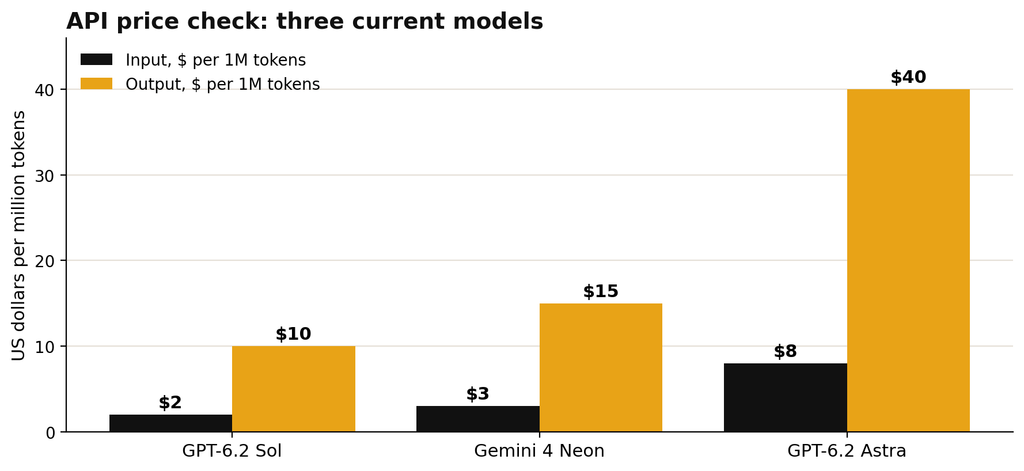
Chart: input and output prices per million tokens, from Google and OpenAI rate cards.
Neon is rolling out in the Gemini API in Google AI Studio, in Gemini for business, in Antigravity, and in the Gemini app for Pro and Ultra subscribers. Our machine learning news roundup covered the launch in full, with the price and the benchmark context. The point to carry into this week is simple: every new coding model now has to beat Neon on cost per finished task, not only on a benchmark score.
For a wider view of the tools around these models, see our best AI tools in 2026 guide, which places each launch beside tools you already use. The weekly hub for this series is our latest AI updates page.
What this week means for your work
If you write code, test SWE-2.1 inside Devin on a real task, and test GLM-5.4 only if you already pay for the Coding Plan. Vendor benchmarks are not your workload, and the access route matters as much as the score. A model you cannot call from your own stack is a demo, not a tool.
If you run products, look at the open-weight releases first. Ling-3.2-air and Inkling 2 Mini are files you can run, measure, and keep, while the flagship launches this week are mostly hosted and subscription gated. That split decides your cost, your data control, and your exit route.
If you follow gen ai news for content or marketing, the price war is still the story. Cheaper tokens change what support, coding, and image workflows cost to automate, and looped models show that labs can now buy depth with compute instead of size. Keep one eye on the benchmarks, and keep the other on the rate card and the access page, because those two decide what you can actually ship.
FAQs
How advanced is AI?
AI is advanced enough to design proteins, write and review code, prove mathematical results, and run multi-step agent work, and it still needs human checks on most jobs. It can handle narrow, well-specified tasks at expert level, yet it fails on open-ended judgment, long-term planning, and physical work. The honest measure is task by task, not one overall score.
How advanced is artificial intelligence?
Artificial intelligence is most advanced in narrow, testable work such as coding, maths proofs, image editing, and protein design, where results can be checked quickly. It is least advanced in open-ended work that needs judgment, physical skill, or long-term responsibility. That split explains why one demo looks superhuman and the next task fails.
How fast is AI growing?
AI is growing fast enough that two frontier models launched in two days last week, GPT-6.2 on November 17 and Gemini 4 Neon on November 18, and new models now arrive monthly. Prices fell at the same time, with Astra 20 percent cheaper than its predecessor. OpenAI planned to grow from 4,500 staff to 8,000 by the end of 2026.
What is the future of artificial intelligence?
The future of artificial intelligence points toward agents that act on their own, smaller models that run on devices, and tighter rules around safety and data. This week showed all three at once, with coding agents, on-device Windows models, and new court and safety cases. Capability will keep moving fast, while rules, courts, and safety testing set the pace.
How many employees does OpenAI have?
OpenAI had about 4,500 employees in March 2026, according to the Financial Times, with a reported plan to reach 8,000 by the end of 2026. A separate workforce count put the wider group at 7,850 in December 2025. OpenAI does not publish an official headcount, so the honest answer depends on the source and the date. OpenAI was co-founded by Sam Altman, the open ai founder named in many searches, with others in 2015.
Bottom Line
This week in ai model updates gave builders a faster coding model they can only use inside Devin, a looped model from China with a big claim and no benchmark table yet, and open-weight models that are smaller, cheaper, and ready to download today. The models are the easy part to read about. The prices, the access routes, and the evidence decide what they cost in practice. We will update this roundup if any of these numbers change. If you tried one of these models this week, write for us and share what you found.


