

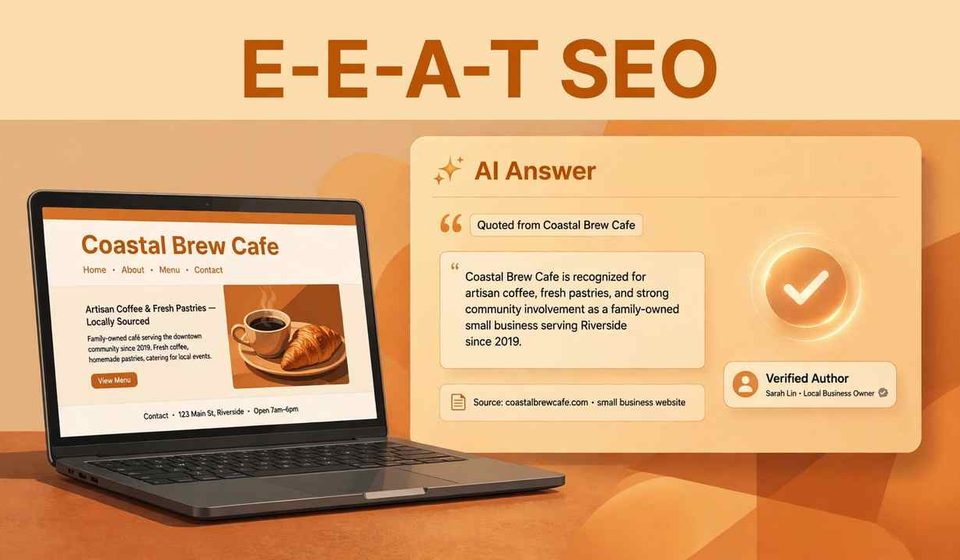

Yes, E-E-A-T SEO now decides whether AI search cites your pages or skips them. In fact, AI engines quote sources they trust, and trust comes from visible experience, real expertise, and honest signals. This guide explains each letter in plain words.
By the end, you will know how to show proof on every page, what to fix first, and what to ignore. In short, you will have a practical checklist for small teams.
What E-E-A-T Means in 2026?
Specifically, the four letters stand for Experience, Expertise, Authoritativeness, and Trustworthiness. For instance, Google uses these ideas in its quality rater guidelines to judge whether a page deserves trust. In other words, they describe proof, not polish.
Notably, Experience joined the list in December 2022, when Google added it to the older E-A-T trio. Above all, that change matters because AI engines now read for first-hand proof. For example, a guide written by someone who did the work beats a summary of other summaries.
Our AI for SEO in 2026 overview sets the wider scene for this shift. It shows how ranking work and citation work now overlap. As a result, the same proof serves both jobs at once.
The four letters in plain words
In other words, experience means you did the thing yourself. You tested the tool, visited the place, or fixed the problem. AI engines look for that first-hand detail.
Similarly, expertise means you know the topic deeply. Your background, training, and past work should be easy to check. A named author with real credentials beats an anonymous page.
Meanwhile, authoritativeness means others point to you as a source. Mentions, links, and reviews from real sites build it over time. No single page can fake it overnight.
Finally, trustworthiness means your facts check out. Clear contact details, honest claims, and visible corrections all count. It is the base the other three letters stand on.
Google says this is not one ranking factor you can switch on. Instead, it is a cluster of signals its systems reward over time. That is why quick tricks fail and steady proof wins.
Why E-E-A-T Matters in AI Search Now?
Pew Research found that AI Overviews cut clicks hard. When an overview appears, users click a normal result only 8% of the time. Our guide to getting cited by AI search explains the retrieve and cite process in plain steps.
Fog-lift Research counted 5.87 citations per AI answer on 3 November 2026. That is down from 6.03 two weeks earlier, while fan-out rose to 30.1 sub-queries per question. In short, each answer cites fewer pages and checks more sources first.
SEOcrawl AI measured traffic from AI assistants growing about 45% year over year. For every 100 visits from Google, AI now sends about 1.25. ChatGPT sends most AI referral traffic, so our guide to ranking in ChatGPT is a useful companion.
Google published its first official AI search guidance in May 2026. Its message is simple: optimizing for AI search is still SEO. That means the basics still count, and proof sits on top of them.
How AI Search Is Changing SEO and Citations?
Google AI Mode keeps changing, and our AI Mode ads guide tracks the placement side. In November 2026, it gained more clickable links and clearer source panels. As a result, cited pages can now earn the click, not just the mention.
A November 2026 roundup lists more proof that citations are the prize. Google now writes AI summaries inside citation cards and tests a source preferences button. Bing added a Topics Portfolio to show where your site gets cited. For E-E-A-T SEO, that means the citation itself is now the metric that matters.
BrightEdge found AI Overviews in 84% of queries back in 2024. Since then, the share has only grown across informational searches. In other words, the AI answer is now the front door, not a side door.
Machine learning reads your page in chunks, so clear passages matter more than clever wording. Retrieval systems cut pages into short passages and score each one. Therefore, one clear answer per section beats a long, tangled page.
SEO vs GEO explains where classic ranking ends and citation work begins. Ranking wins the click, while citation wins the mention. You need both, but they are not the same job.
Experience: Show Real Work, Not Rewritten Summaries

A 16-month study of 4,200 articles found that pages with first-hand experience outperformed the rest. Importantly, the result held even when the pages were technically equal. For E-E-A-T SEO, lived proof is the hardest signal to fake.
For instance, show your work in photos, screenshots, and short process notes. Add dates, real results, and the mistakes you made along the way. Above all, readers trust scars more than slogans.
To demonstrate expertise, write from your own notes, not from other summaries. Quote your own data, your own tests, and your own clients. In addition, name the tools and steps you actually used.
Three fast ways to prove experience
First, add one photo of the real work to each guide. Second, add a short line that says when you did it and what happened. Third, keep the proof near the claim it supports.
Experience also means admitting what you have not done. Say so plainly when a guide rests on research rather than practice. Honesty like that builds more trust than a padded claim.
Expertise: Make Your Author Credentials Visible

Your author credentials should sit where readers can see them. A short bio, a photo, and a link to past work are enough to start. For E-E-A-T, a named expert beats an anonymous page every time.
AI tools for SEO can draft fast, but they cannot hold your credentials for you. Use them to speed up research, then add your own judgment on top. The expert is you, not the tool.
For example, credentials that count include qualifications, years in the field, and client work you can name. Speaking, teaching, and published work count too. In addition, list them plainly, and link to proof where you can.
Build one strong author page for E-E-A-T SEO
Build one author page and link every article to it. Put your photo, your role, your past work, and a way to contact you on it. Then keep it fresh as your work grows.
Small teams can share one expert voice across the whole site. One strong author page lifts every guide that links to it. In contrast, ten thin author pages help no one.
Authoritativeness: Earn Mentions Beyond Your Own Site
Authority grows when other sites mention you as a source. A link helps, but even an unlinked brand mention counts as a signal. For E-E-A-T, outside proof weighs more than self-praise.
Compare the big SEO suites to see who links to you and who mentions your brand. Most of them track backlinks and brand mentions in one place. Pick one, and check it once a month.
AI visibility tool-kits track brand mentions across AI engines, not just rankings. They show whether ChatGPT, Perplexity, or Gemini name you at all. That view matters more than a rank report now.
Ahrefs alternatives include several tools that track mentions on a small budget. Free alerts can catch new mentions the same week they appear. Respond to each one, and thank the writer who named you.
For a small site, original research is the fastest authority builder. For instance, run a short survey, share your own prices, or publish a small case study. Other writers cite fresh numbers far more than fresh opinions.
Trustworthiness: E-E-A-T Signals That Earn Citations

Trust is the base that holds the other signals up. If your facts are wrong, no amount of expertise will save the page. For E-E-A-T SEO, trust is the letter that turns proof into a citation.
Show your contact details, your address, and a real about page. Add reviews with names, and answer the bad ones in public. Keep prices and opening hours true, and fix them fast when they change.
Some readers still prefer search engines that skip AI answers, and they judge trust the old way. Clear pages, honest claims, and named authors win them over. In the end, trust works the same in both worlds.
Above all, keep your business facts identical everywhere an engine checks. Your name, services, and prices should match across your site and your profiles. One mismatch can cost you the citation.
Dates matter too, since stale pages lose trust fast. Show the published date and the last updated date on every guide. Fresh proof beats old claims, even when the old claims were once true.
A quick trust checklist
First, check that every page shows a date and an author. Second, fix any old price or dead link you find. Third, add a short note that says how you check your facts.
7 Practical E-E-A-T Moves for Small Teams
You do not need a big budget to start. Moreover, each move below takes under an hour, and together they cover all four letters. Start at the top and work down.
1. Add a real author box to every guide
Put a photo, a two-line bio, and a link to the author page under each guide. Readers should reach the proof in one click. As a result, every page borrows strength from the author page.
2. Publish one piece of original data
Pick one question your customers ask and answer it with your own numbers. In fact, a ten-client survey beats a thousand borrowed words. Other sites will cite the fresh number, not your opinion.
3. Cite your sources with links
AI search citations go to pages that cite their own sources. Link the study, the price page, or the official doc you relied on. In turn, engines treat your page as a careful source.
4. Keep business facts identical everywhere
Check your name, services, and prices on every profile you own. Fix the old ones the same day you spot them. Consistency is a quiet signal, but engines read it closely.
5. Refresh your best pages with new proof
Rank Math covers the technical basics while you focus on proof. Add a new date, a fresh example, and one new fact to each top page. Then republish it and tell search engines it changed.
6. Ask clients for named reviews
Ask three happy clients for a short review with their real names. Put the best lines on your site and your profiles. In the end, named praise beats anonymous stars every time.
7. Measure citations, not just rankings
A ChatGPT rank tracking tool shows how often the engine cites your pages. Check it weekly and note which pages earn mentions. Then give those pages more proof, not more keywords.
AI visibility platforms such as Profound and Peec AI show whether engines name you at all. Compare the numbers month to month, not day to day. Slow, steady growth is the honest signal.
What E-E-A-T Cannot Do (And What It Can)?
GEO tools measure citations, but no tool can fake experience for you. They report the result; they cannot create the proof. Buy them to measure, not to pretend.
Practitioners report a lag of three to six months before expertise changes show results. However, that is normal, since trust builds slowly. Plan for a quarter, not a weekend.
Princeton researchers found that repeating exact keywords can cut visibility by about 10%. Stuffing looks like spam to retrieval systems. LLM optimization rewards clear, sourced writing instead.
AI detectors are unreliable judges of quality, so do not write for them. A page can pass a detector and still say nothing useful. Write for the reader, and let the signals follow.
The Google Helpful Content update showed what happens without proof. Many strong sites lost 30 to 60% of their traffic overnight in 2023. Overall, the lesson still holds: expertise first, tricks last.
For small teams, E-E-A-T for AI search is a routine, not a project. A little proof each week beats one big push each year. Keep the routine, and the citations will follow.
FAQs
What do the four letters stand for?
Specifically, they stand for Experience, Expertise, Authoritativeness, and Trustworthiness. Google added Experience in December 2022. Together, they describe proof a reader can check.
Does it directly affect Google rankings?
Not as one switch you can flip. Google treats it as a cluster of signals that shape rankings and AI citations over time. As a result, pages with strong proof tend to win both.
How long does it take to work?
Expect three to six months before changes show in rankings or citations. Trust builds slowly, and engines re-check pages over time. Start now, and measure monthly.
Can AI-written content pass these checks?
It can, if a real expert checks it, adds proof, and signs it. Pure AI filler with no experience behind it usually fails. The author matters more than the tool.
What is the fastest win for a small business?
Add a real author box and one piece of original proof to your best page. That single page can start earning mentions within weeks. Then repeat the same fix on the next page.
The Bottom Line
E-E-A-T SEO rewards the work you already do, once you make it visible. Specifically, show real experience, name your experts, earn outside mentions, and keep every fact true. AI for small business works best when real people stay visible behind it.
Start this week with one page: add the author box and one fresh fact. If you run your marketing from one online marketing platform, add the author box there first. Then tell us how it went in the comments, and keep reading AiBlitzo for honest AI guides that respect your time.
