
Quick answer: Most people searching for an AI detector over-trust the percentage they see. Independent 2026 tests show real accuracy rates sit between 76% and 92%, false positives of 5–12% are common, and a high score on your own writing is not proof it was AI-generated.
If you’re searching for an AI detector after watching your essay or article come back 60–80% AI, you already know the anxiety is real. What you don’t know yet is that most tools overstate their reliability, and the number alone won’t tell you whether the flag is fair or a false positive.
By the end of this article you’ll know what the score actually measures, which independent benchmarks expose the marketing claims, how to read false positives and sentence-level highlights, and the exact steps that protect you from costly mistakes built from 2026 university studies and controlled tests, not vendor promises.
What an AI Detector Actually Does (and What the Score Means)
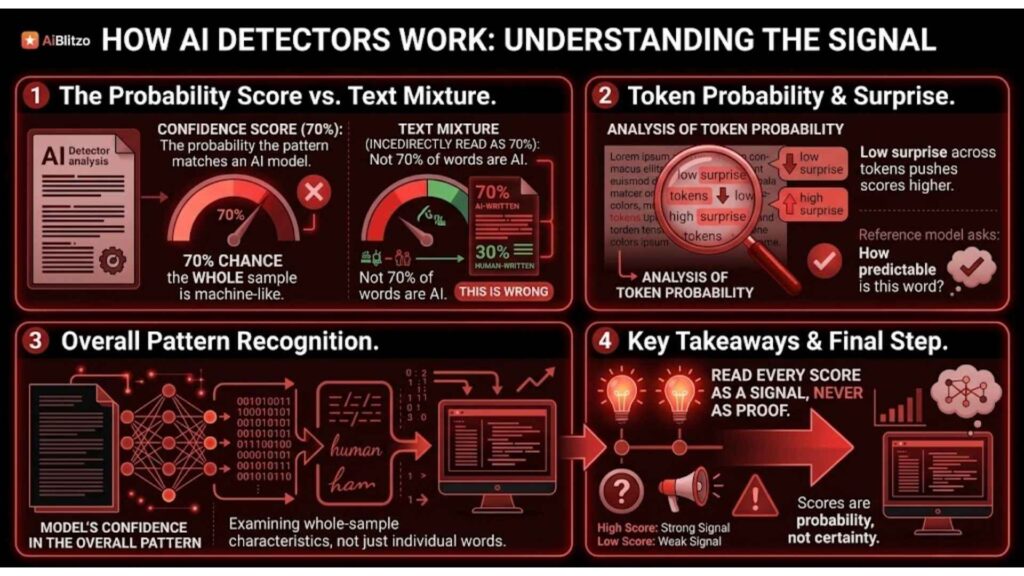
An AI detector estimates the probability that a piece of text was produced by a language model rather than a human. It returns a probability score (often shown as a percentage) and sometimes a confidence score.
That percentage is not a measurement of how much of the text is AI. It is the model’s confidence that the overall pattern matches AI-generated text. A 70% score does not mean 70% of the words came from ChatGPT. It means the detector thinks there is a 70% chance the whole sample looks machine-like.
Most tools also examine token probability. They ask how surprised a reference language model is by each word choice. Low surprise across many tokens pushes the score higher.
Read every score as a signal, never as proof.
How AI Detectors Work Under the Hood
Detectors combine several statistical signals.
Perplexity score measures how predictable the text is to a language model. AI output tends to choose high-probability next tokens, so perplexity stays low. Human writing jumps around more.
Burstiness tracks variation in sentence length and structure. Humans mix short punches with long, winding sentences. Many models produce more even rhythms.
Some systems add stylometry (function-word patterns, syntactic habits) and, when available, watermarking signals that certain model providers embed at generation time. Most commercial tools still rely primarily on perplexity, burstiness, and classifiers trained on large sets of labeled training data.
None of these signals is perfect. Formal academic writing, non-native English, and heavily edited drafts can all look “low-perplexity” even when a human wrote every word.
Accuracy Reality Check: Independent Benchmarks vs Marketing Claims
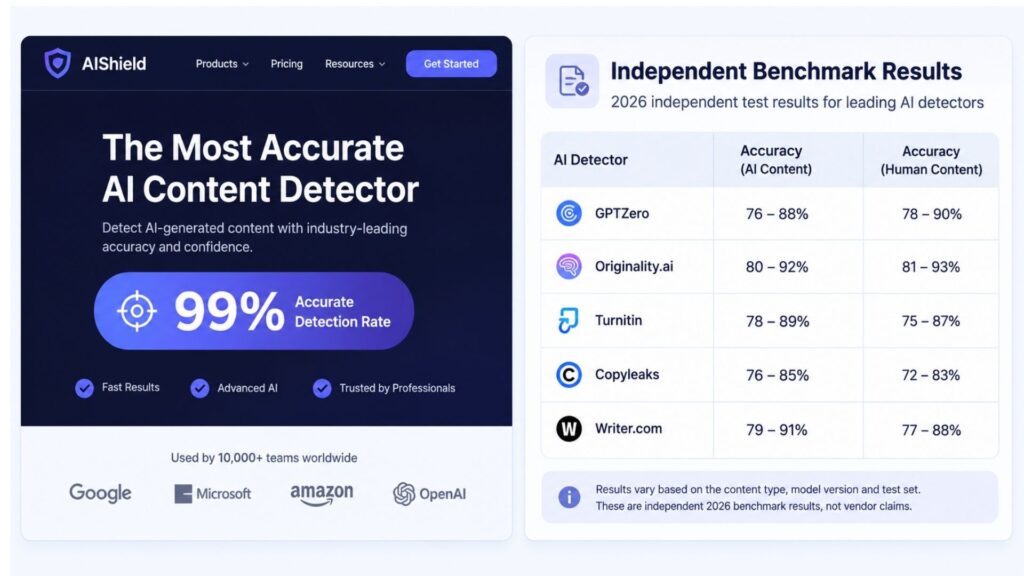
Most AI detectors claim 99%+ accuracy rates. Independent tests in 2026 show the real numbers sit far lower, usually between 76% and 92% depending on the tool, the text length, and whether the writing has been edited.
Vendor marketing pages almost never match outside results. A March 2026 independent benchmark of 2,400 samples put Originality.ai at 91% accuracy with a 7% false positive rate. GPTZero scored 87% accuracy and a 10% false positive rate. Copyleaks landed at 79% accuracy with a 12% false positive rate. These are not edge cases. They are the numbers that appear when researchers control the sample instead of the company.
The gap widens on harder content. In a June 2026 peer-reviewed study of 160 long academic papers, Turnitin, GPTZero, and Copyleaks detected 0% of fully AI-generated papers under the strict measure. Pangram was the only tool that caught any, reaching 65% on the strict measure and 97.5% when partial matches were allowed. The same study recorded zero false negatives on pure human papers across all four tools, but that is the easy half of the job.
Why False Positives Matter More (AI detector)
False positive rates matter more than the headline accuracy number for most users. The University of Chicago Booth working paper found only Pangram consistently stayed under a 0.5% false-positive policy cap while still detecting AI text. Other tools climbed higher once the passages got shorter or the writing came from non-native English speakers. A false positive is not a minor inconvenience. It is the score that makes a student or writer question work they know they produced themselves.
The RAID benchmark and similar independent benchmark results keep showing the same pattern: raw AI output is relatively easy to catch. Hybrid content, paraphrased text, and humanized content drop detection rates by 20–40 points for most tools. Marketing claims rarely mention this drop. For a broader overview of how detection methods have evolved and their documented shortcomings, see the Nature summary of recent AI-detection research.
No current AI detector is accurate enough to serve as proof of authorship. The probability score is a signal, not a verdict. Background on the broader category of tools is also covered in the Wikipedia entry on artificial intelligence content detection.
Free AI Detectors You Can Use Right Now (No Sign up Options)
If you need a quick check without creating an account, several tools still allow zero-click checks.
- ZeroGPT offers unlimited basic scans with no login on shorter samples.
- QuillBot and Scribbr free tiers let you paste text and get a result without registration (word limits apply).
- GPTZero’s free plan gives roughly 10,000 words per month after a light account, but the public checker often works for one-off pastes.
Free tier limits and word limit rules change frequently. Always test with a short sample first. Model coverage varies: most handle ChatGPT and Gemini output reasonably well; newer or heavily edited text is less reliable.
For a deeper look at free versus paid trade-offs, see our guide to Google Gemini free limits in 2026.
Key Limitations You Must Know Before Trusting Any Score
Detectors fail in predictable ways.
Humanized content and light paraphrasing cut accuracy sharply. Hybrid content (human draft + AI polish) is even harder. Short samples under 150–200 words produce unstable scores.
Non-native English bias remains documented. Older studies showed false-positive rates above 50% on TOEFL-style essays; newer tools improved but still flag more non-native writing than native writing in independent checks.
Turnitin AI detector results inside institutions often differ from the public tools students use at home. A high score on a free checker does not automatically equal a high score inside a school’s system.
If your original work gets flagged, do not assume the tool is right. Check the full draft history, notes, and sources. That evidence is stronger than any single percentage.
Sentence-Level Results and How to Interpret Them
Many tools now highlight individual sentences. This is sentence-level highlighting.
A highlighted sentence simply means that portion contributed more strongly to the overall probability score. It does not prove the sentence was generated by AI. Formal transitions, repeated structures, or low-burstiness phrasing can trigger highlights even in fully human text.
Treat the highlights as a map of what the detector found statistically unusual, not as a list of “AI sentences” you must rewrite.
Best Practices: Combining Detectors with Human Review
Run the text through two different detectors. Large disagreements are common and useful.
Then apply a human review process:
- Compare the flagged sections against your actual drafting process.
- Check for your normal voice, specific examples, and source integration.
- If the writing is for school, keep timestamps, outlines, and version history.
This combination protects academic integrity better than any single score. For publishers and SEO teams the same logic applies to content authenticity: use the detector as a first filter, never as the final decision.
Students who also work with Claude will find useful workflow tips in our Claude for students guide.
Choosing the Right Detector by Use Case
- Students: prioritize low false-positive tools and free tiers with reasonable word limits. GPTZero and Pangram currently lead on classroom-friendly reporting.
- Teachers: look for LMS integration and batch features.
- Publishers and SEO teams: Originality.ai and Copyleaks offer stronger bulk scanning plus plagiarism detection.
- Developers: check API access and pricing per 1,000 words.
Multi-language support still varies widely. English remains the strongest language for every major tool.
Reddit threads under best ai detector reddit often surface real-user experiences that marketing pages omit. Cross-check those anecdotes against the independent numbers above.
Table of Leading Free & Paid Options (AI detector)
| Tool | Independent Accuracy Range | False Positive Notes | Free Access | Best For |
|---|---|---|---|---|
| Pangram | Highest on strict false-positive tests | Near-zero in Booth study | Daily credits | Accuracy-first users |
| Originality.ai | 76–92% | ~5–7% in 2026 tests | Limited trial | Publishers |
| GPTZero | 82–87% | 6–10% range | 10k words/month | Students & teachers |
| Copyleaks | ~79% in one large 2026 set | Higher on some samples | Limited free scans | Multilingual / enterprise |
| ZeroGPT | Lower on independent sets | Higher false positives | Unlimited basic | Quick no-signup checks |
Numbers shift with new model releases. Re-test any tool you rely on after major AI updates such as those covered in our GPT-6 Astra overview.
MLA format papers and other structured academic styles can themselves lower burstiness and raise scores. That is a feature of the writing style, not automatic proof of AI use.
Frequently Asked Questions
Q: How accurate are AI detectors in 2026?
Independent benchmarks place most tools between 76% and 92% accuracy. Vendor claims of 99%+ almost never hold up once researchers control the test set. False-positive rates of 5–12% are common, and performance drops further on hybrid or humanized text.
Q: Why do AI detector(s) flag human writing?
Low perplexity and low burstiness can appear in formal, technical, or non-native English writing even when every word is human. Short samples and heavy editing also push scores higher. The tool is measuring statistical patterns, not authorship.
Q: What should I do if an AI detector flags my original work?
Keep your draft history, outlines, notes, and timestamps. Run the same text through a second detector. Present the process evidence rather than arguing with the percentage. A single score is not proof.
Q: Can AI detectors detect paraphrased or humanized text?
Detection rates fall 20–40 points on paraphrased and humanized content in independent tests. Some tools handle light editing better than others, but no current detector reliably catches heavily revised AI text.
Do free AI detectors really work?
Free tools can give a useful first signal, especially for raw AI output. They usually carry stricter word limits, higher false-positive rates, and weaker performance on edited text. Use them for triage, then verify with a second tool or human review.
The core problem never changes: you want certainty that your own work will not be misjudged. Treat every AI detector score as one data point inside a larger process. Keep your drafts, run two tools, and trust the evidence you can actually prove.
Ready to build clearer AI workflows that protect your work instead of creating new anxiety? Contact the team at aiblitzo.com and let’s map the right process for your needs.

1 Comment
Pingback: Moonshot AI: 3 Mistakes New Users Make with Kimi