
Quick Answer
A ChatGPT rank tracking tool monitors how often a brand appears in AI-generated answers, which sources are cited, how prominently competitors appear, and how those signals change over time. Unlike traditional Google rank tracking, AI visibility tracking usually measures mentions, citations, share of voice and source visibility rather than a fixed keyword position.
Introduction
In 2026, appearing in traditional Google search results is no longer the only discovery path that matters. When people ask ChatGPT, Perplexity, Gemini or other AI systems for recommendations, brands that never surface in those answers may be missing an emerging discovery opportunity.
A ChatGPT rank tracking tool (also called an AI visibility tracker or GEO platform) helps close that gap. These platforms run realistic buyer prompts against AI systems, then measure brand mentions, citations, prominence and competitive share of voice.
This guide explains what these tools measure, how AI visibility differs from classic SEO rankings, which platforms are available, and practical ways to improve your presence. It is written for marketers, founders and agencies who need clear, usable data.
Read more: ChatGPT and Gumroad: How I Made $10,000 in One Month Easy Guide 2026
What Is a ChatGPT Rank Tracking Tool?
A ChatGPT rank tracking tool monitors how your brand appears inside AI-generated answers. Unlike a traditional rank tracker, an AI visibility platform usually measures presence and prominence within generated answers rather than a fixed position for a keyword.
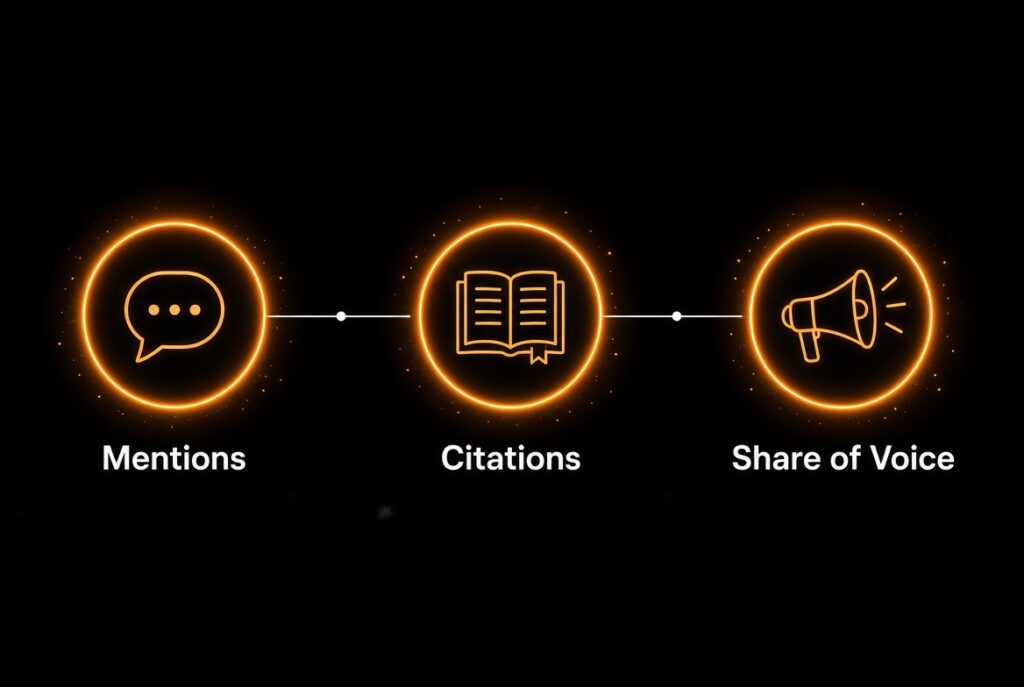
Typical signals these tools capture include:
- Brand mentions: whether the brand or product name appears in the answer
- Citation: whether a specific URL or domain is referenced as a source
- Prominence: how centrally or early the brand is referenced when the answer is structured as a list or recommendation
- Share of voice: relative visibility compared with named competitors across a defined set of prompts
- Source and domain visibility: which third-party sites and pages repeatedly appear as sources
- Sentiment or framing: how the brand is described when it is mentioned
- Trends over time: changes in the above signals across repeated runs
ChatGPT does not return a ranked list of ten blue links. It synthesizes an answer. Tracking therefore works by sending realistic buyer prompts on a schedule, parsing the full responses, and aggregating the results into rates and competitive benchmarks rather than single fixed positions.
Most serious tools now cover more than ChatGPT alone. Common additional surfaces include Google AI Overviews, Google AI Mode, Perplexity, Gemini, Claude and Microsoft Copilot. The better platforms also distinguish between answers that rely mainly on existing model knowledge and answers that use live web search with citations, because the two types of responses can differ.
Why AI Visibility Is Not the Same as Google Rankings?
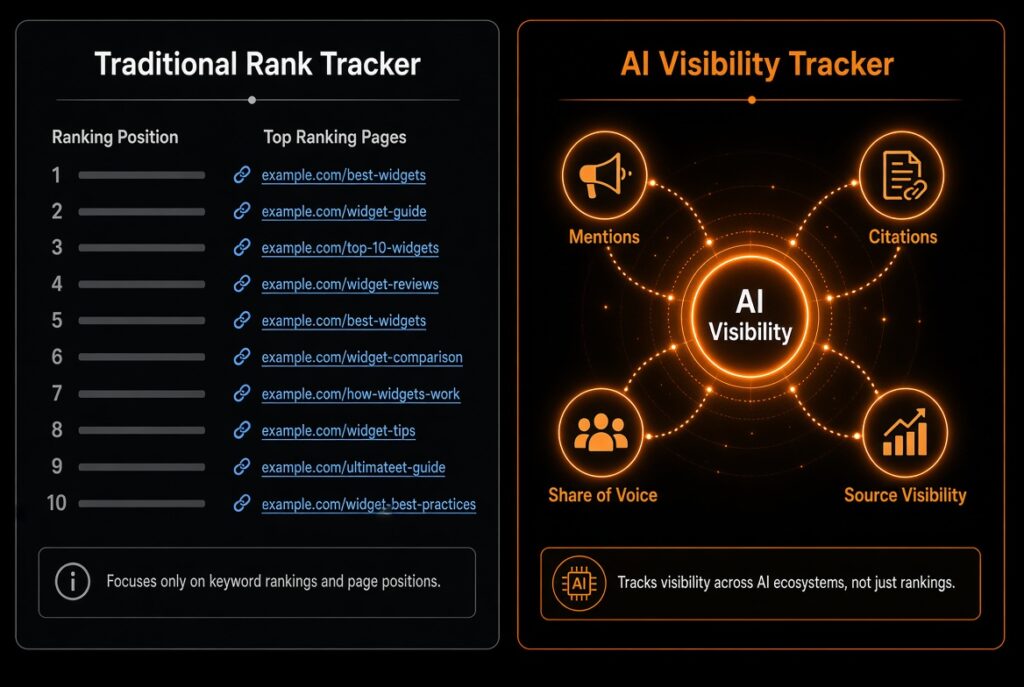
Google still matters. Classic SEO rank tracking remains useful. AI answer engines, however, operate differently:
- Answers are non-deterministic. The same prompt can produce different brand mentions on different runs.
- Many answers are paragraphs rather than ranked lists. “Position” is mainly useful when the response presents brands in a list or recommendation format.
- Brand presence is only one part of visibility. A brand can appear once, repeatedly, as a primary recommendation, via a third-party citation, or with positive or negative framing.
- Citation behaviour varies by platform, query and response type. Citation counts should be compared within the same platform and prompt set rather than treated as universal.
- Buyers often ask conversational, comparison and recommendation questions that never appear as traditional keywords.
Manual checks (opening ChatGPT and typing prompts) give anecdotes. Recurring, multi-run tracking with a ChatGPT rank tracking tool gives usable directional data.
Read more: How to Rank in ChatGPT: The Truth in 5 Data Points
How a ChatGPT Rank Tracking Tool Works?
Most platforms follow a similar workflow:
- You define a set of prompts that match real buyer questions (category, comparison, problem and branded queries).
- The tool runs those prompts against ChatGPT and, in many cases, other engines on a schedule. Monitoring frequency should depend on the importance of the prompts, platform limits and the goal of the tracking program.
- It captures the full answer, detects brand and competitor mentions, extracts cited URLs where available, and stores the data.
- Dashboards show mention rates, share of voice, citation sources, trends and gaps.
- Better tools also surface the specific pages or third-party sources that appear repeatedly so you know what to influence.
Because answers vary, good tools run each prompt multiple times and report rates rather than single snapshots. Some also surface AI crawler activity or referral traffic so you can connect visibility signals to actual visits.
Key Metrics a ChatGPT Rank Tracking Tool Measures
Looking only at raw mentions is incomplete. These are the signals that usually provide the most useful picture:
| Metric | What It Measures | Why It Matters |
| Mention rate | % of tracked prompts where the brand appears | Core presence signal |
| Brand-domain citations | Mentions that include a link to your own domain | Direct traffic potential from your site |
| Third-party citations | Mentions that cite other sites while discussing your brand | Shows the external sources influencing answers |
| Source / domain visibility | Which websites and pages repeatedly appear as sources | Reveals the information ecosystem AI systems rely on |
| Share of voice | Your mentions as a % of all brand mentions in the prompt set | Competitive context |
| Prominence / order | Where the brand appears in list-style or recommendation answers | Useful mainly when answers use ranked formats |
| Sentiment / framing | How the model describes the brand | Accuracy and reputation signals |
| Trend over time | Changes in the above metrics across weeks or months | Shows whether content or PR work is landing |
How We Compared ChatGPT Rank Tracking Tools?
We compared these platforms across supported AI search surfaces, custom prompt tracking, citation and source analysis, competitor benchmarking, reporting capabilities and pricing relative to tracking capacity. Because each platform uses different prompts, models and sampling methods, these comparisons describe product capabilities rather than claiming that one tool produces universally better AI visibility data. Pricing and feature details change; always verify current plans on the vendor sites before purchasing.
Best ChatGPT Rank Tracking Tools Overview
The market has matured quickly. Below is a practical overview of widely discussed platforms based on publicly available information in 2026. Exact prompt limits, engine coverage and pricing should be confirmed directly with each vendor.
RankBits
RankBits focuses on multi-engine AI visibility tracking. It offers a free tier and paid plans that start around the $49 per month range for expanded capacity. Public materials describe support for a broad set of AI and search surfaces, custom prompts, mention and citation tracking, competitor views and API access on paid plans. It is often positioned for solofounders and smaller teams that want relatively broad coverage without the highest enterprise pricing.
Otterly.ai
Otterly.ai is frequently noted for accessible entry pricing. Public plans begin in the low $30s per month for a limited number of prompts and core engines (typically including ChatGPT, Google AI Overviews, Perplexity and Microsoft Copilot). Higher tiers expand prompt volume and add features such as API access and more advanced reporting. Additional engines are often available as add-ons. It is commonly chosen by teams that want a lower-cost starting point for recurring monitoring.
Peec AI
Peec AI emphasises clean dashboards, visibility and position metrics, sentiment scoring and source-level citation analysis. Public self-serve plans typically start around $95 per month with a set number of prompts and the ability to choose a limited number of engines. Unlimited seats are a noted feature on many plans. It is often used by agencies and mid-market teams that want clear competitive and source reporting.
Profound
Profound is positioned toward deeper enterprise-grade AI visibility analytics. Public materials indicate a lower-tier plan focused mainly on ChatGPT and higher-tier plans that expand engine coverage and response volume. Pricing for fuller multi-engine use is higher than entry-level tools. It is frequently considered by larger brands that prioritise compliance, deeper citation analysis and scale.
Semrush AI Visibility Toolkit
Semrush offers AI visibility features as part of or as an add-on to its broader SEO platform. Coverage typically includes ChatGPT and selected Google AI surfaces alongside classic SEO data. It is most relevant for teams already using Semrush who want AI signals inside the same workflow. You can also compare Semrush with other platforms in our Semrush vs Ahrefs vs Moz vs Ubersuggest guide.
Ahrefs Brand Radar
Ahrefs Brand Radar has expanded to include AI mentions, citations, share-of-voice style metrics and coverage across several AI and search surfaces. It sits inside the Ahrefs ecosystem and is most useful for teams that already rely on Ahrefs. For a deeper look at Ahrefs options, see our Ahrefs alternatives and Ahrefs vs Moz 2026 comparisons.
SE Ranking / SE Visible
SE Ranking provides AI visibility tracking (often under the SE Visible branding) that can sit alongside its traditional rank tracking and SEO tools. It is commonly used by agencies that want both classic SEO reporting and AI surface monitoring in one place. Prompt volume, engine coverage and pricing are plan-dependent.
Other platforms such as Promptwatch, Geoptie, Scrunch, Rankability and similar tools also serve specific use cases. The right choice depends on required engines, prompt volume, need for source-level data, existing tool stack and budget.
Read more: AI and Automation for Small Business: 7 Quick Wins
ChatGPT Rank Tracking Tools Comparison Snapshot
The table below summarises typical positioning based on public information. Always verify current details.
| Tool | Best for | AI platforms (typical) | Custom prompts | Citation / source data | Starting price range |
| RankBits | Value & multi-engine | Broad set incl. ChatGPT | Yes | Yes | Free / from ~$49 |
| Otterly.ai | Budget monitoring | Core + add-ons | Yes (limited on entry) | Yes | From ~$29 |
| Peec AI | Agencies & source analysis | Choose from major engines | Yes | Strong focus | From ~$95 |
| Profound | Enterprise depth | ChatGPT + expanded tiers | Yes | Strong focus | From ~$99 (higher for multi) |
| Semrush AI Toolkit | Existing Semrush users | ChatGPT + Google AI surfaces | Plan-dependent | Available | Add-on / plan based |
| Ahrefs Brand Radar | Existing Ahrefs users | Multiple AI surfaces | Plan-dependent | Available | Plan based |
| SE Ranking / SE Visible | SEO + AI in one place | ChatGPT + Google AI surfaces | Plan-dependent | Available | Plan + add-on |
What a ChatGPT Rank Tracking Tool Cannot Measure?
No platform can see every private ChatGPT conversation or guarantee every future AI response. AI answers can vary by prompt phrasing, model version, location, whether live search is used, and the exact moment the query is run. These metrics should therefore be treated as sampled measurements within a defined prompt set, not a complete count of every brand mention across the entire user base.
Tools also differ in how they sample, which models they query, and how they define a “mention” or “citation.” Cross-tool comparisons of absolute percentages are often less reliable than tracking trends inside a single consistent system.
How to Choose the Right ChatGPT Rank Tracking Tool?
Useful decision questions include:
- Do you need ChatGPT only, or multi-engine coverage that includes Google AI Mode, AI Overviews, Perplexity and others?
- How many prompts do you realistically need to track on an ongoing basis?
- Do you want pure monitoring, or monitoring plus recommendations and content actions?
- Is source-level citation data (exact URLs and domains) important, or is brand mention rate enough?
- Are you already paying for Semrush, Ahrefs or SE Ranking?
- What is your monthly budget and team size?
A practical approach is to start with a free check or short trial on two tools, run the same small prompt set, and compare the clarity and actionability of the reports before committing.
Practical Ways to Improve AI Search Visibility
Tracking alone does not move the numbers. Use the data from your ChatGPT rank tracking tool in these ways:
Build a focused prompt set
Include category questions, “best X for Y” queries, comparisons against competitors, problem-solution prompts and a few branded ones. A smaller set of well-chosen prompts can be more useful than hundreds of generic queries, particularly when the prompts reflect real buyer questions.
Strengthen entity clarity
Make sure your brand, products and key people are described consistently and unambiguously across your site and major third-party profiles. Clear entity information helps both traditional search systems and AI systems interpret who you are.
Create evidence-backed content
Pages that contain original data, clear definitions, comparisons, FAQs and structured information are easier for systems to extract and cite. Front-load direct answers and keep sections self-contained.
Improve pages that already receive citations
When a tracker shows specific URLs winning citations, improve those pages further for clarity, depth, evidence and freshness.
Earn authoritative third-party mentions
AI answers often draw from review sites, comparison articles, industry publications and communities. Presence on those sources can influence what the models surface.
Monitor the sources AI systems repeatedly cite
Source and domain visibility data reveals the information ecosystem that is shaping answers. This helps prioritise outreach, content partnerships and updates.
Combine GEO with traditional SEO
Crawlability, technical quality, clear structure and strong traditional SEO remain foundational. Pages that perform well in search and are referenced by authoritative sources can have stronger visibility across AI-assisted search, although no ranking or citation outcome is guaranteed. Treat GEO and SEO as complementary rather than separate channels. For related reading on SEO platforms that now include AI features, see our comparisons of Ahrefs alternatives, Ahrefs vs Moz, and Semrush vs Ahrefs vs Moz vs Ubersuggest.
Re-measure on a sensible schedule
Visibility moves. Monitoring frequency should match the importance of the prompts and the pace of your content and PR work. Monthly or bi-weekly checks on priority prompts are often sufficient for most teams.
Read more: AI Tools for SEO: 7 Costly Mistakes Beginners Make
Frequently Asked Questions About ChatGPT Rank Tracking Tools
What is a ChatGPT rank tracking tool?
It is software that runs buyer-style prompts against ChatGPT and often other AI engines, records whether your brand is mentioned or cited, and tracks those signals over time so you can see visibility trends and competitive gaps.
Can ChatGPT rankings be tracked like Google rankings?
Not in the same way. Google rank tracking reports a fixed position on a results page. AI visibility tracking measures presence, prominence, citations and share of voice inside generated answers. There is usually no stable 1–10 ranking for most prompts.
What is the difference between AI visibility and AI citations?
AI visibility is the broader concept of how often and how prominently a brand appears in AI answers. An AI citation is a more specific signal: the AI response references a particular URL or domain as a source. A brand can be mentioned without a direct citation, or cited via a third-party page.
Do AI visibility tools measure every ChatGPT conversation?
No. They sample responses to the prompts you define. They cannot see private user conversations or guarantee every future answer. Treat the data as directional measurements within a controlled prompt set.
How is ChatGPT rank tracking different from Google rank tracking?
Google rank tracking reports where your URL sits on a results page. A ChatGPT rank tracking tool reports whether and how your brand appears inside a synthesized answer, including mentions, citations and relative prominence when answers use list formats.
Do I need a paid tool or can I track manually?
You can run manual checks for a baseline. For reliable trends you need repeated runs of the same prompts under consistent conditions. Paid tools automate that process and add competitive and source data.
Which metrics matter most?
Mention rate, brand-domain and third-party citations, source visibility, share of voice against competitors, and trend direction over time. Single snapshots are less useful than rates measured consistently.
Is visibility in ChatGPT the same as traffic?
Not always. Mentions build awareness. Citations that include clickable links are more likely to drive visits. Track both presence signals and referral traffic in analytics where possible.
Should I track only ChatGPT?
ChatGPT is a high-volume surface for many categories, but buyers also use Perplexity, Gemini, Google AI features and other systems. Multi-engine coverage gives a more complete picture of AI search visibility.
Final Thoughts
AI answer engines have added a new discovery layer alongside traditional search. The businesses that treat this layer as measurable — rather than a black box — can make more informed decisions about content, entity signals and third-party presence.
Start by defining the prompts that matter to your buyers. Run a free check or short trial with one or two of the ChatGPT rank tracking tools above. Establish a baseline. Then improve the pages and third-party sources that the data shows are already influencing answers. Re-measure. Repeat.
AI visibility tracking is still maturing and imperfect, but the teams that measure it consistently and act on the gaps are better positioned to appear in the recommendations that matter.
You can also find additional AI search and visibility resources on aiblitzo.com. If you need help choosing or implementing a tracking setup, feel free to contact us.

4 Comments
Pingback: ChatGPT and Gumroad: How I Made $10,000 in One Month
Pingback: Micro1 AI Interview: 5 Mistakes That Kill Your Chances
Pingback: Google Gemini Free vs Paid: 5 Real Differences That Matter
Pingback: Perplexity vs Claude: The Honest Truth on Which AI Wins