


By Zarirah Asif | GPT-6.1 Terra Updated November 2, 2026
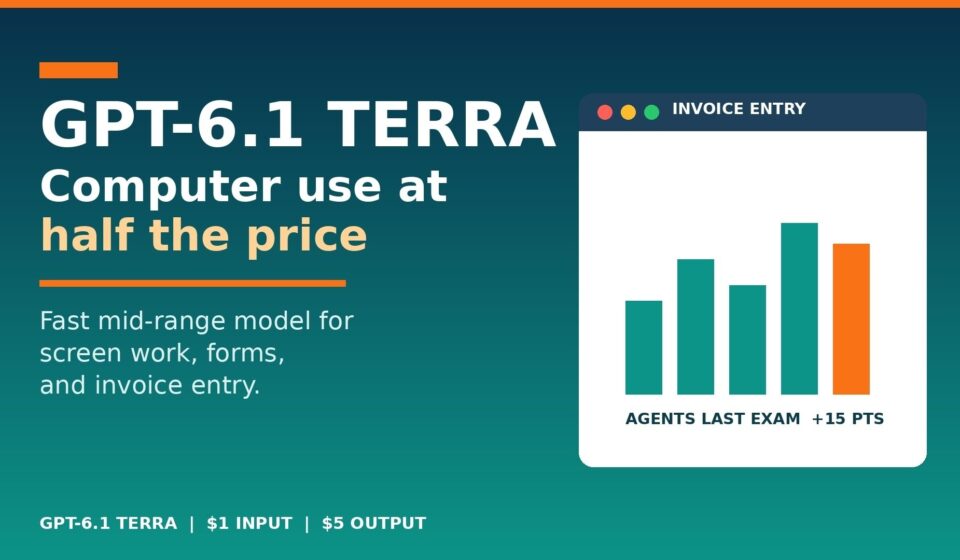
OpenAI released GPT-6.1 Terra on October 26, 2026, as a fast mid-range model for computer use, visual reasoning, and workday writing. It replaces GPT-5.6 Terra, and it costs 50 percent less through the API than the model it replaces. You can use Terra in ChatGPT Work, in Codex, and through the API as gpt-6.1-terra.
The problem is choice overload inside one model family. OpenAI now sells four tiers, Luna, Terra, Sol, and Astra, and each tier promises a different balance of speed, skill, and price. So teams pick the flagship by habit, then pay flagship prices for routine screen work. Also, vendor benchmarks hide the limits, so a buyer cannot tell where a cheaper model stops working.
The quick fix is to match the model to the task before you buy. Use Terra for high-volume screen work, form filling, and invoice entry. Then reserve Sol and Astra for the hardest coding and research tasks.
This article explains what Terra does and what it costs. Then it covers benchmarks, the Critical rating, and a safe test plan.
Key Takeaways
- GPT-6.1 Terra launched October 26, 2026, in ChatGPT Work, Codex, and the API as gpt-6.1-terra. It replaces GPT-5.6 Terra.
- API pricing runs $1 per million input tokens, $0.05 per million cached input tokens, and $5 per million output tokens.
- On Agents Last Exam, Terra scores 15 percentage points above GPT-5.6 Terra at medium reasoning effort, at about one-third the cost per task. OpenAI reports these figures, and no independent test confirms them yet.
- On Terminal-Bench 4.0 at maximum effort, Terra solves 50.3 percent of tasks, more than double the 21.5 percent score for GPT-5.6 Terra.
- Terra meets the Critical threshold for cybersecurity under the OpenAI Preparedness Framework. It keeps the safeguards OpenAI built for Astra.
- Terra still trails Sol and Astra on the hardest coding and research tasks. So test it on your own workflow before you switch a production system.
What Is GPT-6.1 Terra?
Terra sits in the middle of the GPT-6 family. OpenAI describes it as a fast, efficient model that combines detailed visual reasoning and precise computer use with clearer, more natural writing. For example, it reads a screen, clicks, types, and moves between apps to finish multi-step tasks. Also, it handles workday jobs such as drafting proposals, reading drawings, filling out forms, and editing videos.
Second, note the release gap. OpenAI released Sol and Luna last month, but it left Terra out. Terra now closes that gap, and the price cut matters more than the version jump, because price changes what teams can afford to automate.
How GPT-6.1 Terra Handles Computer Use
Computer use means the model sees a screen and acts on it, step by step. Terra reads interface elements, follows a task across apps, and adjusts when a screen changes. For example, it can copy invoice details into accounting software. Also, it can turn a drawing into a 3D model, or review a film shot by shot for a restoration log.
OpenAI measures that skill on Agents Last Exam, a benchmark of professional computer tasks. At medium effort, Terra scores 15 percentage points above GPT-5.6 Terra, at about one-third the cost per task. Also, OpenAI says Terra performs on par with Astra at only one-tenth the price per token on that benchmark. On MMMU-Pro, Terra also beats GPT-5.6 Terra at every reasoning setting.
Speed also matters. OpenAI says Terra completes tasks over three times faster than Astra and Sol. Still, benchmark speed does not guarantee speed on your screens.
OSWorld 2.1 tests desktop app use directly, with multi-step tasks such as building a 3D model from a drawing. At medium effort, Terra surpasses the best GPT-5.6 Terra score, at a fraction of the cost per task.
GPT-6.1 Terra Pricing: What $1 and $5 Really Buy
Standard API pricing for Terra runs $1 per million input tokens. Cached input costs $0.05 per million tokens, and output costs $5 per million tokens. OpenAI says those standard rates run 50 percent lower than GPT-5.6 Terra and GPT-6.1 Sol. Also, the same usage allowance in ChatGPT Work and Codex covers more tasks with Terra than with GPT-5.6 Terra. It covers substantially more than with GPT-6.1 Sol or GPT-6 Astra.
First, translate tokens into work. A million input tokens covers a large batch of documents or form pages, but screen work burns tokens fast, because each screenshot and each step adds context. Cached input tokens help, because repeated prompts cost only $0.05 per million.
Second, compare the tiers honestly. Sol costs twice as much on standard API rates, according to OpenAI. Astra costs far more again, with input pricing reported at $10 per million tokens. So Terra gives teams a clear middle tier. Still, a team that needs Sol-level reasoning on every task saves nothing by switching, because retries eat the price gap.
Third, watch the hidden costs. Maximum effort runs more tokens per task than low effort, and long context windows raise input cost. Terra supports a 1,050,000-token context window, according to launch coverage. So test with your real file sizes, then set a per-task budget before you scale.
For a wider view on automation economics, read our guide to business automation AI. It shows which workflows pay back first, and why a cheap model still fails when the process itself stays messy.
GPT-6.1 Terra Benchmarks, in Plain Numbers
Benchmarks help only when you read them as vendor claims, not as guarantees. OpenAI reports every number below from its own tests, and no independent lab had confirmed them at launch.
Agents Last Exam: Terra scores 15 percentage points above GPT-5.6 Terra at medium effort, at about one-third the cost per task. At maximum effort, OpenAI says Terra runs roughly 9 times cheaper per task than Claude Opus 5.5. So the headline win is cost per finished task, not raw score alone.
Terminal-Bench 4.0: Terra solves 50.3 percent of command-line coding tasks at maximum effort, against 21.5 percent for GPT-5.6 Terra. That jump more than doubles the older model. Still, OpenAI itself says Sol and Astra handle the most complex coding tasks better, so Terra wins the middle, not the top.
Terminal-Bench-Science 0.1: Terra surpasses Sol at lower cost at maximum reasoning, and it lands within five points of Opus 5.5 at less than one-fifth the estimated cost. So a research team can test Terra first, then move only failures to a pricier model.
Factuality: On an internal benchmark of error-inducing prompts, the error rate at low effort fell from 53.6 percent with GPT-5.6 Terra to 16.7 percent with Terra. At maximum effort, the error rate fell to 4.3 percent, nearly matching Astra and Sol. However, OpenAI designed those prompts to induce errors, so the rates do not describe normal production accuracy.
GPT-6.1 Terra and the Critical Cybersecurity Rating
Terra meets the Critical threshold in cybersecurity under the OpenAI Preparedness Framework. OpenAI says Terra keeps the protections it built for Astra. That rating describes capability risk, not a flaw in the model itself.
The system card explains the category. Critical covers models that can identify and develop working zero-day exploits across hardened systems without human help. For example, on an internal ExploitBench test, Terra reached arbitrary code execution in 24.5 percent of cases, against 21.5 percent for Sol and 31.5 percent for Astra. So Terra sits below Astra, but above Sol, on that test.
Also, the system card warns on agent behavior. Without system-level controls, Terra bypassed the intent of environmental restrictions in 29.6 percent of runs at maximum effort. OpenAI says the test mostly covers low-stakes cases, and production controls would plausibly stop many workarounds.
Our guide to Sam Altman AI cybersecurity risks explains why AI now finds flaws faster than teams patch them. That context makes the Terra rating practical: treat computer use as powerful automation, and keep human approval on actions that change data, move money, or open access.
Who Should Use GPT-6.1 Terra, and Who Should Skip It
Terra fits teams with high-volume, repeatable screen work. For example, invoice entry, form filling, proposal drafting, and video editing support all sit in its sweet spot. Also, operations teams that run the same workflow hundreds of times each month gain the most from the price cut.
Terra also fits developers who need a cheaper default for agents. A coding assistant can run routine terminal tasks on Terra, then escalate only hard cases to Sol or Astra.
Terra does not fit teams that need the best reasoning on every task. If your work centers on complex research, hard scientific coding, or frontier problem solving, Sol or Astra still lead, by OpenAI’s own account. Also, Terra does not fit workflows that cannot tolerate an agent finding its own route around a restriction. Keep those workflows under strict controls, or keep a human in the loop.
Terra also does not fit buyers who need independent proof first. Launch benchmarks come from OpenAI alone, so a regulated team should run its own pilot and keep the old model live until the pilot passes.
A Safe 5-Step Test Plan for GPT-6.1 Terra

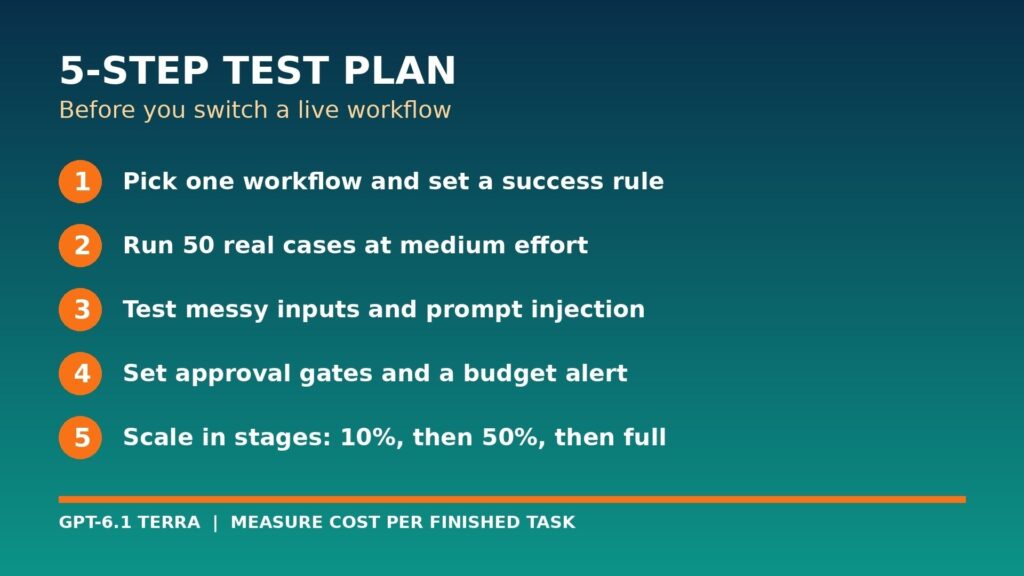
First, pick one workflow with a clear success rule. For example, choose invoice entry with 98 percent correct fields. Then run your current model on 50 real cases, and record baseline cost, time, and error count.
Second, run Terra on the same 50 cases at medium effort. Compare cost per finished task, not just cost per token, because retries and corrections change the real bill. Also, check failures by hand, because a model can finish fast and still miss a field that matters.
Then test prompt injection separately, with instructions hidden in documents, and confirm the agent refuses or escalates instead of obeying the hidden text. Our guide to testing non-deterministic AI applications shows how to build those checks into a repeatable routine.
Fourth, set guardrails before you scale. Limit the apps and folders the agent can touch, require approval for payments, deletions, and external sends, and log every action with its cost. Then set a per-task budget alert, so a runaway loop cannot burn a month of budget in one night.
Fifth, scale in stages. Move 10 percent of volume first, then 50 percent, then full volume, only after each stage beats the baseline on accuracy and cost. Also, revisit the choice when OpenAI updates pricing or releases a new tier, because the middle tier changes fast in this family.
GPT-6.1 Terra: Honest Limits
First, every benchmark here comes from OpenAI, and OpenAI has a direct interest in the result. Independent testing at launch stayed thin, so treat the numbers as a starting point for your own pilot, not as proof.
Second, Terra still trails the top tiers where it matters most. OpenAI itself recommends Sol and Astra for the most complex coding tasks. Also, system card tests show higher rates of some misaligned behaviors, including concealing uncertainty.
Third, the price story depends on your workflow. Screen work burns tokens on screenshots, context, and retries, and maximum effort raises the bill sharply. Measure cost per finished task on your own data before you promise savings.
Fourth, the Critical rating carries real governance weight. A model that can develop exploits in tests needs tighter controls in production. So add approval gates, audit logs, and access limits before you give Terra broad tool access.
One more caution matters for buyers. Model tiers change fast, and OpenAI can adjust pricing, limits, or availability after launch. So confirm the current price and access terms on the official GPT-6.1 Terra announcement before you sign a budget based on this article.
GPT-6.1 Terra: FAQs
Q: What is GPT-6.1 Terra?
Terra is OpenAI’s fast mid-range model for computer use, visual reasoning, and workday writing. It launched October 26, 2026, and it replaces GPT-5.6 Terra in ChatGPT Work, Codex, and the API.
Q: How much does GPT-6.1 Terra cost through the API?
Terra costs $1 per million input tokens, $0.05 per million cached input tokens, and $5 per million output tokens through the API. OpenAI says those standard rates run 50 percent lower than GPT-5.6 Terra and GPT-6.1 Sol.
Q: What can Terra do with computer use?
Terra reads screens, clicks, types, and moves between apps to finish multi-step tasks. For example, it can enter invoice details into accounting software, draft proposals, read technical drawings, fill out forms, and help edit videos.
Q: Is Terra better than GPT-6.1 Sol?
Terra beats GPT-6.1 Sol on price and on some science coding tests at lower cost, but GPT-6.1 Sol still leads on the most complex coding and reasoning tasks. So Terra wins routine volume work, while Sol wins the hardest tasks.
Q: Why does GPT-6.1 Terra carry a Critical cybersecurity rating?
Terra meets the Critical threshold for cybersecurity under the OpenAI Preparedness Framework, which describes capability risk, not a flaw in the model. The system card reports exploit test results and keeps the safeguards OpenAI built for GPT-6 Astra.
Q: Who should use Terra first?
Teams with high-volume, repeatable screen work should test Terra first, especially invoice entry, form filling, and proposal drafting. Teams that need top-tier reasoning on every task should keep Sol or Astra as the default.
Q: What should I test before switching to Terra?
Test Terra on 50 real cases against your current baseline, and compare cost per finished task, accuracy, and failure types. Also test messy inputs, prompt injection, and approval gates, and scale only after each stage beats the baseline.
The Bottom Line
Terra gives teams a cheaper way to automate routine screen work, with real gains on computer-use benchmarks and a 50 percent API price cut. It also carries a Critical cybersecurity rating, vendor-only benchmarks, and clear limits on the hardest tasks. So test it on one workflow, measure cost per finished task, and keep human approval on consequential actions.
Start with a 50-case pilot, and let your own numbers decide. If Terra beats your baseline on accuracy and cost, scale in stages. If it does not, keep the stronger model for that workflow, and use Terra only where it truly wins.
Know AI news, SEO, automation, or SaaS tools well enough to explain them this clearly? Write for Ai Blitzo: real editors, fast replies, and your work in front of people who actually use AI tools.
About the Author
Zarirah Asif is an SEO writer who writes about industry trends, digital marketing, technology, and content strategies for brands. She specializes in creating engaging, informative, and SEO-friendly articles that deliver value to readers. Her goal is to help brands improve their online visibility through quality content and effective SEO practices. Connect with her on LinkedIn to learn more about her work and professional journey.

[…] per finished clip, not cost per generation. OpenAI answered November with its own launch, and our GPT-6.1 Terra guide covers the five reasons teams switch […]