
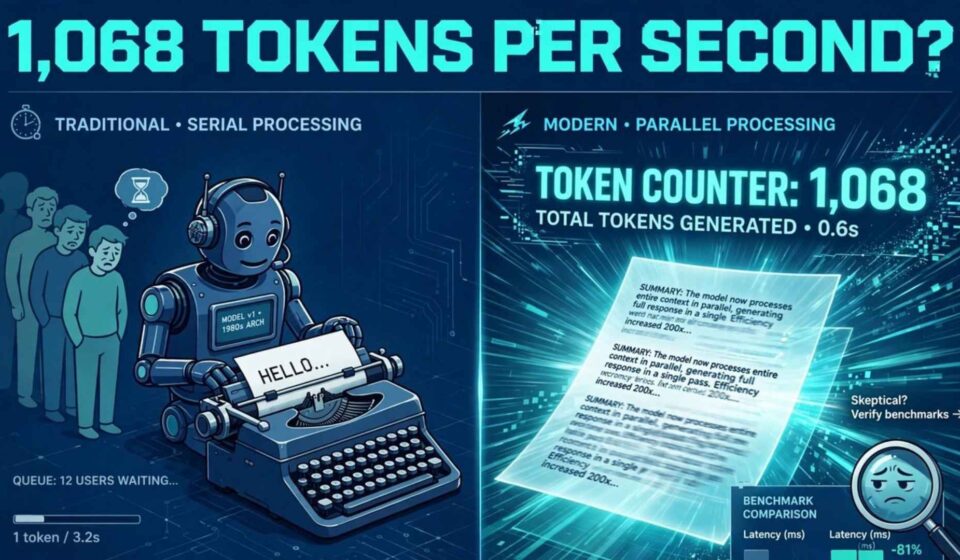

Quick answer. Inception Mercury 3 is a diffusion LLM. It writes whole drafts at once instead of one token at a time. Inception claims 1,068 tokens per second, with wins over Claude Haiku 5.5. Those benchmark wins, however, are the company’s own numbers. The pricing verdict is simpler. At the half price launch rate, Mercury 3 costs about 17% less per finished task than Haiku 5.5. At standard rates, however, it costs about 67% more. Therefore, by the end of this guide, you will be able to check the cost per task yourself. You will also be able to judge the speed claims and decide whether to try it or wait.
What Inception Mercury 3 Actually Is?
Inception Labs is a Redwood City startup founded by Stanford researcher Stefano Ermon, together with Volodymyr Kuleshov and Aditya Grover. The company has one central bet: language models do not have to write one word at a time. Mercury 3, launched on October 20, 2026, is its flagship attempt to prove that bet at real scale. According to the official Mercury 3 launch announcement, the model is more than 40 times larger than Mercury 1. In addition, its context window rises to 1 million tokens. That is up from 260,000 tokens on Mercury 2.5.
The launch facts that matter for buyers are simple:
- It is a diffusion based large language model, not an autoregressive one.
- Inception reports generation at 1,068 tokens per second on NVIDIA GPUs.
- The context window is 1 million tokens.
- It is available through the Inception API, OpenRouter, Baseten, and Vercel.
- The API is OpenAI compatible, and the model string is mercury-3, so switching is mostly a configuration change.
- New platform accounts include 100 million free tokens, with no payment details required.
In addition, Inception launched two sibling products: Mercury Voice for voice agents and Mercury Decide for classification work. Meanwhile, Mercury 2 and Mercury 2.5 are now closed to new users. Existing users, however, keep access only until November 15, 2026. That is what the Unite.AI coverage of the Mercury 3 launch notes. That sunset matters for anyone building on a small platform, and we will come back to it below.
The company behind the model is not a hobby project, either. Inception is backed by Menlo Ventures, Mayfield, and M12, Microsoft’s venture fund, and its individual backers include Andrew Ng, Andrej Karpathy, and Eric Schmidt. That backing does not prove the technology, of course. It does, however, explain why a small lab can afford to give away 100 million tokens per account. It also explains how the lab sustains a launch discount while it hunts for users.
How Inception Mercury 3 Works: Diffusion vs Autoregressive?
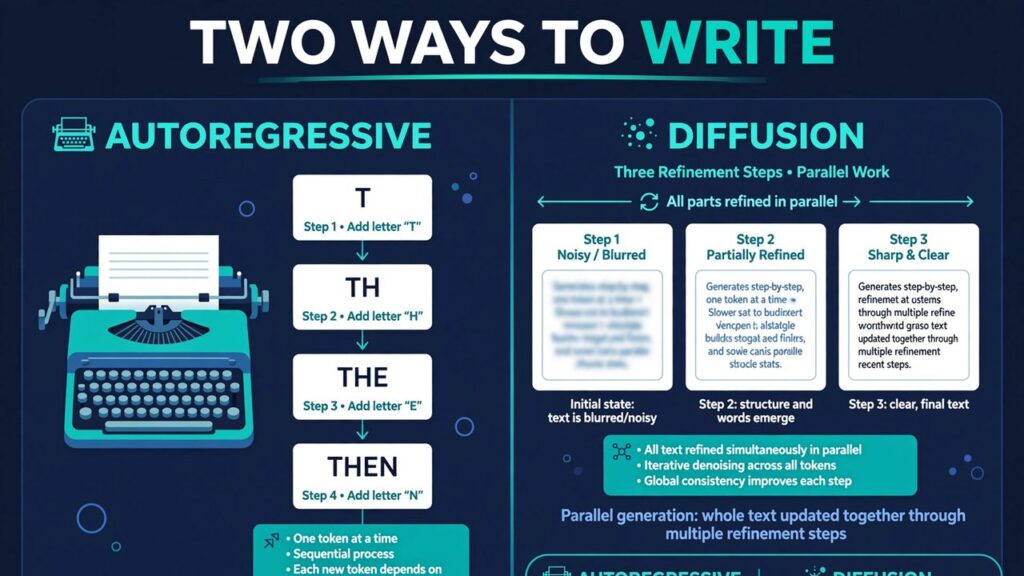
Almost every model you use today is autoregressive. ChatGPT, Claude, Gemini, and the models in our Moonshot AI and Kimi explainer all write the same way. They write one token, then the next. Each token is conditioned on everything before it. The sixth word cannot start until the fifth word exists. That design is reliable, however, it is also a speed limit built into the architecture itself.
A diffusion language model works differently. Instead of writing left to right, it starts with a rough, partly masked draft of the whole answer. It then refines every position in parallel over a small number of steps. Image generators, similarly, use the same coarse to fine process to turn noise into a picture. As a result, hundreds of tokens move toward their final form at the same time. Inception calls this parallel token generation. It is the entire reason Mercury 3 can post a number like 1,068 tokens per second. Comparable small models, meanwhile, post only a few hundred.
There are trade-offs, of course. A diffusion model spends its compute on refinement steps, so Inception exposes a reasoning_effort setting that trades speed against care on harder prompts. Furthermore, the approach is young at this scale. Mercury 1 was a proof of concept. Mercury 3, notably, is the first version claiming parity with mainstream small models. Whether the quality holds on your workload, therefore, is an empirical question, not a settled one.
The Benchmark Claims, Read With Care
Inception says Mercury 3 beats GPT-6 Luna and Claude Haiku 5.5, and the company published its numbers. In Inception’s own testing, the model leads on 8 of 12 benchmarks against those two rivals. That testing is covered in detail by MarkTechPost’s technical breakdown of Mercury 3. The standout scores are SWE-Bench Atlas at 51.08 and IFBench at 76.84, and GPQA Diamond is also listed among the wins. For wider context on the GPT-6 family, see our GPT-6 Astra guide.
However, the same table shows where Mercury 3 loses. Haiku 5.5 still wins DeepSWE v1 and MRCR v2, and MRCR v2 is specifically a long context retrieval test. In other words, the claim that Mercury 3 beats Haiku is true on most of Inception’s chosen tests and false on a few important ones. Notably, every one of these numbers comes from Inception’s own runs. No independent lab had replicated them at the time of writing.
“It’s getting 1,000 tokens per second. It’s almost instant in the way you get answers from these models.” (Stefano Ermon, Inception CEO, describing Mercury 3 at launch)
We have seen this launch pattern before, for example in our Elorian Glimpse vs GPT-6 Astra coverage. A new model arrives with vendor benchmarks first. Independent tests follow weeks later. Treat the scores, consequently, as a strong claim worth testing on your own work, not as a verdict.
One more claim deserves a note. Inception says Mercury 3 is more than 40 times larger than Mercury 1. Benchmark intelligence also roughly tripled between Mercury 1 (mini) and Mercury 3. Speed, meanwhile, stayed above 1,000 tokens per second. If that scaling story is real, diffusion models improve with size the same way autoregressive models do. For now, notably, the parameter count itself is undisclosed, so this claim rests on the company’s own reporting, like everything else in this section.
Inception Mercury 3 Pricing vs Claude Haiku 5.5: The Cost per Finished Task
Here is the Inception Mercury 3 pricing, side by side, per million tokens:
- Mercury 3 standard price: $0.20 input and $0.70 output.
- Mercury 3 launch price: $0.10 input and $0.35 output, which is 50 percent off, with no published end date.
- Mercury 3 cached input: $0.02 at standard rates and $0.01 during the launch.
- Claude Haiku 5.5: $0.10 input and $0.50 output for prompts up to 100K tokens, then $0.50 input and $2.50 output above 100K tokens.
We priced Anthropic’s model in full in our Claude Haiku 5.5 pricing and benchmarks breakdown. That breakdown includes its 100K price cliff. That cliff, notably, becomes important below.
Per token prices, however, are not what you actually pay. You pay per finished task. Take a typical support or drafting task with 2,000 input tokens and 500 output tokens:
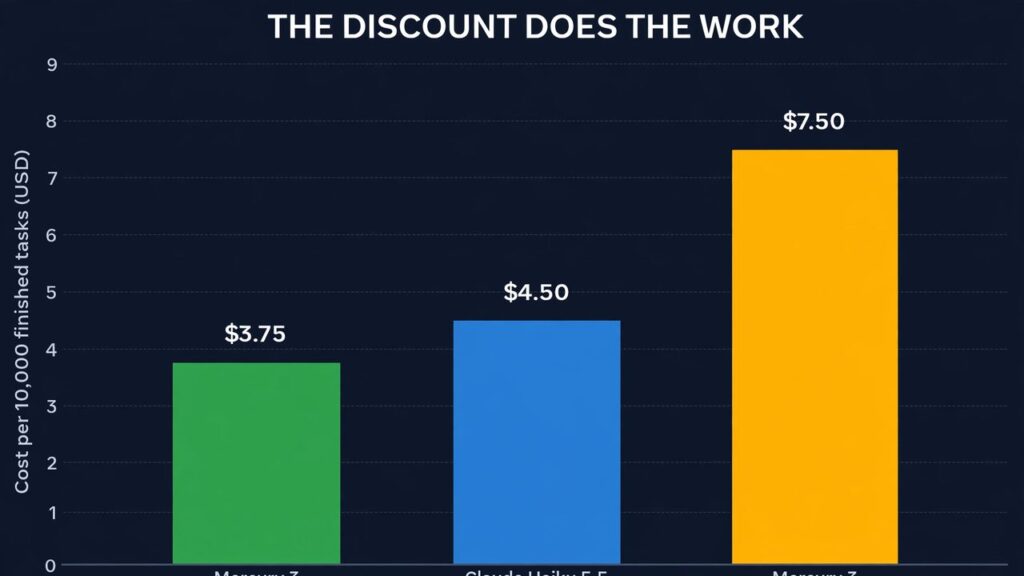
- Mercury 3 at launch pricing costs $0.000375 per task, so 10,000 tasks cost $3.75.
- Claude Haiku 5.5 costs $0.00045 per task, so 10,000 tasks cost $4.50.
- Mercury 3 at standard pricing costs $0.00075 per task, so 10,000 tasks cost $7.50.
At launch pricing, therefore, Mercury 3 is roughly 17 percent cheaper per task than Haiku 5.5. At standard pricing, it is roughly 67 percent more expensive per task. The discount, in short, is doing most of the work in the value story, and any honest comparison has to say so.
The math flips for long documents, however. Cross 100K tokens of input and Haiku 5.5 reprices the entire request at the higher tier. A 200,000 token document with a 1,000 token summary costs about $0.103 on Haiku 5.5. The same job costs about $0.041 on Mercury 3 at standard rates, and about $0.020 at launch rates. For document heavy work, consequently, Mercury 3 is the cheaper option even after the promotion ends.
One more caveat matters. Models do not use tokens identically. Our Haiku 5.5 analysis, for example, noted independent findings that Haiku can burn more output tokens per task than its rivals. That, consequently, raises its real cost per task. Mercury 3’s token appetite on real work is unmeasured so far. Similarly priced speed models, such as GLM 5.3 Flash and DeepSeek V4.1 Flash, deserve a lane in any serious test. Measure cost per finished task on your own prompts, specifically, before moving real volume to any of them.
Where the Speed Actually Pays Off ?
Speed is not a vanity metric when a person or a program is waiting on the answer. At 1,068 tokens per second, a 500 token answer finishes generating in about half a second. A speed tuned autoregressive rival at roughly 200 tokens per second needs about 2.5 seconds for the same answer. In a chat window, moreover, that gap is the difference between a tool that feels instant and a tool that feels like it is loading.
Agent loops multiply the gap further. Take a research or coding agent that makes 20 sequential calls of 500 tokens each. It spends about 9.4 seconds generating on Mercury 3. At 200 tokens per second, however, the same agent spends about 50 seconds. As a result, agents finish sooner and can try more approaches inside the same time budget. This is also why live products feel different with a fast model underneath. Our Muse Spark Open guide covered the same lesson from the interface side.
Early customer stories point the same way. Inception’s launch material quotes an education company, RevisionDojo. It says hints and marked answers now return in about a second. Quality, moreover, matches the models the company used before. MarkTechPost, moreover, notes that support platform Lorikeet found Mercury 3 ahead on latency and evaluations for support agents. These are launch testimonials, however, so treat them as leads rather than proof. They do show exactly the workloads where a sub-second answer changes the product: tutoring, support, and live assistance.
On the other hand, speed does not repair a wrong answer. If a model misunderstands the task, it simply misunderstands faster. Latency matters most, therefore, where the task is well defined and the volume is high. It matters most, specifically, when someone is actively waiting on the answer. Support chats, live writing tools, voice interfaces, and agent steps are the natural home for a model like this.
Who Should Try Mercury 3, and Who Should Wait ?
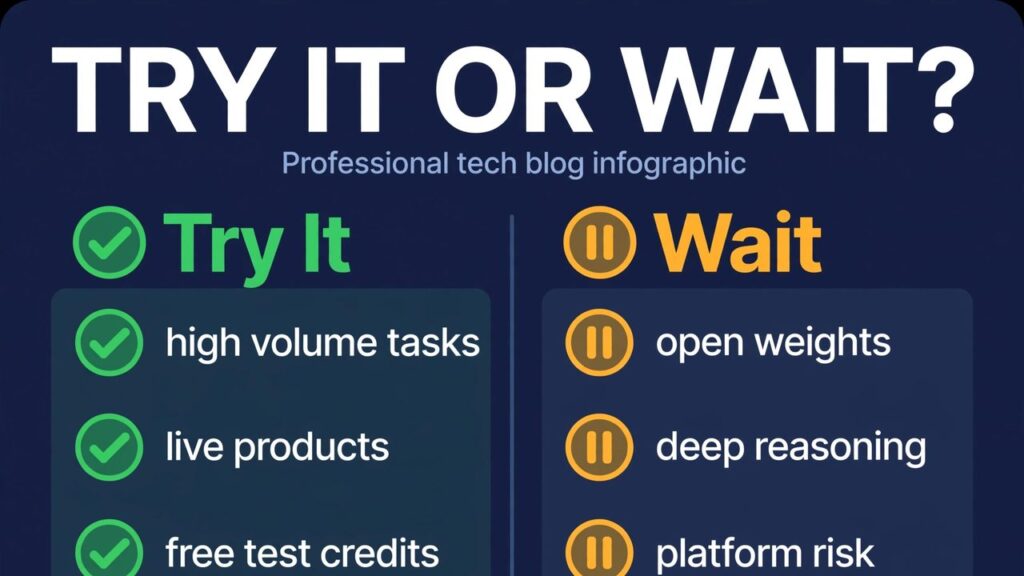
The honest answer depends on your workload. Specifically, three groups should test Mercury 3 this week:
- Freelancers and small teams running support replies, classification, or summarization at volume. As a result, the launch price and the 100 million free tokens make the test nearly free.
- Builders whose products make users or agents wait on model calls, because latency is the one advantage rivals cannot copy with a price cut.
- Marketers producing high volumes of short drafts and variants. We applied that same volume logic, for example, in our Kling 4.0 vs Veo 3.1 comparison for video generation.
Three other groups should wait, instead:
- Anyone who needs open weights. Mercury 3 is API only, and its weights are not open, so self hosting is not an option today.
- Teams whose hardest work is deep, multi step reasoning. Flagship models still own that tier, as our Muse Wonder vs Claude Opus 5.5 comparison shows. Haiku 5.5 itself, moreover, still wins specific long context tests against Mercury 3.
- Anyone deeply locked into a small platform’s road map. The Mercury 2 sunset on November 15, 2026 is a fair reminder that young platforms retire products quickly.
What Is Still Marketing ?
Four parts of the launch story deserve a raised eyebrow:
- The benchmark table is vendor run and unreplicated, and it naturally emphasizes the tests Mercury 3 won.
- The launch discount has no published end date, so the attractive price may be temporary by design.
- The 1,068 tokens per second figure is measured on Inception’s own serving setup, and your latency through a third party host will vary.
- The size claim is relative: 40 times larger than Mercury 1 sounds dramatic, but Inception has not disclosed the actual parameter count.
On the discount, specifically, CEO Stefano Ermon told The Deep View’s analysis of Mercury 3 economics that he hopes to make the launch price permanent. A hope, however, is not a pricing commitment, and budgets should be planned at the standard rate until it becomes one. None of this makes Mercury 3 a bad product. Ultimately, it is a new product, and new products earn trust through independent testing and, furthermore, through your own results.
Conclusion: What Changes Now ?
One thing has genuinely changed: diffusion is no longer a research curiosity. A diffusion model now sits in the same price tier as Claude Haiku 5.5 and GPT-6 Luna. Its speed advantage is architectural rather than cosmetic. Whether it keeps that seat depends on independent benchmarks and on real world token usage. It also depends, ultimately, on whether the standard price still looks fair once the launch discount ends.
Do the cheap experiment first. Inception gives new accounts 100 million free tokens. Run your 20 hardest real tasks on Mercury 3 and Haiku 5.5 side by side. Then compare cost per finished task and answer quality before you switch anything. Meanwhile, browse our best AI tools in 2026 roundup for the other models worth testing this month. And keep following aiblitzo. We will publish our own Mercury 3 task tests as soon as independent numbers land.



[…] On the other hand, it also changes your budget math, because attention has a meter now. Our recent Inception Mercury 3 breakdown made the same point about models: the honest number is always cost per finished […]