
If you’ve searched for how to rank in ChatGPT, you’ve probably already read three articles that told you to “optimize your content” and “add schema markup” without explaining why any of that works, or whether it actually does.
This guide is different. It walks through how ChatGPT actually decides what to cite, why most advice online is half-right at best, and what the evidence shows moves the needle. By the end, you’ll know exactly what to fix on your site first, what to ignore, and how long to expect results to take.
Quick Answer: To rank in ChatGPT, fix five things: write specific (not generic) content, add FAQ Page/How To schema, keep pages updated, earn real external mentions of your brand, and structure each page so its core answer can be lifted in one paragraph. There’s no fixed position to climb, only a higher likelihood of being cited.
Key Takeaways
- ChatGPT has no ranking position: it either cites you or it doesn’t, based on pattern-matching, not a list.
- Two separate systems decide visibility: frozen training data and live web search (Track 1 and Track 2).
- Generic, unstructured content is the #1 reason sites never get cited.
- You cannot pay for ChatGPT placement; you can only invest in PR or content that increases organic mentions.
- The same fixes improve visibility across ChatGPT, Perplexity, and Google AI Overviews at once.
What “Ranking” in ChatGPT Actually Means (And Why It’s Not Like Google)
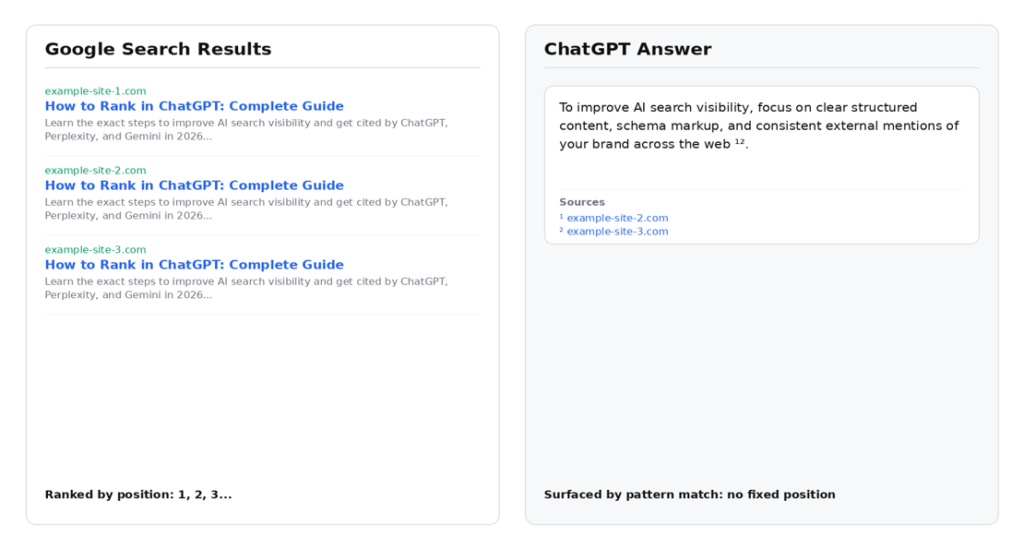
Google ranking is a position. ChatGPT ranking isn’t: there’s no list, no #1 spot, no SERP to climb. Understanding that difference changes how you should think about AI search visibility from the start.
Mentions vs. Citations: The Distinction Nobody Explains Clearly
Most guides use “ranking,” “mentioning,” and “citing” interchangeably. They’re not the same thing:
- A mention is ChatGPT naming your brand or product in an answer, with or without a link.
- A citation is ChatGPT linking directly to your page as the source of a claim.
You can get mentioned constantly and still send zero traffic, because most brand mentions vs citations never include a link at all. If your goal is traffic, citations are the real target; mentions alone are closer to brand awareness.
Why “Position #1” Doesn’t Exist in ChatGPT
ChatGPT is powered by a large language model (LLM), not an index you climb. It generates an answer from a mix of what it learned during training and, when needed, live results it pulls in real time. There is no fixed ranking to reverse-engineer, only patterns that make a source more or less likely to get pulled into that answer.
How ChatGPT Actually Decides What to Cite
This is the part almost every guide skips, and it’s the part that actually matters.
Training Data Knowledge vs. Live Web Search: The Two-Track System
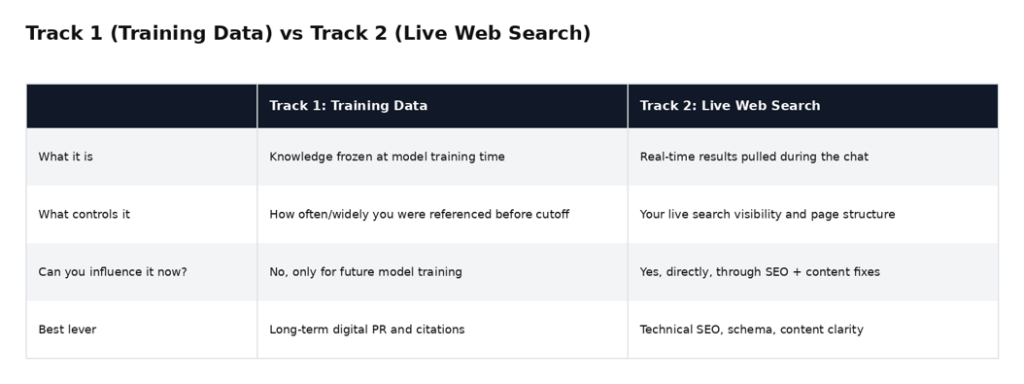
ChatGPT operates on two separate tracks:
1. Training data: facts and patterns learned during model training, frozen at a point in time.
2. Real-time web search: when a question needs current information, ChatGPT rewrites your prompt into search queries and pulls live results, closer to how a search engine works.
If your site launched after the model’s training cutoff, or has almost no footprint anywhere else online, you don’t exist on Track 1. Your only way in is Track 2, which means live search visibility still matters, a lot.
How a Prompt Gets Rewritten Into Search Queries Behind the Scenes
When someone asks a conversational search query like “what’s a good tool for tracking AI mentions,” ChatGPT doesn’t search that sentence verbatim. It breaks the intent down into more specific, Google-style queries, runs those, and then synthesizes an AI-generated answer from whatever ranks well enough to surface.
This is why traditional search visibility isn’t optional: it’s the raw material Track 2 pulls from.
Why Your Website Isn’t Showing Up Yet
If you’ve asked ChatGPT about your own niche and gotten silence, one or more of these is almost always the reason.
Thin or Generic Content (No Original Insight)
Topical authority isn’t built by covering a topic: it’s built by saying something about it that isn’t a rewrite of what’s already out there. Generic advice content is the single biggest reason sites get skipped, because the model has ten other sources saying the same thing, often with stronger E-E-A-T signals.
No Structured Data or Unclear Headings
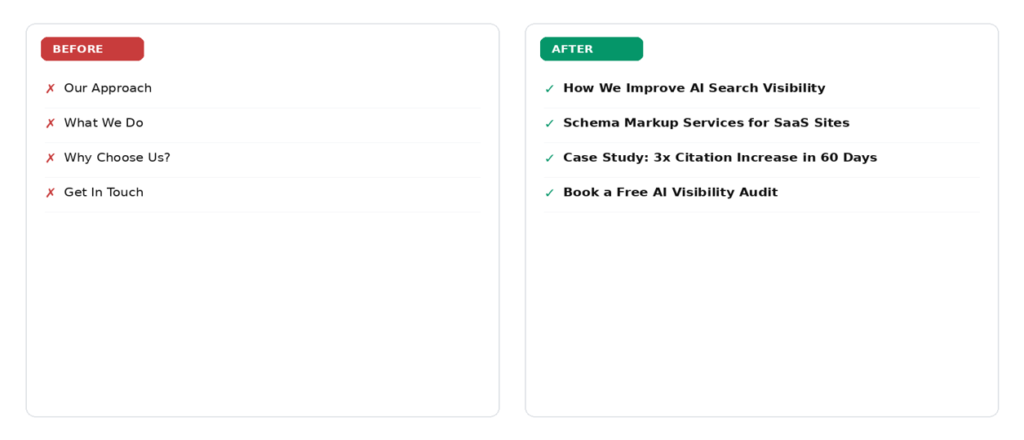
Vague headings like “Our Approach” or “What We Do” give both crawlers and language models nothing to latch onto. Descriptive, specific structured data and headings do the opposite: they act as labeled data points a model can extract cleanly.
Low or No External Authority Signals
Crawlability and a clean robots.txt matter, but they only get you found; they don’t get you trusted. If nothing on the wider web references you, you’re invisible to the pattern-matching that drives Track 1, and thin on the credibility signals that help Track 2.
This also connects to a slower, related trend: zero-click search and organic traffic decline are already reshaping how much value a “ranking” even delivers, which is exactly why AI visibility is becoming its own line item instead of an SEO afterthought.
The 5 Data Points: What Actually Moves the Needle
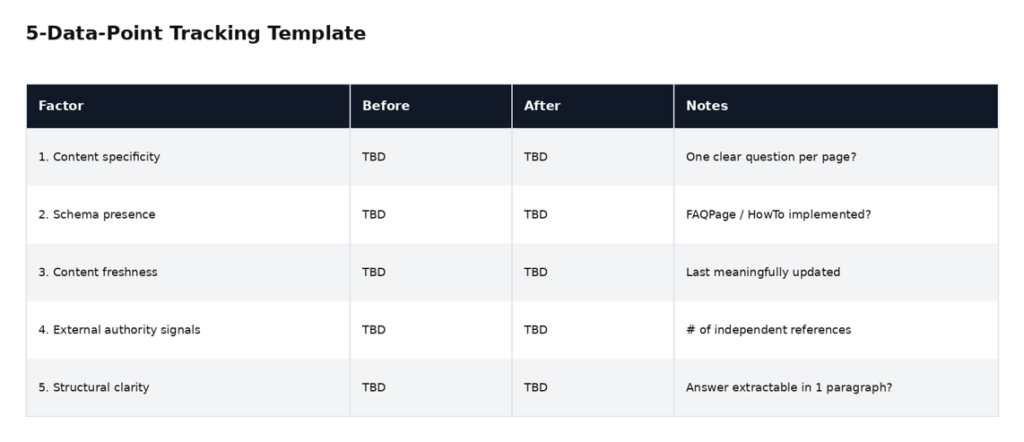
Here’s where most content in this space goes generic. Instead of recycled advice, test these five factors directly against your own site before you assume any of them apply:
1. Content specificity: does the page answer one clear question, or several vaguely?
2. Schema presence: is structured markup actually implemented, not just planned?
3. Content freshness: when was the page last meaningfully updated, not just re-saved?
4. External authority signals: how many independent sources reference this page or brand?
5. Structural clarity: can the page’s core answer be extracted in one paragraph?
Note before you publish: treat this as your testing framework, not a finished study. Run your own pages through these five factors, track what changes when you fix each one, and replace this section with your actual findings. That’s what turns this from “another advice post” into original research, which is the single biggest differentiator available in this space right now.
The Technical Checklist: Schema, Structure, and llms.txt
Once you know what’s missing, here’s what to actually implement.
FAQ Page and How To Schema: Where They Matter Most
FAQ Page schema and How To schema help structure content into question-and-answer or step-by-step formats models can parse cleanly. They won’t force a citation, but they make your content easier to lift accurately when it is used.
What llms.txt Does (and Doesn’t Do): Most Guides Oversell This
llms.txt is a proposed standard, not an official OpenAI or Google requirement, that lets you point AI crawlers toward your most important content in a simple, readable file, similar in spirit to robots.txt. You can read the original proposal at llmstxt.org.
Be clear-eyed about it: no major AI platform has confirmed it uses llms.txt to influence citations. It’s worth adding because it’s cheap and forward-looking, not because it’s a guaranteed visibility lever.
Internal Linking and Content Clusters
Group related pages into content clusters with clear internal linking between them. This helps both traditional crawlers and models understand which pages are authoritative on a given subtopic, rather than treating each page as an isolated island.
See our complete llms.txt setup guide for the exact file structure to use.
Building Authority AI Models Actually Trust
Digital PR and Guest Posts That Actually Get Cited Elsewhere
Digital PR and guest posting work here for the same reason they work in SEO, but with a twist. It’s not just about the backlink. It’s about your name and claims appearing on sites the model already treats as credible, reinforcing expert commentary and a consistent backlink profile across the wider web.
Why One Great Page Beats Ten Mediocre Ones
A single, deeply specific page, with real numbers, a clear structure, and nothing generic, will outperform ten shallow posts covering the same ground. Depth reads as authority; volume without depth reads as noise.
Does Traditional SEO Still Matter? (Yes, Here’s Exactly How)
Generative Engine Optimization (GEO) and Answer Engine Optimization (AEO) are new terms, but they’re not a replacement for SEO; they’re layered on top of it.
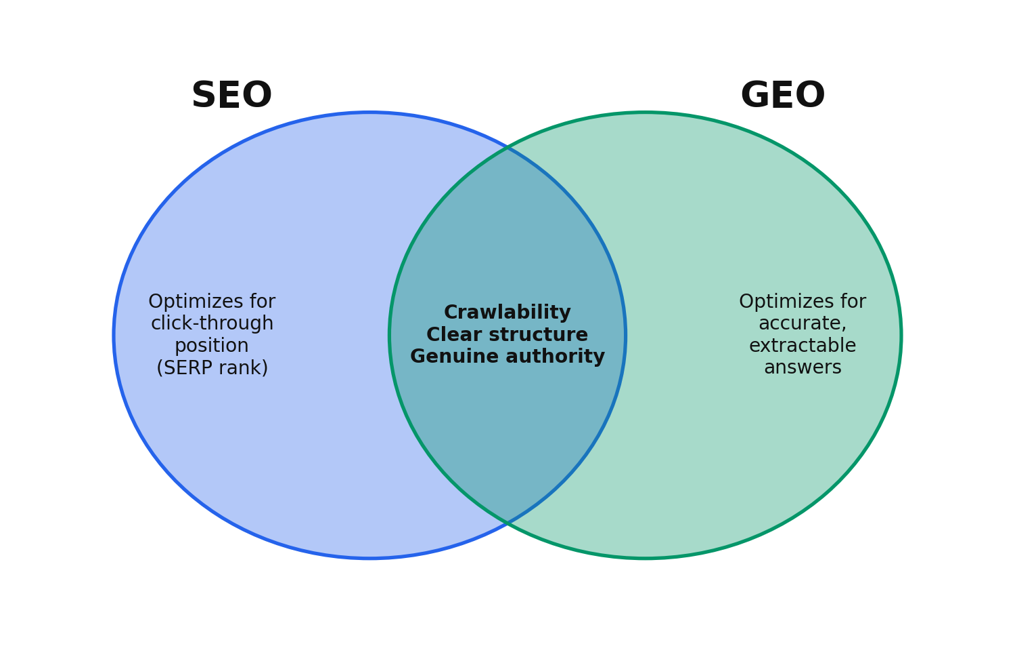
Where SEO and GEO Overlap
Both depend on crawlability, clear structure, and genuine authority. If your site doesn’t perform in a traditional search engine results page (SERP), it has a much harder time surfacing through Track 2’s live search step at all. Check your current technical health in Google Search Console before assuming the problem is AI-specific.
Where They Diverge, and Why You Need Both
SEO optimizes for clicks. GEO optimizes for being the accurate, extractable answer, even when no click happens. A page can rank #1 on Google and still never get cited by an AI model if it’s built for clicks (thin intro, ads, slow load) rather than clarity.
Ranking Beyond ChatGPT: Perplexity and Google AI Overviews Too
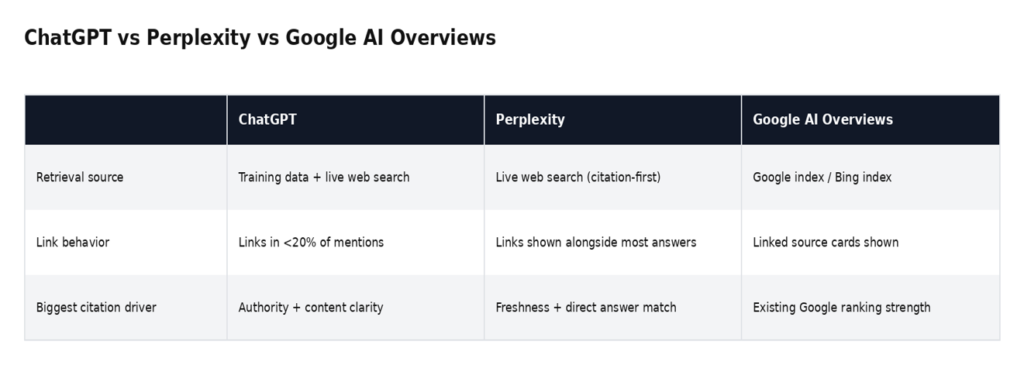
Most guides only talk about ChatGPT. Real search behavior doesn’t work that way anymore: people are asking the same question across Google AI Overviews, Perplexity, Google Gemini, and Microsoft Copilot in the same week.
What Changes (and What Doesn’t) Across Engines
The underlying requirement, clear, specific, well-structured, externally validated content, stays consistent everywhere. What changes is the retrieval mechanism: Perplexity leans heavily on live search citations, Google AI Overviews draws from Bing / Bing Search Index and Google’s own index depending on the surface, and Gemini pulls more directly from Google’s existing crawling infrastructure.
One Content Strategy, Three Visibility Surfaces
You don’t need a separate strategy per platform. Fix the same five data points above, and you improve your odds across all of them simultaneously, which is a far better use of limited time than chasing platform-specific tricks. For a narrower, blogger-focused version of this approach, see our guide to optimizing blog posts for ChatGPT search.
How to Check If It’s Working
Manual Prompt-Testing Method (Free, Do-It-Yourself)
Ask ChatGPT, Perplexity, and Gemini the exact questions your target audience would ask: not questions about your brand, but questions about the problem your brand solves. Track whether you appear, whether you’re linked, and how that changes month to month.
When a Paid Monitoring Tool Is Worth It
Once you’re tracking more than a handful of prompts across multiple engines, a dedicated AI visibility monitoring tools platform becomes worth the cost, mainly for consistency and historical tracking, not because manual checks stop working. We compare the leading options in our AI visibility monitoring tools roundup.
How Long This Takes, and Whether You Can Pay for Placement
Realistic Timeline Based on the Data Points Above
There’s no universal number, but a reasonable pattern: technical fixes (schema, structure) can show up in live search results within weeks. Training-data-level recognition, actually being “known” by the model, is slower and tied to how often you’re referenced elsewhere, often months rather than weeks.
Why You Cannot Pay for ChatGPT Placement
You cannot pay OpenAI, Google, or Perplexity for guaranteed citation frequency the way you can buy a search ad. What people sometimes mean by “paying for placement” is actually paid PR or sponsored content designed to increase organic mentions elsewhere: a legitimate tactic, but not a direct purchase of AI visibility. For a deeper breakdown of GEO versus classic SEO tactics, read our GEO vs SEO comparison.
FAQ
How is ranking in ChatGPT different from ranking in Google?
Google ranking is a position on a results page. ChatGPT visibility is the likelihood of being pulled into a generated answer; there’s no fixed list to climb.
Can I pay to get featured in ChatGPT results?
No. You can invest in PR and content that increases the odds of being referenced, but there’s no direct paid placement mechanism today.
What schema markup helps with AI search visibility?
FAQ Page and How to schema are the most directly relevant, alongside general structured data that clarifies what a page is actually about.
How long does it take to start appearing in ChatGPT answers?
Technical improvements can affect live search results within weeks; broader model-level recognition typically takes longer.
Do backlinks matter for AI search visibility?
Yes, they remain one of the clearest external signals of authority, for both traditional SEO and AI-driven visibility.
Is GEO the same thing as SEO?
No. GEO builds on SEO fundamentals but optimizes for being an accurate, extractable answer rather than for click-through position.
Ranking in ChatGPT isn’t about tricking a model; it’s about removing every reason it would have to skip you. Fix the five data points above, treat GEO as an extension of SEO rather than a replacement for it, and check your own results with the manual testing method before paying for any tool.
Want help auditing your own site against these five data points? Contact us and we’ll walk through exactly what’s holding your visibility back.

4 Comments
Pingback: Micro1 AI Interview: 5 Mistakes That Kill Your Chances
Pingback: ChatGPT Rank Tracking Tool Guide 2026 | Best AI Visibility Tools
Pingback: Moonshot AI: 3 Mistakes New Users Make with Kimi
Pingback: Perplexity vs Claude: The Honest Truth on Which AI Wins