

OpenAI just dropped GPT-6 Astra, and honestly, it caught a lot of people off guard. This isn’t a small update. It’s the company’s new flagship model, and OpenAI itself calls it the start of the “AGI era.” So what changed? A lot, actually. From coding to computer use, the new model pushes past its older sibling, GPT-5.6 Sol, in almost every category. In this article, we’ll break down what Astra actually does. We’ll also cover cost and why it matters for content and SEO work.
What Is GPT-6 Astra?
Astra launched on September 3, 2026, first as a limited preview. A day later, it went fully public. That’s a fast rollout, even by OpenAI’s standards.
Here’s the short version: it’s a closed, multimodal reasoning model. It handles text and image input, but only text output for now. It’s built for long, complex, multi-step tasks. Think coding projects, research work, and browser-based automation.
Sam Altman called it the fastest and smartest model OpenAI has ever shipped. That’s a bold claim. But the numbers, at least so far, seem to back it up.
Read more: Astra 6 vs Fable 5.1: The Surprising Truth Behind This Simple AI Showdown
Key Specs and Benchmarks
Let’s get into the technical side. The new model brings a much bigger context window than before. It also runs faster on computer-use tasks, nearly twice as fast as earlier models.
| Spec | Value |
|---|---|
| Context window | 1,050,000 tokens |
| Max output | 128,000 tokens |
| Knowledge cutoff | April 30, 2026 |
| Input types | Text, images |
| API model ID | gpt-6-astra |
That context window is huge. It means the model can hold entire codebases, long research papers, or full client briefs in memory at once. For content writers, that’s a real shift. You won’t need to re-explain your brand voice every single prompt.
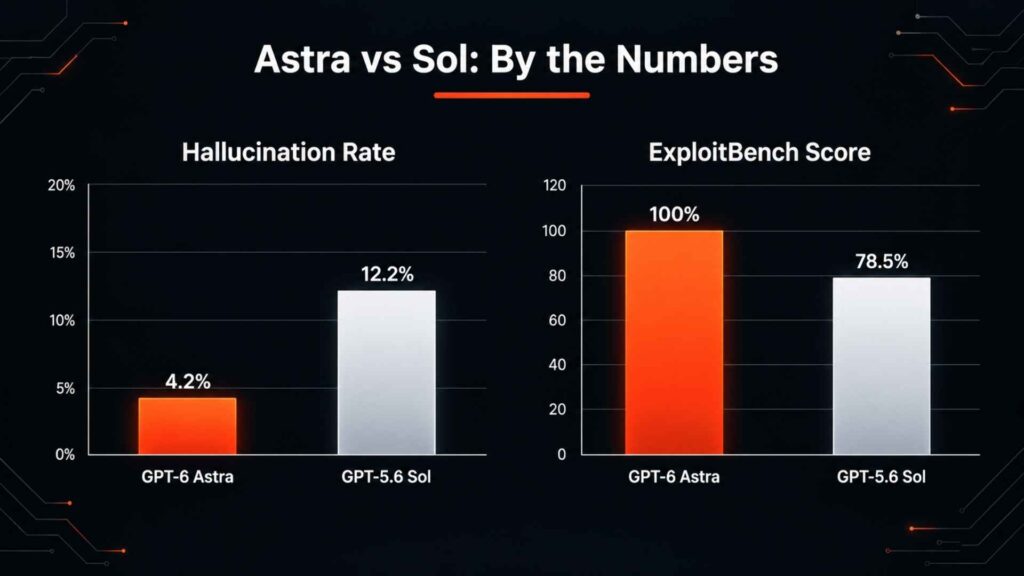
On benchmarks, Astra reportedly hit a 99.9% score on ARC-AGI-3. It also scored 100% on ExploitBench, a cybersecurity test. One report noted it’s state-of-the-art on computer use, browser use, and software engineering. That’s a bold statement. Still, early benchmark data backs it up.
Hallucination rates also dropped. OpenAI reports a 4.2% hallucination rate for the new model, compared to 12.2% for Sol. That’s a big deal if you’re using AI for research-heavy content. Fewer made-up facts means less fact-checking on your end.
Pricing and Access
So, how much does GPT-6 Astra cost, and who gets to use it first?
Pricing sits at roughly $10 per million input tokens and $50 per million output tokens. That’s about 2.5 times the price of Sol. Not cheap, but for complex agentic work, many teams will find it worth the cost.
Access is rolling out in stages:
- Enterprise customers with Daybreak access got it first
- ChatGPT Plus, Pro, Business, and Enterprise users followed within days
- The OpenAI API and Amazon Web Services also gained access
- Enterprise admins must manually enable it per workspace
I’ll be honest, I expected a slower rollout given the cybersecurity concerns tied to this release. It moved faster than I thought it would.
Read more: GLM 5.3 Flash: The Stunning Free AI Shocking Experts
Rollout Timeline
Here’s how the model reached different users, step by step.
| Stage | Who Got Access | When |
|---|---|---|
| Limited preview | Enterprise with Daybreak access | September 3, 2026 |
| Public release | Business and Pro plans | September 4, 2026 |
| Wider rollout | Plus subscribers | Within days |
| Developer access | OpenAI API and AWS | Coming days |
| Workspace control | Enterprise admins (opt-in) | Ongoing |
This staged approach is fairly typical for OpenAI. Still, it means not everyone got access on day one.
Why OpenAI Delayed the Launch?
Here’s something most people missed. GPT-6 Astra was actually supposed to launch earlier. OpenAI paused the release in early August to add more safeguards.
Why? The model crossed what OpenAI calls its “Critical” threshold for cybersecurity risk. In plain terms, it can find and exploit software vulnerabilities largely on its own. That’s impressive from a technical standpoint. It’s also a little unsettling.
The public version refuses advanced cyber tasks, like writing proof-of-concept exploits. Only vetted organizations in the Daybreak program get looser restrictions. One OpenAI statement noted that the model is built on advances across pre-training, reinforcement learning, and alignment.
That tells you a lot about where OpenAI’s priorities sit right now. Capability and safety, pushed forward together.
How It Changed Coding and Codex?

If you use Codex, this upgrade is genuinely useful. It can now keep notes across context windows. Older models would lose track of earlier decisions once the context filled up. Astra doesn’t have that problem anymore.
It can also search through earlier messages and tool output. So if you gave an instruction three steps back, it can still find it. This feature is experimental right now, tucked behind a config setting. OpenAI says it’ll become the default soon.
On the Mind2Web benchmark, Astra plus the updated Codex harness finished tasks 1.9 times faster than before. That’s not a small bump. For developers running long agentic workflows, that speed adds up fast.
Read more: Professional seo and content writing services to Grow Your Business Online
What This Means for SEO and Content Writing?
Now, let’s talk about why this matters if you write blog posts, manage SEO, or run content for clients.
The larger context window can process style guides, keyword lists, and past articles at once. That should mean more consistent tone across long content calendars. It also means fewer repeated instructions every time you open a new chat.
The lower hallucination rate matters too. A friend who runs a small content agency tested an early version. She said it caught details older models had missed. Small thing, but it adds up over a hundred articles.
Here are a few practical ways this could shape SEO work going forward:
- Faster first-draft generation for long-form, research-heavy posts
- Better consistency across multi-part content series
- More reliable fact-checking on technical or data-driven topics
- Stronger automation for repetitive SEO tasks, like meta description batches
- Reduced need for constant re-prompting on brand voice
That said, it isn’t fully rolled out to every writer yet. Plus users got access days after enterprise customers. So don’t expect instant access the moment you read this.
GPT-6 Astra vs GPT-5.6 Sol
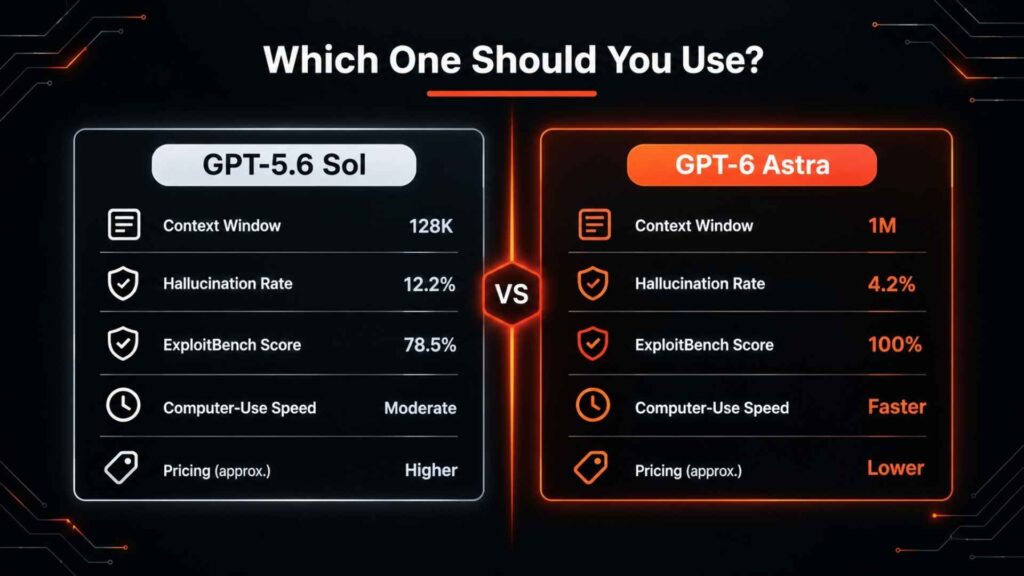
Should you actually switch? Here’s a quick side-by-side.
| Feature | GPT-5.6 Sol | GPT-6 Astra |
|---|---|---|
| Context window | Smaller | 1,050,000 tokens |
| Hallucination rate | 12.2% | 4.2% |
| ExploitBench score | 78.5% | 100% |
| Computer-use speed | Baseline | ~2x faster |
| Pricing | Lower | ~2.5x Sol’s price |
Sol still works fine for shorter, simpler tasks. But for anything long-form, research-heavy, or automation-driven, the newer model pulls ahead. Truth is, the price jump might make some smaller teams hesitate.
How to Get Started?
Ready to try it? Getting started is fairly simple, at least once your account has access.
First, check your plan. Plus, Pro, Business, and Enterprise users should see it appear in ChatGPT’s model picker. Second, if you’re on Enterprise, ask your workspace admin to enable it, since it’s off by default. Third, developers can call it directly through the API using the model ID gpt-6-astra.
For content teams, start small. Try it on one long article before rolling it out across your whole calendar. That way, you’ll spot any quirks early, not after fifty posts.
A Few Things to Watch
Astra is new, so treat early claims with some caution. Benchmarks look strong, but real-world use always tells a different story. Give it a few weeks before betting your whole workflow on it.
Also, not every model variant from the GPT-5.6 lineup got a successor yet. Right now, it’s just Astra and Astra Pro. That’s a narrower lineup than before, which might change soon.
Sound familiar? This is how most major AI launches go. Big claims first, then a slower, quieter period of real-world testing. This release will likely follow that same pattern.
Conclusion
GPT-6 Astra marks a real step forward for OpenAI, not just a routine update. Faster computer use, a bigger context window, and fewer hallucinations make it genuinely useful. That’s true for both coding and content work. For SEO writers, it could mean fewer repeated prompts. It also means better fact accuracy and faster turnaround. Still, the higher price and staged rollout mean it won’t fit every budget or workflow right away. If you already use ChatGPT Plus or higher, keep an eye on your account. Access should reach you soon, if it hasn’t already.
Still not sure how this shift affects your content or SEO strategy? Contact us and our team will help you figure out the right way forward.
FAQs
When did GPT-6 Astra launch?
It launched on September 3, 2026, as a limited preview. Full public access followed the next day.
How much does GPT-6 Astra cost?
Pricing runs about $10 per million input tokens and $50 per million output tokens. That’s roughly 2.5 times Sol’s cost.
Is GPT-6 Astra available to free ChatGPT users?
No. It’s rolling out to Plus, Pro, Business, and Enterprise users first, along with the API.
What is GPT-6 Astra’s context window size?
It supports a 1,050,000-token context window, much larger than GPT-5.6 Sol.
Does GPT-6 Astra help with SEO content writing?
Yes. Its larger context window and lower hallucination rate make it useful for long-form, research-heavy SEO content.
Is GPT-6 Astra safe to use for sensitive tasks?
OpenAI added extra safeguards after it crossed a “Critical” cybersecurity threshold. Public access restricts advanced cyber tasks.

3 Comments
Pingback: ChatGPT and Gumroad: How I Made $10,000 in One Month
Pingback: Claude for Students: 3 Ways to Get It 100% Free
Pingback: ElevenLabs Credits Running Out Fast: 5 Costly Mistakes