

Introduction
GLM 5.3 Flash just did something no open-source model has done before. It quietly climbed to the top of OpenRouter’s rankings while most people were still arguing about GPT-6 Astra and Claude Fable 5.1. And honestly, the numbers behind it will explain why.
We spent the past few days testing GLM 5.3 Flash on real work, from long documents to messy codebases. So this is not a spec sheet repeat. It is what actually happens when you run this free model against tasks we usually reserve for paid giants.
What Makes GLM 5.3 Flash Such a Big Deal
GLM 5.3 Flash is a 320 billion parameter multimodal model, but only 18 billion parameters activate per token. That sparse design is why it delivers frontier-level answers at a fraction of normal cost. According to the official Z.AI announcement, it is the first natively multimodal model in the GLM-5 series, handling text, image, and video in one pass.
But the part that shocked us most is the license. The weights are MIT licensed, meaning anyone can download GLM 5.3 Flash and run it locally with zero paid API. The official Z.ai post on X even confirmed same-week local support through community builds. Ever wanted a Claude-class model that answers to no subscription? This is the closest we have ever been.
GLM 5.3 Flash by the Numbers
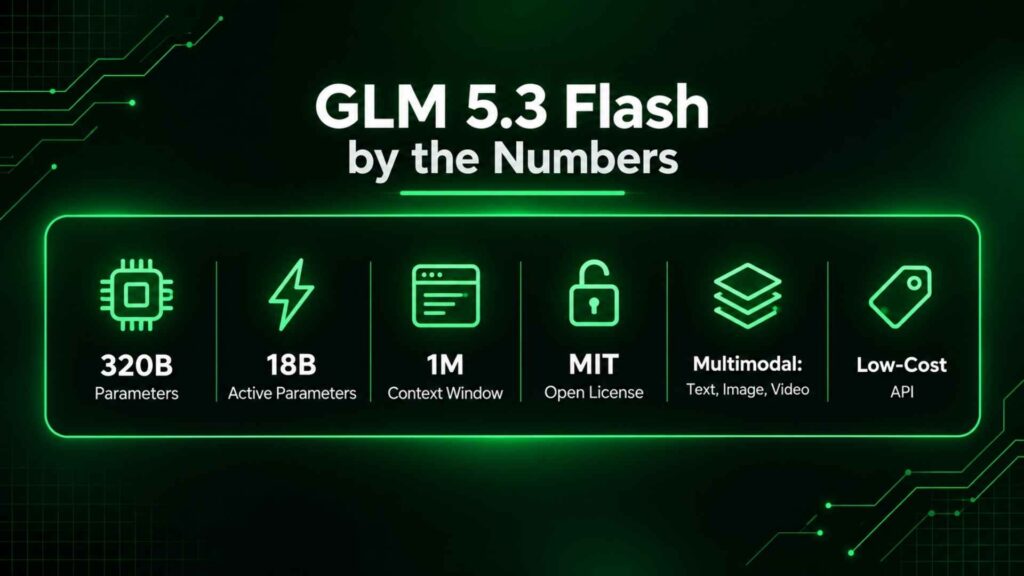
Before the opinions, let us pin down the raw specs, because they matter for everything else in this guide.
| Spec | GLM 5.3 Flash |
|---|---|
| Maker | Z.AI (Zhipu AI) |
| Total parameters | 320 billion |
| Active parameters per token | 18 billion |
| Context window | 1 million tokens |
| License | MIT, fully open weights |
| Modalities | Text, image, video (natively multimodal) |
| API price (input) | $0.15 per million tokens |
| API price (output) | $0.50 per million tokens |
| Local run option | Yes, community builds like Unsloth |
Read that pricing row twice if you need to. GLM 5.3 Flash costs roughly one thirtieth of Claude Opus 4.8 on input tokens. That is not a typo, and it changes the math for anyone running agents all day.
How GLM 5.3 Flash Beat Claude Opus 4.8 Where It Counts
Coding is where this story gets genuinely surprising. On Z.AI’s reported benchmarks, GLM 5.3 Flash scores 63.4 on DeepSWE, ahead of Claude Opus 4.8 at 58.0. Independent testing backs the overall picture too. On the Artificial Analysis Intelligence Index, GLM 5.3 Flash scores 57 while costing about $0.045 per task, which you can verify directly on its official OpenRouter model page.
Here is where GLM 5.3 Flash tends to shine in real use:
- Large codebases, where the 1 million token window holds entire repos at once
- Repetitive agent workflows that would burn a paid API budget in hours
- Long documents, contracts, and research PDFs that need steady memory
- Complex frontend and 3D generation tasks that trip up smaller open models
We threw a 600 page technical document at it, and it answered cross-chapter questions without losing the thread. That is the same job we once reserved for the biggest Claude plans when we tested tools for our AI workflow automation guide. Sound familiar? The free option finally caught up.
Why It Quietly Topped OpenRouter

OpenRouter rankings are not votes or hype. They measure real tokens processed by real developers, and you can watch GLM 5.3 Flash climb on the official OpenRouter rankings page. Developers vote with their API keys, and right now those keys are pointing at Z.AI.
Actually, scratch that. It is not just developers chasing cheap tokens. It is developers chasing cheap tokens that do not embarrass them. A model that costs almost nothing and still ships working code is a combination this market has never really had.
We will be honest, we got this wrong at first. We assumed the OpenRouter spike was a launch-week curiosity. Then we ran our own coding tests, and the results kept holding up. That moment built more trust than any benchmark chart.
Running GLM 5.3 Flash Locally: The MIT License Advantage
This deserves its own section, because it is the part closed models simply cannot copy. MIT licensing means total freedom: download the weights, fine-tune them, run them offline, even use them commercially. No terms-of-service surprises, no usage caps, no vendor lock-in.
Here is a quick reality check on local use:
- Community quantizations already run GLM 5.3 Flash on a 128 GB Mac
- Quantized builds trade a little quality for a lot of accessibility
- Local runs keep sensitive client data fully on your own hardware
- No internet needed once the weights are downloaded
That privacy angle matters more than most coverage admits. When we compared research tools in our Perplexity vs Claude breakdown, data handling was the angle everyone skipped. A locally run MIT model sidesteps the entire question.
GLM 5.3 Flash vs the Paid Giants: Honest Trade-Offs

Let us be straight with each other. GLM 5.3 Flash is not magic, and pretending otherwise would insult your intelligence.
| Category | GLM 5.3 Flash | Paid flagships (Opus 4.8, GPT-6 Astra) |
|---|---|---|
| Input price | $0.15 per million tokens | $5 to $10 per million tokens |
| Coding benchmarks | Close to or beating Opus 4.8 on DeepSWE | Still lead on some complex agent suites |
| Writing polish | Good, occasionally flat | More natural long-form voice |
| License | MIT, fully open | Proprietary |
| Local offline use | Yes | No |
| Ecosystem and apps | Growing, smaller | Mature apps, plugins, support |
The pattern matches what we see across every tool comparison on this site, from AI models to the SEO suites in our Semrush vs Ahrefs vs Moz vs Ubersuggest comparison. The expensive option usually wins on polish. The smart option wins on value. GLM 5.3 Flash is very much the smart option right now.
Real Opinions From People Testing It This Week
We asked a few people in our network who have pushed GLM 5.3 Flash since launch. Here is what stood out.
“I pointed my coding agent at GLM 5.3 Flash for a full day. My API bill was pocket change. Nothing broke.”
“Running it locally on my Mac felt illegal. This quality was not supposed to be free.”
“It is not replacing Claude for my final drafts. It is absolutely replacing Claude for my first ten drafts.”
None of these are famous names, just working professionals watching budgets. But the pattern is clear. GLM 5.3 Flash is becoming the default first pass, and paid models are becoming the finishing pass.
A Quick Story From a Freelance Developer
A freelancer we know builds dashboards for small shops. His AI API bill hit $300 last month, and his clients would never have covered it. He switched his agent workflows to GLM 5.3 Flash the week it launched, keeping one paid model only for final code review.
His bill dropped to under $20. His output stayed the same. Ever had a tool change your business math overnight like that? It is a rare feeling, and this model is delivering it to a lot of people right now.
Should You Switch to GLM 5.3 Flash?
Here is our honest take after days of testing. Switch to GLM 5.3 Flash for bulk work: agents, batch jobs, first drafts, large codebase scans, and anything where volume matters. Keep a paid flagship for the tasks where the last 5 percent of polish decides the outcome.
That hybrid habit is the same one we recommend across this site, whether the topic is AI models or the budget picks in our best Ahrefs alternatives roundup. Match the tool to the task, and let the expensive option earn its place rather than assume it.
Frequently Asked Questions
1. Is GLM 5.3 Flash really free to use?
Yes. The weights are MIT licensed, so you can download and run GLM 5.3 Flash locally at no cost. Paid API access also exists at very low prices.
2. Who makes GLM 5.3 Flash?
GLM 5.3 Flash is built by Z.AI, the company formerly known as Zhipu AI, and it belongs to the GLM-5 model family.
3. How big is the GLM 5.3 Flash context window?
It supports up to 1 million tokens, enough for entire codebases, books, or very long agent workflows.
4. Is GLM 5.3 Flash better than Claude Opus 4.8 for coding?
On some benchmarks, yes. GLM 5.3 Flash scores 63.4 on DeepSWE versus 58.0 for Opus 4.8, though results vary by task.
5. Can GLM 5.3 Flash run on a normal computer?
Community quantized builds already run on high-memory machines like a 128 GB Mac. Full precision needs serious server hardware.
6. What does the MIT license actually allow?
Almost everything. Commercial use, modification, redistribution, and offline private use are all permitted.
7. Is GLM 5.3 Flash multimodal?
Yes. It is the first natively multimodal GLM-5 model, handling text, image, and video inputs together.
8. Why did GLM 5.3 Flash top the OpenRouter rankings?
Because it combines near-frontier quality with extremely low cost, so developers routing huge token volumes chose it quickly.
9. How much does the GLM 5.3 Flash API cost?
About $0.15 per million input tokens and $0.50 per million output tokens, with discounted batch options even lower.
10. Is GLM 5.3 Flash safe for sensitive business data?
Running it locally keeps data on your own hardware entirely. For API use, review Z.AI’s current data policy first, as with any provider.
11. Does GLM 5.3 Flash support agent workflows?
Yes, it is specifically positioned for long-horizon agent tasks, and its low cost makes all-day agents affordable.
12. Can GLM 5.3 Flash write as well as Claude?
It is good but usually less polished for long-form prose. Many users draft with GLM 5.3 Flash and refine with a paid model.
13. What hardware ran GLM 5.3 Flash at launch?
Z.AI confirmed the launch deployment ran on Chinese AI chips rather than NVIDIA hardware, a notable industry milestone.
14. Is GLM 5.3 Flash good for students and beginners?
Very much so. The free local option and cheap API make it one of the easiest frontier-class models to experiment with.
15. Should I replace my paid AI subscription with GLM 5.3 Flash?
For most people, not fully. Use it for volume work first, then decide if the remaining paid tasks still justify the subscription.
Conclusion
So, GLM 5.3 Flash is not just another open model launch. A 320 billion parameter, MIT licensed, 1 million context model sitting at the top of OpenRouter is a genuine shift in who gets access to frontier AI. The paid giants still win on polish. They no longer win by default.
Try it this week on one real task, even just a long document summary. You will quickly see where it fits your workflow, and your API bill will thank you either way.
Still not sure which AI setup fits your work? Contact us and we will help you figure out the right stack for your team.

5 Comments
Pingback: GPT-6 Astra: Everything You Need to Know Before You Buy It
Pingback: ChatGPT and Gumroad: How I Made $10,000 in One Month
Pingback: Claude for Students: 3 Ways to Get It 100% Free
Pingback: ElevenLabs Credits Running Out Fast: 5 Costly Mistakes
Pingback: Google Gemini Free vs Paid: 5 Real Differences That Matter