













Introduction
Supervised learning models rank among the most important technologies in machine learning today, and in 2026, they continue to power the smart tools and applications we rely on every day – from spam filters and recommendation systems to fraud detection and medical diagnosis.
Because businesses now collect enormous amounts of information, demand for these models keeps growing steadily.
As a result, companies use them to make smarter decisions, cut costs, and deliver better customer experiences, and the pace of adoption shows no signs of slowing down.
The good news is that supervised learning is far easier to understand than many people initially think.
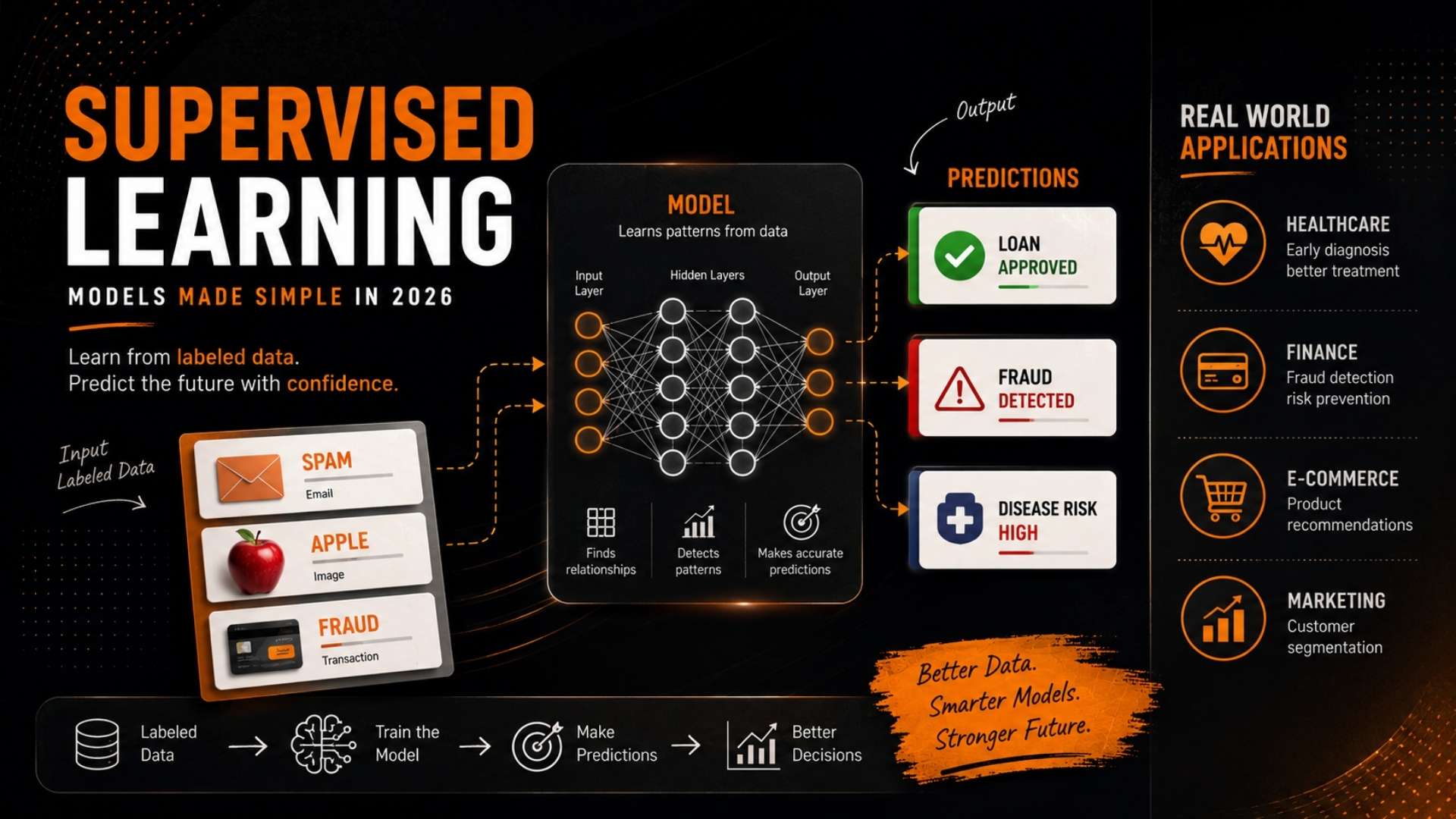
In simple terms, these models learn from examples that already contain the correct answers, and then they apply those patterns to make predictions when new data arrives.
Put differently, the model studies the past so it can anticipate the future.
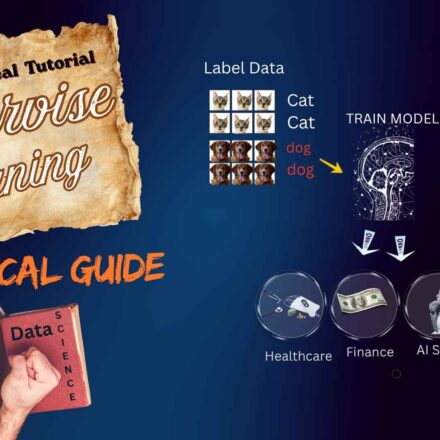
To make this tangible, imagine teaching a child to recognize apples by showing hundreds of pictures labeled “apple” or “not apple.” Over time, the child gradually learns the difference.
In the same way, supervised learning works the same way – the model trains on labeled data and, little by little, gets better at identifying patterns with each new example it processes.
In this beginner-friendly guide, you will learn what supervised learning models are, how they work, which types and algorithms exist, where they get applied in the real world, and what trends are shaping their future in 2026.
Read More: Supervised Learning in 2026: Best Methods, Models, and Uses
What Are Supervised Learning Models?
Supervised learning models are machine learning systems that train on labeled data – meaning the training data already contains the correct answers.
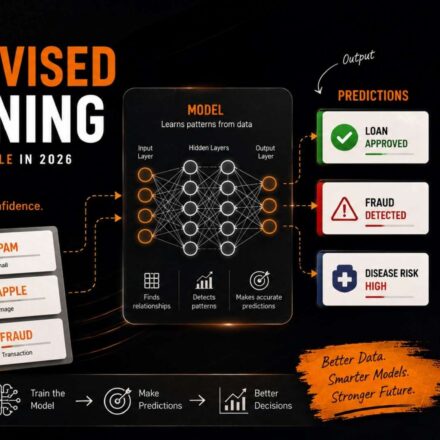
The model studies these examples carefully, learns the relationship between inputs and outputs, and then uses that knowledge to make accurate predictions on new, unseen data.
Because the model always learns from known answers, supervised learning consistently delivers highly accurate results, which is precisely why it has become so popular across so many fields.
Simple Definition
A supervised learning model learns from labeled data to predict future outcomes or classify information.
A Practical Example of Supervised Learning Models
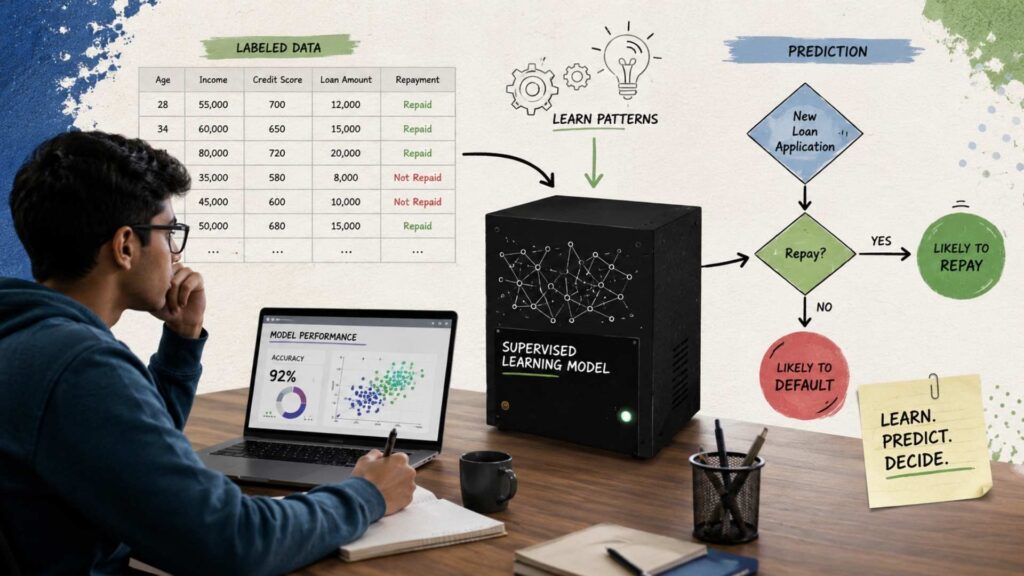
To illustrate, suppose a bank wants to predict whether a customer will repay a loan. The model takes in details like age, income, credit score, and employment history, along with historical outcomes from previous customers:
| Customer Profile | Result |
|---|---|
| High income | Repaid loan |
| Low credit score | Defaulted |
| Stable employment | Repaid loan |
By studying these patterns, the model learns what separates reliable borrowers from risky ones and, going forward, confidently predicts outcomes for future applicants.
How Supervised Learning Models Work
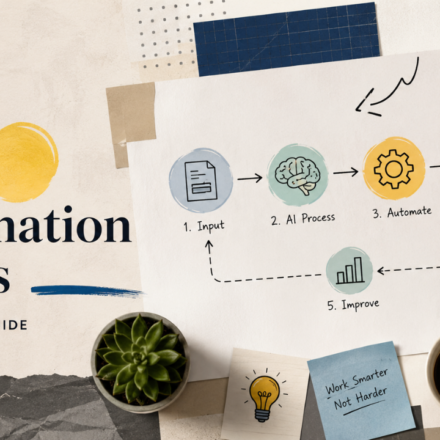
Although the technology behind supervised learning models can be complex, the overall process follows five straightforward steps.
Step 1: Collect Data
Teams begin by gathering data from sources such as customer databases, sales reports, medical records, website analytics, and images. Data quality matters enormously at this stage, because better inputs almost always produce better predictions in the end.
Read More: Why Data Science Is the Most In-Demand Skill in the AI Era?
Step 2: Label the Data
Next, human experts assign a correct answer to each data point. An email gets labeled “Spam” or “Not Spam,” a transaction gets flagged as “Fraud” or “Legitimate,” and so on. In turn, these labels give the model a ground truth to learn from.
Step 3: Train the Model
The algorithm then studies the labeled examples closely, continuously searching for patterns and relationships within the data. Over time, and with enough examples, the model builds an increasingly accurate understanding of how different variables drive the final result.
Step 4: Test the Model
After training, developers test the model on entirely new data it has never seen before, revealing how it performs in real conditions. Importantly, this critical step lets the team pinpoint specific weaknesses and make targeted improvements before deployment.
Step 5: Make Predictions
With training and testing complete, the model starts making predictions on live, unseen data.
Consequently, businesses can then automate complex decisions, save time, and significantly improve overall efficiency.
Types of Supervised Learning Models
There are two main types of supervised learning models, each suited to a different kind of problem.
Classification Supervised Learning Models
Classification models predict categories rather than numbers – instead of estimating a value, they assign a label or group. Common real-world examples include identifying emails as spam, flagging credit card transactions as fraudulent, and detecting diseases from medical records.
Read more: Supervised learning
| Input | Prediction |
|---|---|
| Spam | |
| Credit Card Transaction | Fraud |
| Medical Record | Disease Detected |
As a result, these models work best when outcomes naturally fall into specific, defined groups.
Regression Supervised Learning Models
Regression models, on the other hand, estimate a continuous number rather than a label. A model predicting house prices, forecasting monthly sales, or projecting tomorrow’s temperature all fall into this category.
| Input | Prediction |
|---|---|
| House Features | $300,000 |
| Sales Data | 15,000 Units |
| Weather Data | 30°C |
Because of this ability to forecast quantities, regression supervised learning models serve a vital role in business planning and financial analysis.
Popular Algorithms Used in Supervised Learning Models
Several powerful algorithms drive supervised learning models, each with its own strengths and best-fit use cases.
Linear Regression
Linear Regression is the go-to algorithm for predicting numerical values such as revenue, house prices, or product demand. In fact, its simplicity and interpretability make it the first algorithm most beginners encounter when exploring machine learning.
Logistic Regression
Despite its name, Logistic Regression handles classification tasks rather than regression. Specifically, it outputs a probability score that maps to a specific category, making it a natural fit for spam detection, customer churn prediction, and disease diagnosis.
Decision Trees
Decision Trees make predictions by asking a structured series of yes-or-no questions – for example, whether a customer earns above a certain threshold, currently holds a job, or carries a strong credit history.
Because the logic is easy to visualize and explain, Decision Trees remain especially popular in industries that demand transparent decision-making.
Random Forest
Random Forest takes Decision Trees further by combining many of them into one stronger model, which often produces more accurate and reliable predictions than any single tree could achieve alone.
Therefore, many businesses favor it precisely because it strikes a strong balance between accuracy and stability.
Read More: Quantum machine learning
Support Vector Machine (SVM)
Support Vector Machines find the clearest possible boundary between categories and use it to separate data into groups. So, they excel at complex, high-dimensional classification tasks where simpler models typically fall short.
K-Nearest Neighbors (KNN)
KNN predicts outcomes for a new data point by looking at the most similar examples it has already seen and voting based on what those neighbors suggest. Because of this, its intuitive simplicity makes it a frequent choice for educational projects and smaller datasets.
Neural Networks
Loosely inspired by the human brain, Neural Networks power some of the most advanced AI systems available today – including image recognition, voice assistants, language translation, and personalized recommendation engines.
Moreover, their capabilities keep expanding with every passing year.
Real-World Applications of Supervised Learning Models
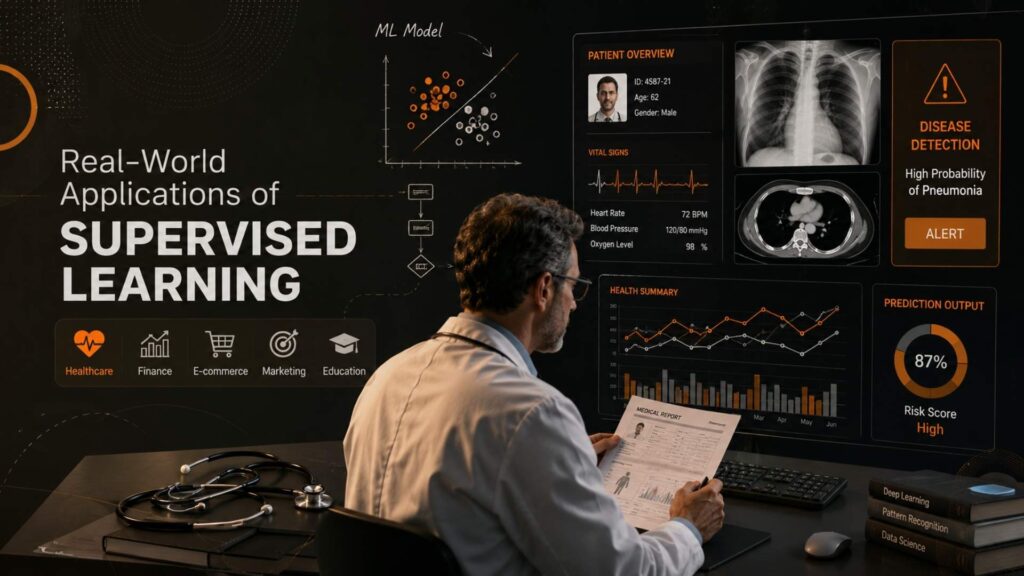
Supervised learning models appear across nearly every major industry. Here are some of the most impactful examples.
Supervised Learning Models in Healthcare
Healthcare organizations use these models to detect diseases earlier, analyze medical images more precisely, predict patient risks before symptoms worsen, and recommend the most appropriate treatments – enabling doctors to make faster and far more informed clinical decisions.
Supervised Learning Models in Finance
Banks and financial institutions rely on supervised learning models for fraud detection, credit scoring, risk assessment, and customer behavior analysis. As financial fraud grows in both scale and sophistication, these predictive models have become an essential line of defense.
Supervised Learning Models in E-Commerce
Online stores use supervised learning models to recommend products, predict customer purchases, and forecast inventory demand, creating a smoother, more personalized shopping experience.
As a result, many e-commerce companies now depend on these systems just to stay competitive in a crowded market.
Supervised Learning Models in Marketing
Marketing teams use supervised learning models to predict conversions, identify customer interests, and sharpen ad targeting. Consequently, the result is significantly better campaign performance and stronger returns on marketing investment.
Supervised Learning Models in Education
Educational platforms apply supervised learning models to track student performance, predict learning outcomes, and personalize study paths for each individual.
Because every student learns at a different pace, these models therefore help platforms deliver truly customized experiences at scale.
Key Benefits of Supervised Learning Models
Supervised learning models offer several important advantages that explain their rapid and widespread adoption.
High Accuracy – Training directly on labeled data allows these models to produce highly accurate predictions, and accuracy tends to improve further as teams feed them more data.
Easy Performance Evaluation – Because results can be compared directly against known answers, measuring accuracy and spotting errors is far more straightforward than with unsupervised methods.
Broad Industry Applications – From healthcare to marketing and beyond, supervised learning models work effectively across a remarkably wide range of industries, making them one of the most versatile tools in AI.
Improved Decision-Making – Instead of relying on guesswork or intuition, businesses can make confident, data-driven decisions that lead to more consistent and measurable outcomes.
Automation – Moreover, These models can automate many repetitive and time-consuming tasks, helping organizations save valuable time, reduce human error, and cut operational costs considerably.
Challenges and Limitations of Supervised Learning Models
Although supervised learning models are undeniably powerful, they also carry important limitations that every practitioner needs to understand.
Requires Labeled Data – Labeled datasets take both time and money to create, and in many specialized industries, trained human experts must handle the labeling process, which adds further cost and delay.
Data Quality Issues – No matter how sophisticated the model is, poor-quality input data will produce poor predictions. Organizations must therefore prioritize collecting accurate, clean, and representative data from the very start.
Overfitting – A model that learns the training data too closely ends up memorizing it rather than generalizing from it, causing it to perform poorly on truly new data that differs even slightly from its training set.
Bias Problems – Historical bias in training data will very likely be reproduced – and even amplified – in the model’s predictions. As a result, this serious concern is a key reason why responsible AI practices have grown increasingly important across the industry.
Ongoing Maintenance -Moreover, As business environments, user behaviors, and data patterns shift over time, teams must update their models regularly or watch prediction accuracy gradually decline.
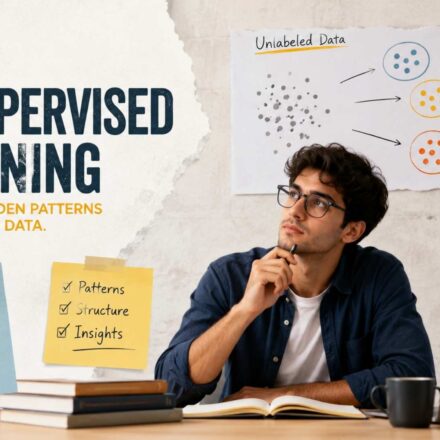
Supervised Learning Models vs. Unsupervised Learning
Many beginners confuse supervised and unsupervised learning, which is completely understandable – but each approach serves a fundamentally different purpose.
| Feature | Supervised Learning Models | Unsupervised Learning |
|---|---|---|
| Uses Labels | Yes | No |
| Goal | Prediction | Pattern Discovery |
| Training Data | Labeled | Unlabeled |
| Output | Known Results | Hidden Patterns |
| Example | Spam Detection | Customer Segmentation |
In short, supervised learning models predict known outcomes, while unsupervised learning discovers hidden patterns within unlabeled data. Still, both approaches have their place, but they solve very different kinds of problems.
Read More: Machine Learning: The Ultimate Guide for 2026
How to Choose the Right Supervised Learning Model
The right model depends on both your specific goals and the nature of your data. Before deciding, consider these key questions.
Is It Classification or Regression? – First, determine whether you need to predict categories or numerical values. This single distinction immediately narrows down your options significantly.
How Much Data Do You Have? – Some algorithms need large datasets to perform reliably, while others – such as KNN – work well even with smaller amounts.
How Important Is Accuracy? – In fields like healthcare and finance, high accuracy is not just preferred it is essential, making it worth investing in more sophisticated models and higher-quality training data.
Do You Need Explainable Results? – Decision Trees communicate logic far more easily than Neural Networks, which matters greatly in regulated or high-stakes industries where stakeholders need to understand why a prediction was made.
What Resources Are Available? – Complex models demand more computing power, time, and technical expertise, so your available resources should always factor into the final decision.
The Future of Supervised Learning Models in 2026 and Beyond
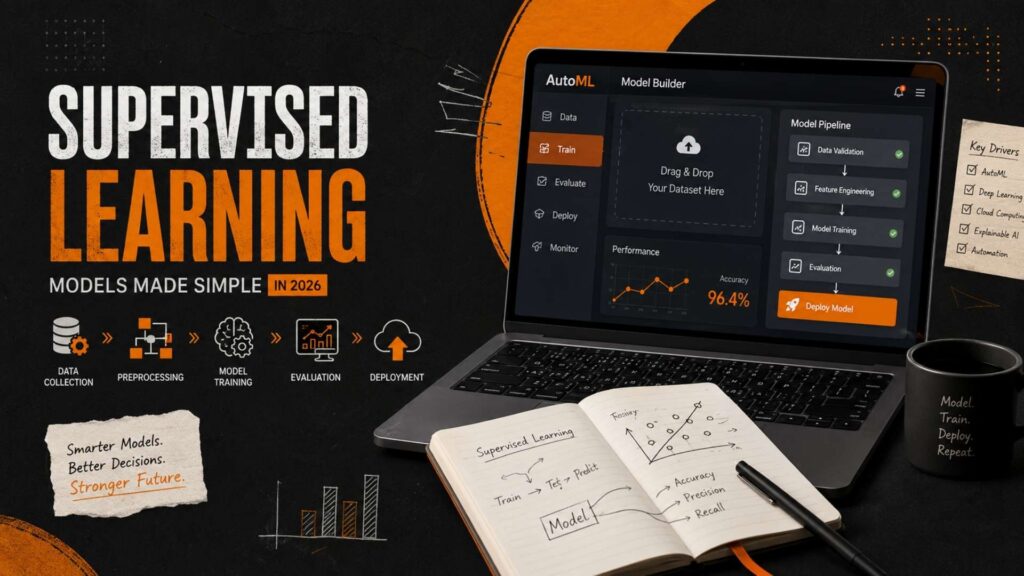
Supervised learning models continue to evolve at a remarkable pace. Today, organizations actively combine them with deep learning, cloud computing, and automation technologies, making models faster, smarter, and far more accessible to businesses of every size.
Several important trends are shaping what comes next:
- AutoML tools let teams build and deploy models faster with far less manual effort
- AI-powered analytics now operate at unprecedented business scale
- Advanced neural networks achieve dramatically higher accuracy than earlier generations
- Better data labeling tools cut the time and cost of preparing quality training data
- New explainable AI systems help regulated industries trust and act on model decisions
With businesses worldwide continuing to invest heavily in artificial intelligence, supervised learning models will therefore undoubtedly remain one of the most critical and widely used machine learning methods for years to come.
Read More: Everything You Need to Know About AI Jewelry Design Tools in 2026
Frequently Asked Questions About Supervised Learning Models
What are supervised learning models in simple terms?
They are machine learning systems that learn from labeled examples containing the correct answers, and then apply those patterns to make accurate predictions on new, unseen data.
Why are they called supervised learning models?
They earn the name “supervised” because labeled data actively guides the learning process — much like a teacher steering a student toward the right answers.
What are the two main types of supervised learning models?
Classification models predict categories and regression models predict numerical values. Together, and as a result, they cover a wide range of real-world prediction tasks.
Are supervised learning models part of artificial intelligence?
Yes. They stand among the most common and foundational techniques within the broader field of artificial intelligence and machine learning.
Which supervised learning algorithm is best for beginners?
Linear Regression, Logistic Regression, and Decision Trees are all excellent starting points — intuitive, well-documented, and easy to visualize.
Where do supervised learning models get used?
They appear in healthcare, finance, e-commerce, marketing, education, cybersecurity, and countless other industries. Whenever, teams use data to make predictions, supervised learning is likely at work.
Does working with supervised learning models require coding?
Not always. Many modern AI tools and platforms let users build and deploy supervised learning models without extensive programming knowledge, though coding skills certainly help.
Final Thoughts
Supervised learning models stand as one of the true foundations of modern artificial intelligence, enabling machines to learn from labeled data, identify meaningful patterns, and make accurate predictions that drive real business value.
Because they are practical, reliable, and highly effective across such a broad range of tasks, they now operate in virtually every corner of the global economy.
Whether you are a student just starting out, a business owner looking to leverage AI, or simply a curious technology enthusiast, understanding how these models work will help you better appreciate and navigate the increasingly AI-powered world we live in.
So, As machine learning continues to advance in 2026 and well beyond, supervised learning models will remain a critical technology driving innovation, enabling automation, and supporting smarter decision-making across every sector.
Read More: Types of Machine Learning: A Complete 2026 Guide
Call To Action
Need SEO content that ranks on Google and keeps readers engaged?
I create:
- SEO blog posts
- Keyword-focused articles
- Human-style content
- Easy-to-read blogs
- High-engagement website content
Let’s build content that performs.
📧 Email: craziya167@gmail.com
Author Bio
Digital Raziya is an SEO content writer specializing in AI, machine learning, and digital marketing. She creates simple and clear content that is easy to read. In addition, she focuses on SEO-optimized articles that help websites grow. Overall, her goal is to make complex topics easy for everyone.