


Machine Learning vs AI: Which Is More Powerful?
Introduction
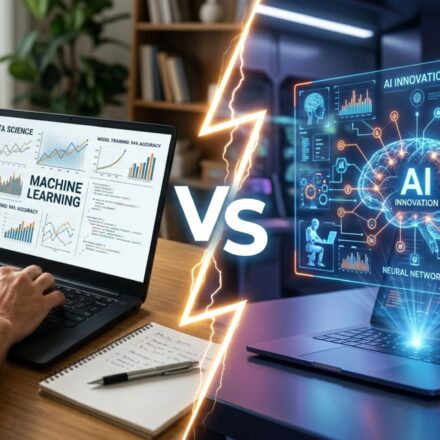
Machine learning vs AI is one of the most discussed topics in technology today.
However, many people still use these terms interchangeably. As a result, they often misunderstand how these technologies actually work.
The truth is simple.
Artificial Intelligence and Machine Learning are closely connected. However, they are not the same thing.
AI is the bigger field. Machine Learning is one part of that field.
Because both technologies are growing rapidly, businesses, students, and professionals want to understand the difference. Moreover, companies are investing billions of dollars into AI-powered solutions every year.
So, what makes them different?
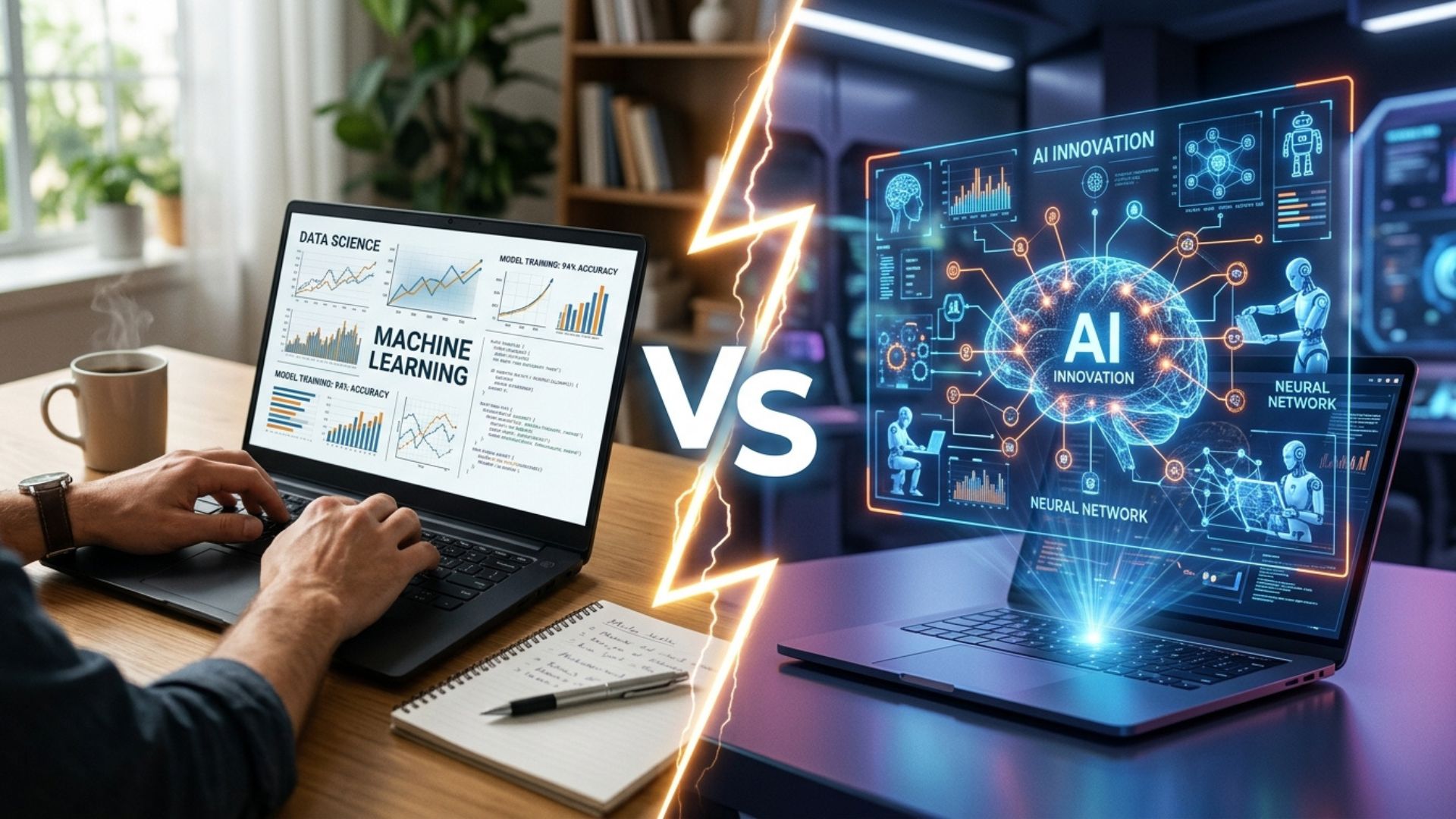
More importantly, in the debate of Machine Learning vs AI, which one is more powerful?
In this guide, you’ll learn:
- What AI really means
- What Machine Learning does
- How they work together
- Their biggest differences
- Real-world examples
- Benefits and challenges
- Which technology has more power in 2026
Let’s begin with the basics.
Read More: Machine Learning for Beginners: A Practical Guide (2026)

Machine Learning vs AI: Why Do People Get Confused?
Many people get confused because Machine Learning and AI are often used interchangeably.
For example, when people use chatbots, voice assistants, or recommendation systems, they often refer to all of them as “AI.”
However, that’s only part of the story.
Machine Learning is one technology that helps AI become smarter. Therefore, when people see an intelligent system learning from data, they often assume it is pure AI.
The relationship is actually very simple.
Think of AI as a large umbrella.
Under that umbrella, you’ll find:
- Machine Learning
- Deep Learning
- Computer Vision
- Natural Language Processing
- Robotics
Therefore, every Machine Learning system belongs to AI.
However, not every AI system uses Machine Learning.
Quick Example
Imagine you’re building a smart robot.
So, if the robot follows fixed rules, it’s using AI.
If the robot learns from experience and improves over time, it’s using Machine Learning as well.
As a result, Machine Learning makes AI more flexible and intelligent.
Read More: Text-to-Speech: A Complete Guide for Better Digital Content
What Is Artificial Intelligence (AI)?
Artificial Intelligence is the ability of a machine to perform tasks that normally require human intelligence.
In simple words, AI helps computers think, reason, learn, and make decisions.
Today, AI is everywhere.
For example, it helps smartphones recognize faces. It also helps businesses answer customer questions automatically.
Main Goals of AI
AI aims to:
- Solve problems
- Make decisions
- Understand language
- Recognize images
- Learn from the information
- Automate tasks
Because of these abilities, AI has become one of the most important technologies in the world.
Read More: Artificial Intelligence as a Career: Expert Tips for 2026

Types of Artificial Intelligence
The field of AI is often divided into different categories.
| Type of AI | Description | Example |
|---|---|---|
| Narrow AI | Designed for one task | Siri, Alexa |
| General AI | Can perform many tasks like humans | Still under development |
| Super AI | More intelligent than humans | Theoretical concept |
Currently, most AI systems belong to Narrow AI.
Real-Life Examples of AI
You probably use AI every day without noticing it.
Some common examples include:
- Voice assistants
- Chatbots
- Smart cameras
- Self-driving cars
- Language translation apps
- Virtual customer support
As technology improves, AI applications continue to expand.
What Is Machine Learning (ML)?
Machine Learning is a branch of Artificial Intelligence.
However, instead of following only programmed instructions, Machine Learning learns from data.
The more data it receives, the better it becomes.
Because of this ability, Machine Learning powers many modern digital services.
How Machine Learning Works
Machine Learning follows a simple process:
- Collect data
- Analyze patterns
- Train a model
- Make predictions
- Improve through feedback
As a result, the system becomes smarter over time.
Read More: Machine Learning for Beginners: A Practical Guide (2026)

Simple Machine Learning Example
Suppose you watch cooking videos on YouTube.
After some time, YouTube starts recommending similar videos.
Why?
Because Machine Learning studies your behavior and predicts what you may like next.
Therefore, recommendations become more accurate over time.
Main Types of Machine Learning
| Type | How It Works | Example |
|---|---|---|
| Supervised Learning | Learns from labeled data | Spam detection |
| Unsupervised Learning | Finds hidden patterns | Customer segmentation |
| Reinforcement Learning | Learns through rewards | Self-driving cars |
These methods help solve different types of problems.
Machine Learning vs AI: The Main Difference Explained
Now let’s answer the biggest question.
What is the actual difference between Machine Learning and AI?
The easiest answer is this:
Artificial Intelligence is the broader concept.
Machine Learning is one technique used within AI.
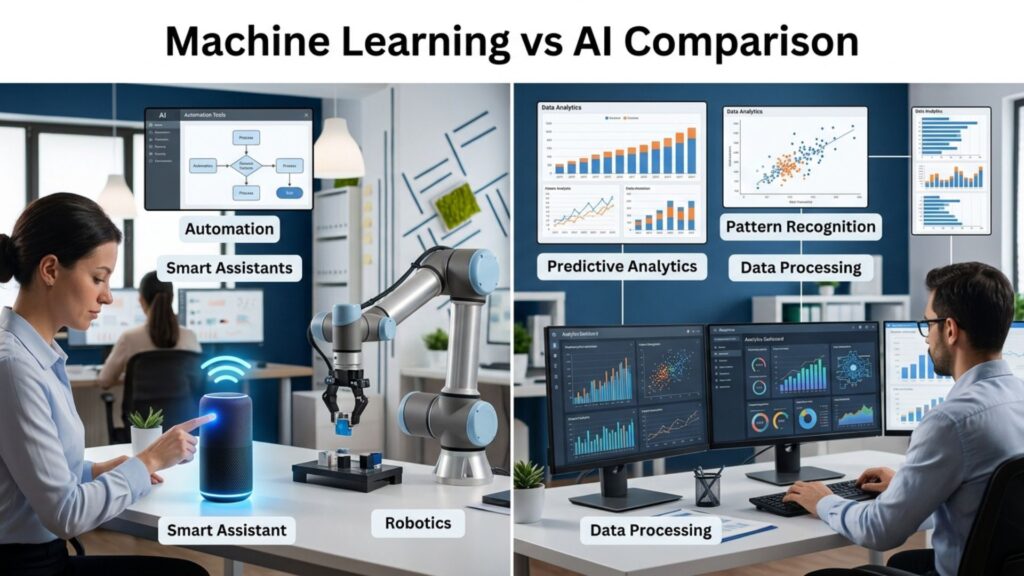
Machine Learning vs AI at a Glance
| Feature | Artificial Intelligence | Machine Learning |
|---|---|---|
| Meaning | Creates intelligent systems | Helps systems learn from data |
| Scope | Broad field | Subset of AI |
| Goal | Mimic human intelligence | Find patterns and predictions |
| Learning | May or may not learn automatically | Learns automatically from data |
| Data Usage | Not always required | Essential |
| Applications | Robotics, assistants, automation | Recommendations, analytics |
Therefore, AI focuses on intelligence.
Meanwhile, Machine Learning focuses on learning.
That’s the key difference.
Simple Analogy
Think about a university.
The university represents AI.
A specific department inside that university represents Machine Learning.
The department is important.
However, it is still part of the larger institution.
Likewise, Machine Learning is a powerful part of Artificial Intelligence.
Machine Learning vs AI Comparison Table: Key Differences at a Glance
Now that you understand the basics, let’s compare Machine Learning vs AI side by side.
Although these technologies are closely related, they serve different purposes. Therefore, understanding their differences is important.
Moreover, knowing how they compare can help you choose the right technology for your project or career path.
The table below highlights the most important differences between Machine Learning and AI.
Therefore, AI is the larger field. Machine Learning, meanwhile, is one important part of it.
In other words, every Machine Learning system is part of AI. However, not every AI system uses Machine Learning.
Read More: Clustering in AI and Machine Learning: Everything You Need to Know
Machine Learning vs AI: How AI and Machine Learning Work Together
Many people compare Machine Learning vs AI. However, these technologies are not competitors.
Instead, they work together to create smarter systems.
Think of AI as the final goal. Meanwhile, Machine Learning is one of the most important tools used to achieve that goal.
For example, an AI-powered chatbot must understand questions and provide useful answers.
So, it often uses Machine Learning to learn from thousands of conversations.
As a result, the chatbot becomes more accurate over time.
Machine Learning vs AI Example: A Self-Driving Car
Imagine a self-driving car.
AI helps the car:
- Make driving decisions
- Follow traffic rules
- Avoid obstacles
Meanwhile, Machine Learning helps the car:
- Recognize traffic signs
- Detect pedestrians
- Learn from road data
Therefore, AI provides intelligence, while Machine Learning provides learning ability.
Together, they create systems that can perform complex tasks with minimal human involvement.
Read More: Reinforcement Learning in 2026: A Complete Beginner Guide
Machine Learning vs AI: Real-Life Examples You Use Every Day
You probably interact with Machine Learning vs AI technologies every day.
However, most people don’t realize how often they use them.
From online shopping to streaming platforms, these technologies are everywhere.
However, Let’s look at some practical examples.
Machine Learning vs AI Example 1: Netflix Recommendations
When Netflix suggests movies, Machine Learning analyzes your viewing history.
As a result, it predicts what you may want to watch next.
Therefore, your recommendations become more personalized over time.
Machine Learning vs AI Example 2: Voice Assistants
Siri and Alexa use AI to understand human language.
Meanwhile, Machine Learning helps improve speech recognition.
Because of this, these assistants become smarter with continued use.
Machine Learning vs AI Example 3: Email Spam Filters
Spam filters learn from millions of emails.
Then, they identify suspicious messages automatically.
As a result, your inbox stays cleaner and safer.
These examples clearly show that Machine Learning vs AI is not just a technical concept.
Instead, it is already part of daily life.
Read More: PyTorch Basics to Advanced: A Complete Learning Guide 2026
Machine Learning vs AI: Benefits of Artificial Intelligence
Artificial Intelligence offers many benefits for businesses and individuals.
As technology continues to improve, these benefits become even more valuable.
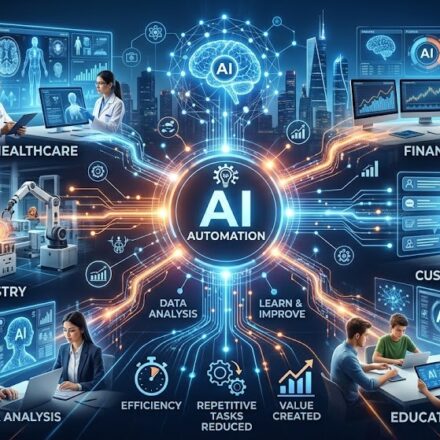
Moreover, organizations use AI to improve efficiency, reduce costs, and deliver better customer experiences.
1. Faster Decision Making
AI can process large amounts of information within seconds.
Therefore, work is becoming easy for humans.
As a result, businesses can make decisions much faster.
2. Better Automation
AI automates repetitive tasks.
Therefore, employees can focus on more meaningful work.
Read More: AI automation: Simple Steps for Smarter Business Growth now 2026
3. Improved Customer Service
Many companies use AI-powered chatbots.
Moreover, companies are contacting customers with the help of workflows in less time
Consequently, customers can receive support at any time.
Overall, AI helps businesses become faster, smarter, and more productive.
Machine Learning vs AI: Benefits of Machine Learning
Machine Learning is one of the most powerful branches of AI.
Therefore, it makes AI more powerful
Because it learns from data, it can improve without constant human intervention.
As a result, many industries rely on Machine Learning for predictions and decision-making.
1. Learns Automatically
Unlike traditional software, Machine Learning improves through experience.
Therefore, performance often gets better over time.
2. Better Predictions
Machine Learning finds patterns in data.
As a result, businesses can make more accurate decisions.
[Keep ML benefits table here]
In short, Machine Learning helps organizations turn data into valuable insights.
Machine Learning vs AI: Common Challenges You Should Know
Although both technologies offer impressive benefits, they also come with challenges.
Therefore, businesses must understand these limitations before adopting them.
Read More: AI for Companies: The Ultimate 2026 Guide for Growth And Automation
Challenge 1: High Development Costs
Building advanced AI systems can be expensive.
Moreover, powerful hardware is often required.
Challenge 2: Data Quality Issues
Machine Learning depends heavily on data.
Therefore, poor-quality data can produce inaccurate results.
Challenge 3: Privacy Concerns
Many AI systems collect user information.
As a result, organizations must protect sensitive data carefully.
Even so, many organizations continue investing in AI because the benefits often outweigh the challenges.
Machine Learning vs AI: Which Is More Powerful?
This is one of the most common questions in the Machine Learning vs AI debate.
However, the answer depends on what you mean by “powerful.”
If we look at overall capabilities, AI is more powerful.
This is because AI includes Machine Learning, Deep Learning, Computer Vision, Robotics, and Natural Language Processing.
Therefore, AI has a much broader scope.
On the other hand, Machine Learning is extremely powerful when it comes to finding patterns and making predictions.
As a result, many modern AI systems depend heavily on Machine Learning.
Machine Learning vs AI: Final Verdict
If you’re comparing overall capabilities, AI wins.
However, if you’re comparing learning and prediction abilities, Machine Learning stands out.
Therefore, the real strength comes from combining both technologies.
Read More: How to Make Big Money with High-Ticket Amazon Affiliate Niches in 2026
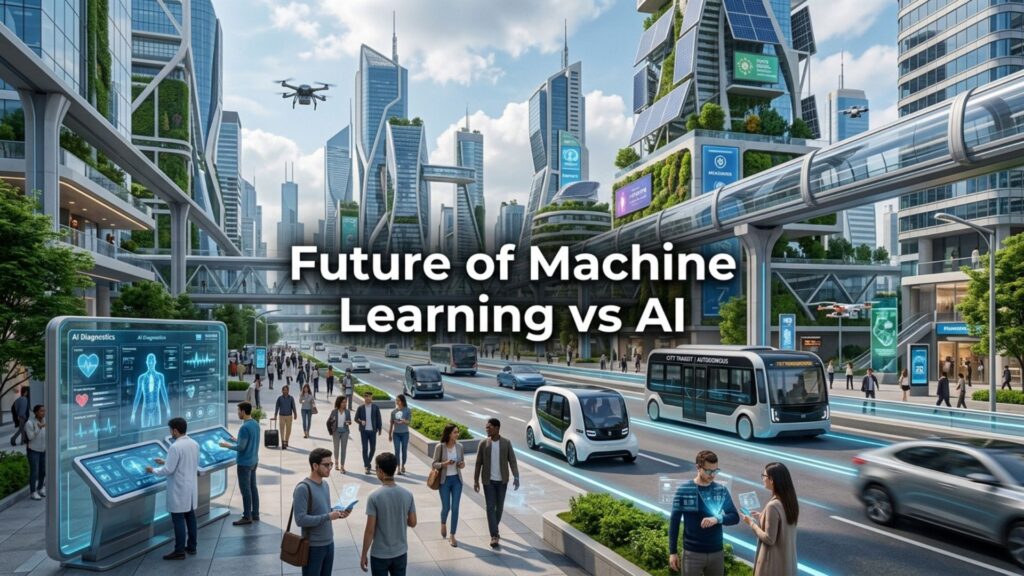
Machine Learning vs AI: Future Trends in 2026 and Beyond
The future of Machine Learning vs AI looks extremely promising.
In fact, both technologies continue to grow faster every year.
Moreover, companies across the world are investing heavily in AI-powered solutions.
For example, hospitals use AI to detect diseases.
Meanwhile, financial institutions use Machine Learning to detect fraud.
As technology advances, these systems will become faster, smarter, and more reliable.
Therefore, AI and Machine Learning will continue shaping the future of business and everyday life.
Machine Learning vs AI FAQs
1. Is Machine Learning the same as AI?
No. Machine Learning is a subset of AI.
Therefore, AI is the broader field.
2. What is the main difference between Machine Learning vs AI?
AI focuses on creating intelligent systems.
Meanwhile, Machine Learning focuses on learning from data.
3. Which is more powerful, Machine Learning or AI?
Overall, AI is more powerful because it includes many technologies.
However, Machine Learning is stronger in prediction and pattern recognition.
4. Why is Machine Learning important in AI?
Machine Learning helps AI learn from data.
As a result, AI systems become smarter over time.
5. Can AI work without Machine Learning?
Yes, it can.
For example, some AI systems use fixed rules instead of learning from data.
6. Is Deep Learning part of Machine Learning or AI?
Deep Learning is part of Machine Learning.
Therefore, it is also part of AI.
7. What are some real-life examples of Machine Learning vs AI?
For example, Netflix recommendations, Siri, Alexa, spam filters, and self-driving cars all use AI and Machine Learning.
8. Which has more career opportunities, Machine Learning or AI?
Both offer strong career opportunities.
However, AI roles are usually broader.
9. Is Machine Learning difficult to learn?
At first, it may seem difficult.
However, with practice, it becomes much easier to understand.
10. What industries use Machine Learning and AI?
Today, many industries use them.
For instance, healthcare, finance, education, and e-commerce rely heavily on these technologies.
11. Will AI replace human jobs completely?
No, not completely.
Instead, AI will automate some tasks while creating new opportunities.
12. What is the future of Machine Learning vs AI?
The future looks promising.
Moreover, both technologies are expected to grow rapidly in the coming years.
Read More: Free AI Logo Generator Tools | Best Logo Makers 2026
Call To Action
Need SEO content that ranks on Google and keeps readers engaged?
I create:
- SEO blog posts
- Keyword-focused articles
- Human-style content
- Easy-to-read blogs
- High-engagement website content
Let’s build content that performs.
📧 Email: craziya167@gmail.com
Author Bio
Digital Raziya is an SEO content writer specializing in AI, machine learning, and digital marketing. She creates simple and clear content that is easy to read. In addition, she focuses on SEO-optimized articles that help websites grow. Overall, her goal is to make complex topics easy for everyone.