



By Zarirah Asif | Cybertruck Updated November 7, 2026
Tesla will wind down Cybertruck production in mid-2027. CEO Elon Musk announced the move on X on November 6, 2026. That is about three and a half years after the first deliveries.
The problem is the gap between the promise and the sales. Tesla built a line for 250,000 trucks a year, yet buyers take home only about 30,000 a year.
The quick fix is simple. First, separate the truck from the company. Then, check the sales math, the Cybercab plan, and the owner checklist below.
This article explains why Tesla is ending the truck, how bad sales really are, and what the Cybercab shift means. Also, it covers what owners should do now, plus honest limits, because one announcement does not settle every question.
Key Takeaways
- Musk said on Nov 6, 2026 that Tesla will wind down production of the truck at Gigafactory Texas around mid-2027. The reason: more Cybercab production.
- The truck sells at roughly 12% of the 250,000 units a year Tesla planned for. That is about a quarter of the 125,000 units of installed capacity.
- Cox Automotive estimates 11,586 US sales in the first nine months of 2026, down 28% year over year.
- Tesla has not said how long it will keep selling inventory, or what happens to parts and service.
- The truck’s real wins, steer-by-wire and rear-wheel steering, now live on in the Cybercab and Tesla’s autonomy bet.
Why Is Tesla Ending Cybertruck Production?
Musk gave one sentence and no details. His post on X said Tesla will wind down production of the truck at Gigafactory Texas around the middle of next year. The reason: more Cybercab production. Also, he said nothing about how long Tesla will keep selling inventory, or about parts and service for existing owners.
The timing tells the rest of the story. Tesla handed over the first trucks in November 2023, two years behind its original schedule. So the wind-down lands about three and a half years after launch.
Musk also answered a user who called the news an end of an era. He replied that the truck was the best vehicle Tesla has ever made. He also added that the fleet will be around for a long time. Still, praise does not change the sales math.
What Musk actually said
The full post ran a single sentence. It named the place (Gigafactory Texas), the timing (around the middle of next year), and the reason (more Cybercab production). That is all Tesla has said so far. There is no separate formal release with a retooling budget or a headcount plan.
Lead engineer Wes Morrill posted about the news the same day. He also said the truck was an incredible technology development platform and lives on through Cybercab.
The Electrek report put it bluntly: Tesla is not ending the truck because the Cybercab needs room. It is ending the truck because almost nobody buys it at anything close to the volume Tesla planned. Also, the report notes that Tesla did the same thing with Model S and Model X this year. It ended their production to free up Fremont for Optimus.
How Bad Are Cybertruck Sales, Really?
Still, the numbers are stark. Tesla does not break out truck deliveries. It lumps the truck into Other Models, along with Model S, Model X, and now the Semi. Still, that bucket tells the story anyway.
For example, Tesla delivered 8,295 Other Models in Q3 2026, down 48% year over year. That was the lowest total since Q2 2021. Model S and Model X production ended in April. Electrek estimates 7,000 to 8,000 of those 8,295 were trucks, about 30,000 a year.
Then compare that pace with the plan. Tesla built the line for 250,000 units a year. Its latest shareholder letter still lists more than 125,000 units of installed capacity. So the truck sells at about 12% of plan. That is roughly a quarter of what the factory can actually build.
The Cox Automotive numbers
Also, Cox Automotive tracks US sales directly, and its numbers look worse. Cox estimates 3,519 US sales in Q1 2026 and 3,744 in Q2. That compares with 14,416 in Q3 2024, the truck’s best quarter. Also, Cox puts the first nine months of 2026 at 11,586 trucks, down 28% year over year.
Kelley Blue Book estimates 20,237 US sales in 2025, down from 38,965 in 2024. Sales nearly halved in the truck’s second full year. Electrek estimates only about 70,000 trucks delivered in total across roughly three years.
The SpaceX twist
Still, not every sale was a real customer. S&P Global Mobility data showed SpaceX bought 1,279 trucks in Q4 2025. Musk’s companies took 1,339 that quarter, about 19% of US registrations. Nearly one in five trucks went to companies Musk himself controls. Without that self-dealing, the sales picture would look even weaker.
First, Tesla tried to fix demand and failed. It launched a cheaper rear-wheel-drive version in 2025 and pulled it months later. Then it brought a cheaper dual-motor trim this summer, then raised prices by $5,000 in August. The dual-motor now starts at $74,990. Still, none of it moved the needle.

Cybertruck vs. the Cybercab: What Tesla Gains
The official reason does not hold up on its own. Giga Texas has more than 10 million square feet of factory floor, by Tesla’s own count. The truck line already runs at about a quarter of its installed capacity. Most of it sits idle.
The Cybercab is not fighting anyone for floor space yet. Texas had 463 Cybercabs registered as of late October, and Tesla built a separate line for its unboxed manufacturing process.
So what Tesla gains is a clean exit from a costly line. The truck needs its own stainless steel body, its own castings, and its own supply chain. Supporting all of that at 30,000 units a year costs far more per truck than at 250,000. Also, the Cybercab line gives Musk a forward-looking reason to wrap a product failure in. It is far easier to say we need room for the future than to say this did not sell.
The Cybercab itself is a two-seat autonomous robotaxi, unveiled in 2024. First, Tesla began building it at Giga Texas in April 2026. Paid rides started in limited areas of Austin in September. Also, Musk told investors Tesla plans to expand Robotaxi to a dozen or so states by year end. Our guide to business automation AI makes a similar point for buyers: judge automation on measured returns, not on the launch demo.
What Happens to Cybertruck Owners Now?
Owners face the most practical questions, and Tesla has answered almost none of them yet. The company has not said how long it will keep selling inventory, or what happens to parts and service. It has not said whether production moves to another plant or stops altogether. Giga Texas is the only known Tesla plant that builds the truck, so a move looks unlikely.
Musk did offer one reassurance. He said the fleet will be around for a long time. Also, lead engineer Wes Morrill confirmed separately that spare parts and service support will continue. Still, a promise on X is not a service contract. Owners should watch for a formal Tesla statement with dates and terms.
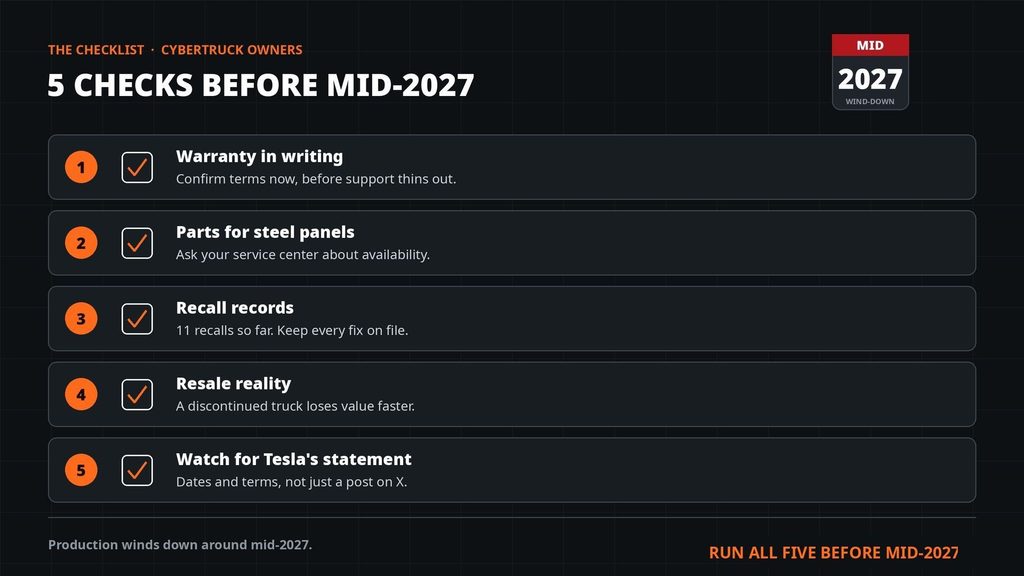
Resale values will move first. A discontinued truck usually loses value faster, because buyers fear parts and support. Also, the truck already had 11 US safety recalls as of November 6, 2026. The most recent recall came in April 2026. It covered 173 trucks with 18-inch steel wheels, because wheel studs could separate from the hubs. So check recall history before any used purchase.
Owners should also check the basics now, while support is certain. Confirm warranty terms in writing. Ask the service center about parts for the stainless body panels. Keep records of every recall fix. Those steps cost little, and they protect value if support thins out later.
The Cybertruck’s Real Legacy: Engineering Wins
Still, the truck failed as a product, yet it succeeded as a test bed. Nobody else has put steer-by-wire and rear-wheel steering in a production EV pickup. Both systems work well in the real world.
Also, that engineering now moves into Tesla’s next vehicles. Morrill said the truck lives on through Cybercab. The unboxed manufacturing process at Giga Texas grew out of lessons from building the truck. So the truck’s ideas survive, even as the truck itself goes away.
The failure also taught Tesla a lesson about design. Musk once talked about a more traditional electric truck design if the truck failed. Also, the truck cannot sell in Europe or most right-hand-drive markets. Its shape and size break local rules. Tesla cancelled it for Australia and New Zealand two weeks before the wind-down news.
The AI bubble debate separates price hype from real business risk, and it helps here too. The truck was real engineering wrapped in hype. That engineering stays useful. Still, hype does not pay the factory bills.
What Tesla’s Robotaxi Bet Means for Buyers
Tesla now bets the house on autonomous vehicles. Musk has said he plans to focus on Optimus robots, Cybercabs, and the Semi, while Chinese competition pressures conventional EVs. Also, the company ended Model S and Model X production this year to free up Fremont for Optimus.
First, buyers should read that bet with care. A robotaxi fleet earns money only if regulators, riders, and city rules all line up. Paid rides in Austin cover limited areas so far. The promise of a dozen states by year end is bold. Tesla’s promises have slipped before: the first trucks arrived two years late.
Still, the bet has real logic behind it. A Cybercab costs less to build than a truck. It needs no steering wheel or pedals, and it can run all day. Also, Tesla’s camera-only approach scales faster than sensor-heavy rivals, if the software proves safe. The Anthropic IPO guide shows how big tech bets get priced: investors pay for the future story first, then check the numbers later.
Cybertruck: Honest Limits
Finally, three limits keep this article honest. First, the sales figures here are estimates, not Tesla numbers. Tesla never breaks out truck deliveries. So the 7,000 to 8,000 Q3 figure is an Electrek estimate, and the US figures are Cox Automotive estimates. Second, Musk gave no firm end date, only around the middle of next year. He also said nothing about outstanding orders or inventory. Third, the Cybercab’s expansion plans are Musk’s statements, not delivered results. Paid rides cover limited Austin areas today, and the dozen-states target is a plan, not a fact.
Cybertruck: FAQs
Q: Why is Tesla ending Cybertruck production?
Tesla is winding down production of the truck because sales stalled near 12% of plan. Musk said the wind-down frees Gigafactory Texas for more Cybercab production, yet the factory has plenty of space. Also, supporting a unique truck at about 30,000 units a year costs far more per vehicle than Tesla planned.
Q: When will Cybertruck production actually stop?
Musk said production will wind down around the middle of 2027, about three and a half years after the first deliveries. He gave no firm end date, and he said nothing about how many more trucks Tesla will build before then. Also, Giga Texas is the only known plant that builds the truck, so production is unlikely to move elsewhere.
Q: How many Cybertrucks did Tesla sell?
Tesla does not report truck sales separately, so every figure is an estimate. Cox Automotive estimates 11,586 US sales in the first nine months of 2026, down 28% year over year. Kelley Blue Book estimates 20,237 in 2025, down from 38,965 in 2024. Also, Electrek estimates only about 70,000 trucks delivered in total across roughly three years.
Q: What will happen to Cybertruck owners and parts support?
Musk said the fleet will be around for a long time. Lead engineer Wes Morrill confirmed that spare parts and service support will continue. Still, Tesla has issued no formal statement with dates and terms. Also, owners should confirm warranty terms in writing. Ask about parts for the stainless body panels, and keep records of every recall fix.
Q: Why is Tesla replacing the Cybertruck with the Cybercab?
Tesla says it needs the Gigafactory Texas space for more Cybercab production, its two-seat robotaxi. The Cybercab began production in April 2026, and paid rides started in limited Austin areas in September. Also, the real driver is cost: the truck needs its own stainless steel body, castings, and supply chain. That support is expensive at only 30,000 units a year.
Q: Can you still buy a Cybertruck?
Tesla has not said when sales will stop, so buyers can still order one. The dual-motor version starts at $74,990 after a $5,000 price rise in August 2026. Also, buyers should check the recall history first. The truck has had 11 US safety recalls as of November 6, 2026. A discontinued model can lose resale value faster, so the price should reflect that risk.
Q: Was the Cybertruck a failure?
As a sales product, yes. It sold about 12% of the 250,000 units a year Tesla planned. Total deliveries reached only about 70,000 in three years. As an engineering project, no. Steer-by-wire and rear-wheel steering were real firsts for a production pickup, and that tech now lives on in the Cybercab. So the truck failed as a business, yet its ideas survive.
The Bottom Line
So the truck ends because the math never worked. Tesla built a 250,000-unit factory for a polarizing $75,000 truck, then sold about 30,000 a year. Also, the factory has room to spare, so the Cybercab story explains the timing, not the cause.
For owners, the action is calm and practical. Confirm warranty and parts support in writing, keep recall records, and expect resale values to soften. For buyers, the truck is now a used-market question, not a new-car one.
Know AI news, SEO, automation, or SaaS tools well enough to explain them this clearly? Write for Ai Blitzo: real editors, fast replies, and your work in front of people who actually use AI tools.
