









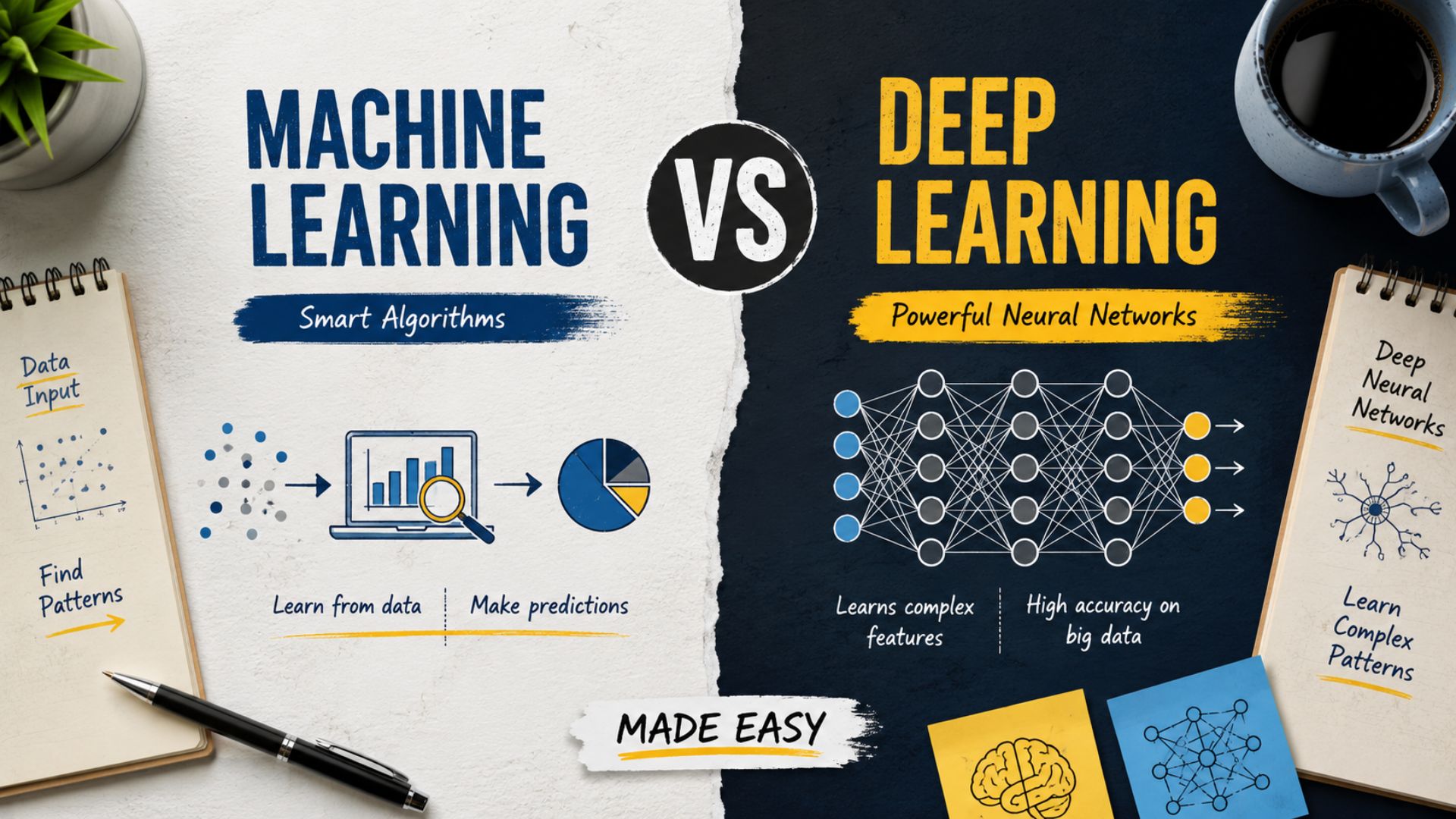

Machine Learning vs Deep Learning
Have you ever wondered how Netflix knows what movie you will enjoy next? Or how Face ID still recognizes you after a haircut? These smart features are not accidents. In fact, behind them are two powerful technologies: Machine Learning vs Deep Learning. Although both help computers learn from data, they work in very different ways. Moreover, many people think both terms mean the same thing. However, that is simply not true. Deep Learning is actually a special type of Machine Learning — and understanding the difference matters.
By the end of this guide, you will clearly understand Machine Learning vs Deep Learning — without any technical jargon.
What Is Machine Learning?
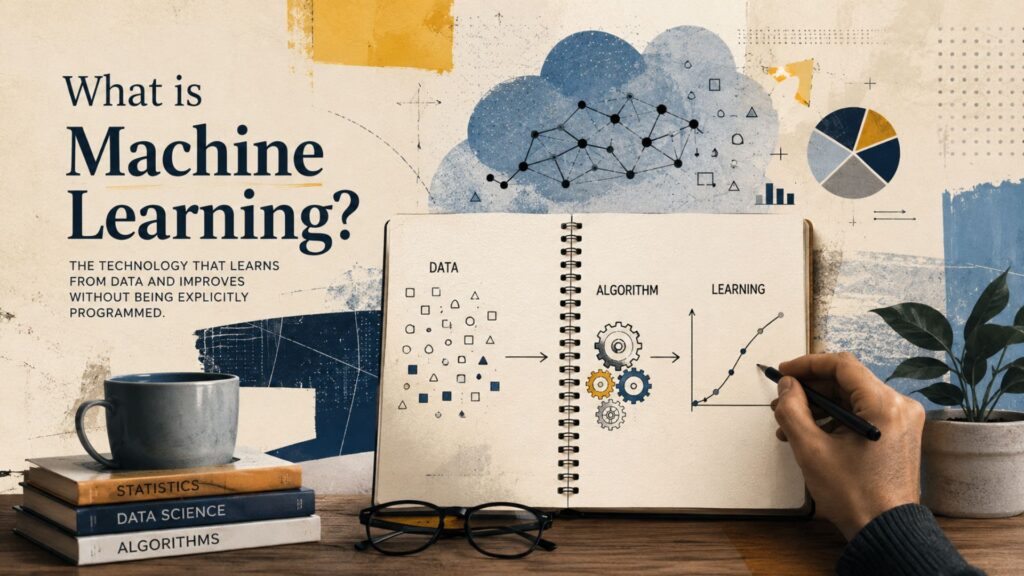
Machine Learning teaches computers to learn from examples. Instead of following fixed rules, the system studies data, finds patterns, and makes predictions on its own.
Think of teaching a child to recognize apples. You show red, green, big, and small ones. Over time, they recognize apples without a rulebook. Similarly, Machine Learning works the same way.
For example, spam filters do not follow a fixed list of blocked words. Instead, they study thousands of spam emails and learn what spam looks like. As a result, they catch new spam automatically — without any manual updates.
Read More: Machine Learning: The Ultimate Guide for 2026
Everyday Examples of Machine Learning
You use Machine Learning daily without even realizing it. In fact, some of the most familiar tools rely entirely on it. Common examples include:
- Netflix and YouTube recommendations
- Gmail spam filters
- Amazon product suggestions
- Credit card fraud detection
- Weather forecasts
- Search engine rankings
Because it is flexible, affordable, and easy to deploy, Machine Learning is now used across almost every industry worldwide.
What Is Deep Learning in Machine Learning vs Deep Learning?
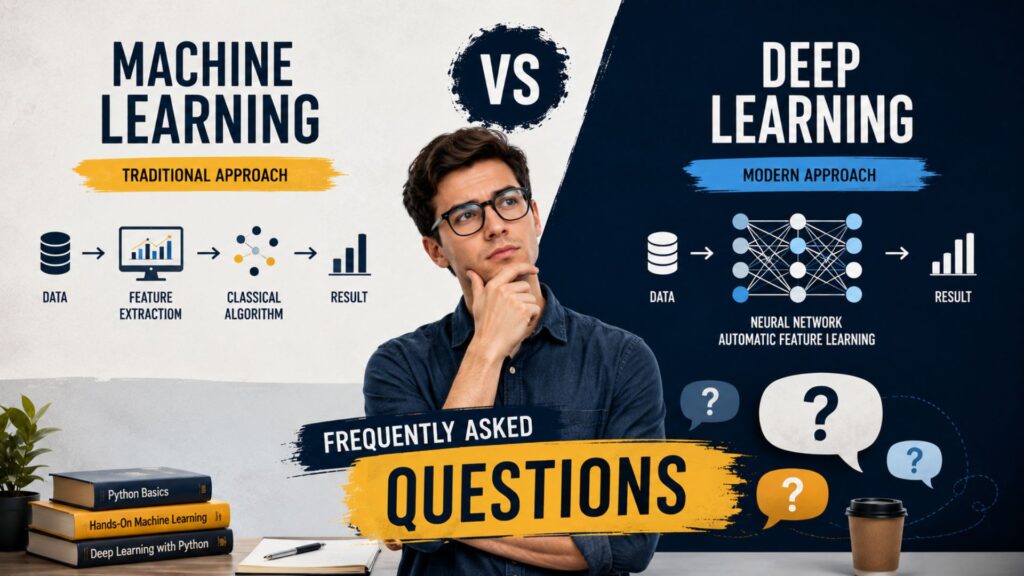
Deep Learning is a more advanced form of Machine Learning. Specifically, it uses artificial neural networks inspired by the human brain. These networks contain many layers. Moreover, each layer processes information step by step. That is precisely why it is called “deep.”
For example, when identifying a dog in a photo:
- The first layer detects basic edges
- The next layer identifies shapes like ears and eyes
- The final layer combines everything and recognizes: “This is a dog.”
As a result, when comparing Machine Learning vs Deep Learning, it becomes clear that Deep Learning handles tasks that traditional methods often cannot manage at all.
Everyday Examples of Deep Learning
Deep Learning, in particular, powers some of the most advanced technologies today. Examples include:
- Face recognition on smartphones
- Voice assistants like Siri and Alexa
- Self-driving cars
- Medical image analysis
- AI chatbots like ChatGPT
- Real-time language translation
In short, whenever AI feels surprisingly human-like, Deep Learning is almost always behind it.
Read More: Machine learning aids in discovery of sperm whale ‘alphabet’
Machine Learning vs Deep Learning: Quick Overview Table
Before going further, here is a clear side-by-side snapshot of Machine Learning vs Deep Learning.
| Feature | Machine Learning | Deep Learning |
|---|---|---|
| Uses Neural Networks | Sometimes | Always |
| Data Needed | Less | Much More |
| Training Speed | Faster | Slower |
| Hardware Needed | Standard Computer | Powerful GPU |
| Human Involvement | More | Less |
| Best For | Structured Data | Images, Audio, Video |
| Cost | Lower | Higher |
While this table provides a useful starting point, the real differences between Machine Learning vs Deep Learning become much clearer when you see how each one works in practice.
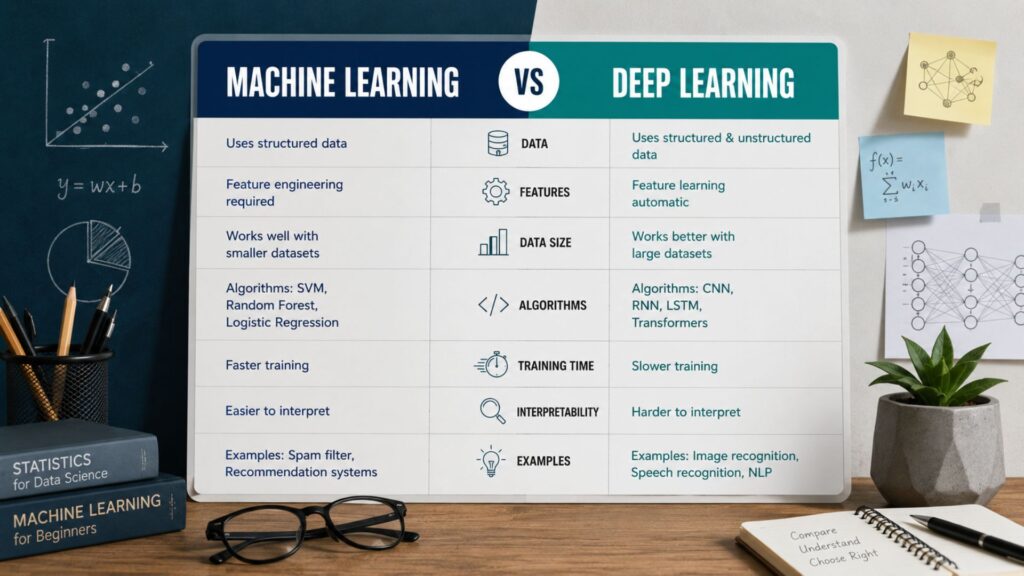
How Machine Learning Works in Machine Learning vs Deep Learning
Traditional programs follow strict, fixed rules. For example: “If the temperature is above 30°C, show a heat warning.” Machine Learning, however, is different. Instead of rigid rules, you give the system data and a goal. The system then discovers patterns entirely on its own.
The Basic Machine Learning Process
- Collect data – Gather information from available sources
- Clean the data – Fix errors and remove duplicates
- Train the model – Let the algorithm learn from the data
- Test the model – Check performance on new, unseen data
- Make predictions – Deploy the model for real-world use
Ultimately, the better the data, the better the results. That is why AI experts often say, “Good data beats complicated algorithms.”
Read More: Machine learning is set to speed up the detection of contamination in food factories
How Deep Learning Works in Machine Learning vs Deep Learning
Deep Learning follows the same overall goal as Machine Learning. Nevertheless, it uses layered neural networks instead of simple rules. Each layer focuses on specific patterns. Furthermore, as data moves through the layers, the system builds a progressively deeper understanding.
For example, when ChatGPT answers your questions, Deep Learning is actively working behind the scenes. Likewise, self-driving cars and medical imaging systems both rely heavily on it. Therefore, in the broader comparison of Machine Learning vs Deep Learning, both technologies play vital roles, just in very different situations.
Machine Learning vs Deep Learning: Key Differences Explained
Many beginners assume Deep Learning is simply a newer version of Machine Learning. While that is partly true, the real differences in Machine Learning vs Deep Learning go much deeper.
Think of it this way. Machine Learning is like riding a bicycle. Deep Learning, on the other hand, is like flying an airplane. Both involve learning; however, one is far more complex and demands far more resources.
1. Data Requirements in Machine Learning vs Deep Learning
One of the biggest differences in Machine Learning vs Deep Learning is how much data each needs. Machine Learning works well with small to medium datasets. For example, a company can train a solid model using just a few thousand customer records.
Deep Learning, however, needs far more data — often millions of examples. Without enough data, therefore, it performs poorly.
Read More: Why Data Science Is the Most In-Demand Skill in the AI Era?
| Data Factor | Machine Learning | Deep Learning |
|---|---|---|
| Dataset Size Needed | Small to Medium | Very Large |
| Performance with Limited Data | Good | Often Poor |
| Learning Speed | Faster | Slower |
Because of this gap, many small businesses still prefer Machine Learning over Deep Learning for their everyday projects.
2. Hardware Requirements in Machine Learning vs Deep Learning
Machine Learning runs comfortably on a standard laptop. Deep Learning, however, requires powerful GPUs. Without them, training can drag on for days or even weeks. As a result, Deep Learning projects cost significantly more to build and maintain.
3. Human Involvement in Machine Learning vs Deep Learning
Another key difference in Machine Learning vs Deep Learning is human input. With Machine Learning, experts manually choose the most useful data features. This is called feature engineering. For instance, when predicting house prices, a data scientist selects bedrooms, location, and property size as key inputs.
Deep Learning, in contrast, finds those features automatically. Consequently, it reduces human effort upfront. However, it increases the demand for data and hardware in return.
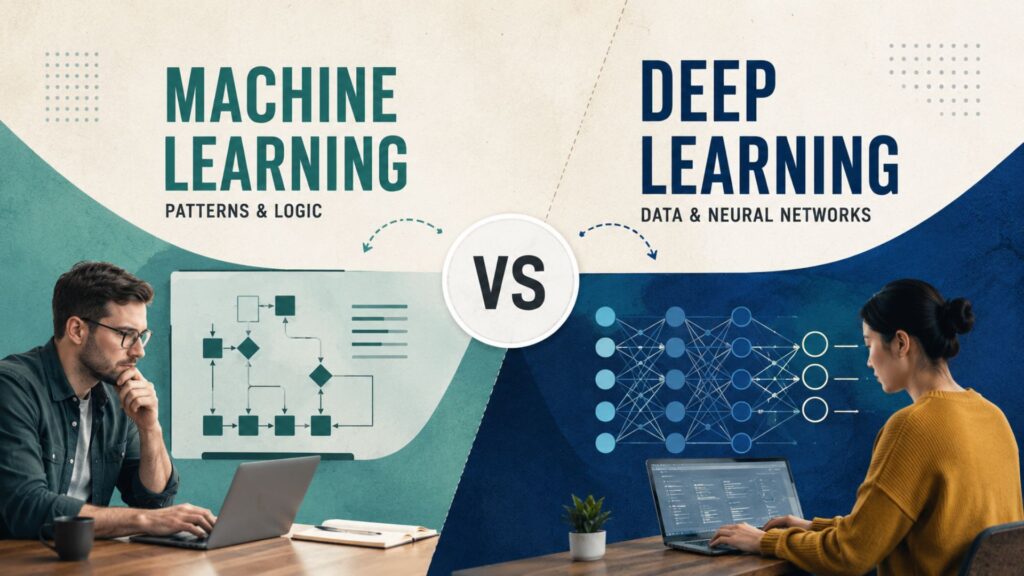
4. Accuracy on Complex Tasks in Machine Learning vs Deep Learning
Machine Learning performs very well on structured data – sales records, financial reports, and customer databases.
Deep Learning, on the other hand, excels with unstructured data – images, audio, video, and language. That is precisely why it powers face recognition, voice assistants, and self-driving vehicles. In those areas, therefore, Deep Learning reaches accuracy levels that Machine Learning simply cannot match.
5. Training Time in Machine Learning vs Deep Learning
If speed matters, Machine Learning wins easily. Most Machine Learning models train in minutes. Deep Learning models, however, may take hours or days.
Think of it like cooking. Machine Learning is making a quick sandwich. Deep Learning, on the other hand, is preparing a five-course meal. Both work — but one clearly takes far more time and effort.
Machine Learning vs Deep Learning: Full Comparison Table
Here is a complete comparison of Machine Learning vs Deep Learning for quick reference.
| Feature | Machine Learning | Deep Learning |
|---|---|---|
| Data Requirement | Lower | Higher |
| Training Time | Faster | Slower |
| Hardware Need | Standard Computer | Powerful GPU |
| Human Input | High | Low |
| Cost | Lower | Higher |
| Best For | Structured Data | Unstructured Data |
| Interpretability | Easier | More Difficult |
| Accuracy on Images and Speech | Good | Excellent |
Real-World Examples of Machine Learning vs Deep Learning
Where Machine Learning Is Used in Real Life
Netflix Recommendations — Netflix closely studies your viewing habits. Then, based on those patterns, it recommends shows you are likely to enjoy. As a result, you rarely run out of things to watch.
Email Spam Filters — Gmail continuously learns from millions of emails. Consequently, it filters spam automatically with almost no effort from you.
Fraud Detection — Banks scan millions of daily transactions. If something looks unusual, therefore, Machine Learning immediately flags it — often within seconds.
Product Recommendations — Amazon studies your browsing and purchase history. Machine Learning then predicts what you may want next. In turn, this increases sales and customer satisfaction.
Read More: Machine Learning Training Techniques: A Complete Guide for Accurate Models
Where Deep Learning Is Used in Real Life
Face Recognition — Deep Learning analyzes dozens of unique facial features. Furthermore, it reliably handles changes in lighting, angle, and accessories like glasses.
Voice Assistants — Siri, Alexa, and Google Assistant use Deep Learning to understand spoken language. Specifically, they convert speech to text, interpret your intent, and respond — all within seconds.
Self-Driving Cars — Autonomous vehicles use Deep Learning to recognize roads, signs, and pedestrians in real time. Moreover, every second on the road involves hundreds of rapid decisions.
AI Chatbots — This is one of the clearest examples of where Machine Learning vs Deep Learning truly matters. Specifically, Deep Learning is what separates a basic chatbot from a genuinely intelligent conversational AI.
Advantages and Challenges of Machine Learning vs Deep Learning
Advantages of Machine Learning
- Trains faster and therefore deploys quickly
- Costs less to build and maintain
- Easier to explain and interpret
- Moreover, Works well with smaller datasets
Advantages of Deep Learning
- Achieves higher accuracy on complex tasks
- Discovers features automatically — without human guidance
- Handles images, audio, and language effectively
- Moreover,Improves as more data becomes available
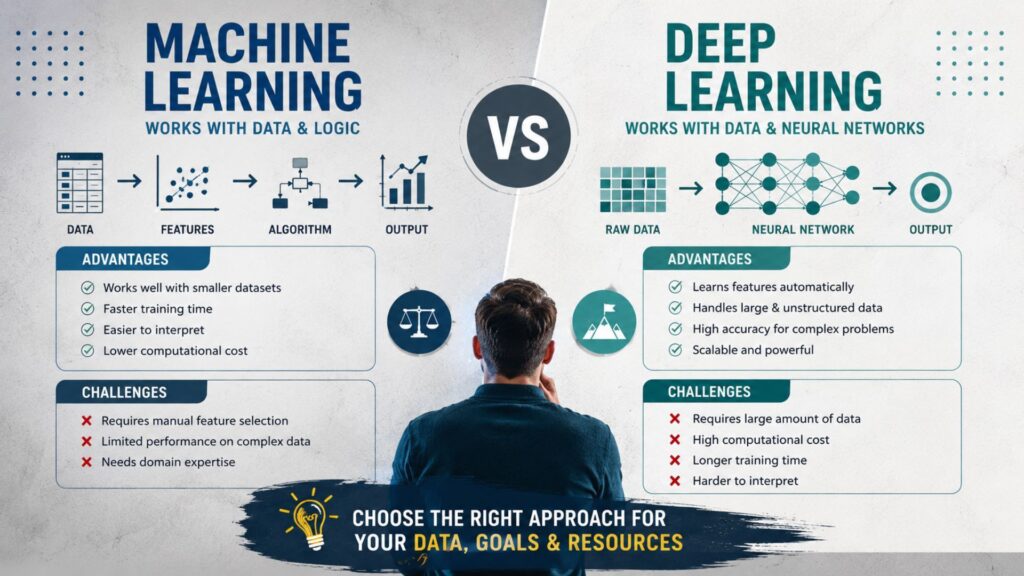
Challenges of Machine Learning
- Feature engineering takes considerable time and expertise
- Limited performance on complex or unstructured problems
Challenges of Deep Learning
- Requires expensive GPU hardware
- Needs very large datasets to perform reliably
- Training takes much longer than Machine Learning
- Difficult to explain — often called a “black box.”
Machine Learning vs Deep Learning: Which One Is Better for You?
After reviewing all these differences, most beginners ask one question: which is better — Machine Learning or Deep Learning? The honest answer, however, is neither is automatically better. Instead, the right choice always depends on your problem, data, and budget.
Think of transportation. A bicycle and an airplane both get you somewhere. However, one suits a short trip. So, The other makes far more sense for crossing continents. Similarly, Machine Learning vs Deep Learning works the same way.
Choose Machine Learning When:
- Your dataset is small to medium in size
- You need fast results on a limited budget
- The problem is relatively straightforward
- You need to explain how decisions are made clearly
Choose Deep Learning When:
- You have a very large dataset available
- You are working with images, audio, or video
- Maximum accuracy is essential
- The task is highly complex and unstructured
For instance, self-driving cars generate massive sensor data every second. Traditional Machine Learning, therefore, cannot process that reliably. As a result, Deep Learning becomes the only practical option. That is precisely why Tesla, Google, and OpenAI invest so heavily in it.
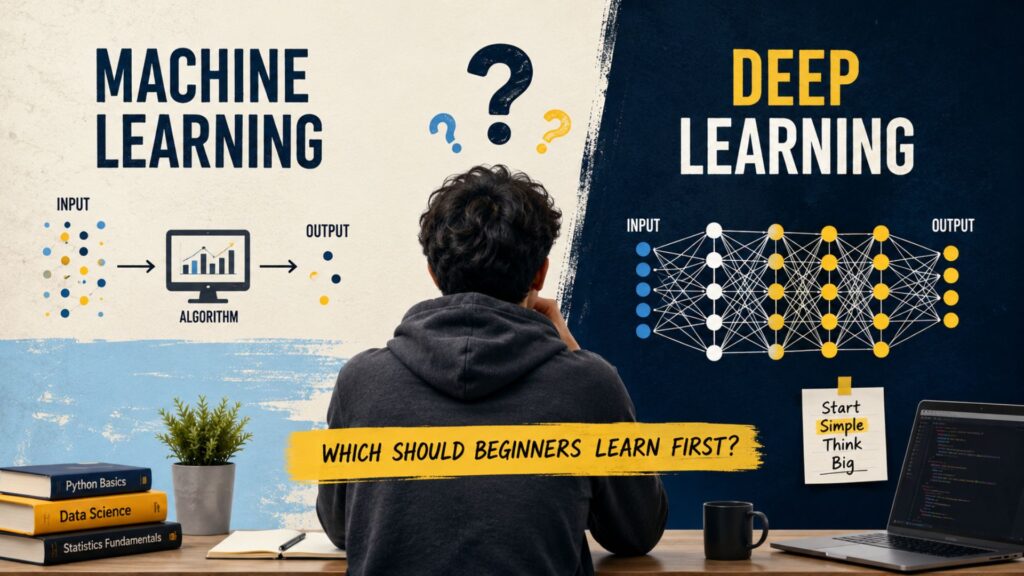
Which should beginners learn first?
Start with Machine Learning. Although Deep Learning gets more media attention today, Machine Learning teaches the most important fundamentals first. So, It shows you how data works, how models learn, and how predictions are made. Once those foundations are solid, Deep Learning becomes far easier to understand. In fact, it simply builds on top of what you already know.
Read More: Machine learning in physics
Recommended Learning Path for Machine Learning vs Deep Learning
- First, learn basic AI concepts
- Then, study Machine Learning fundamentals
- Next, practice supervised and unsupervised learning
- After that, move into Deep Learning and neural networks
- Finally, explore advanced real-world applications
Common Myths About Machine Learning vs Deep Learning
There is a lot of misleading information out there. Therefore, let us clear up the most common myths about Machine Learning vs Deep Learning once and for all.
Myth 1 — Deep Learning will replace Machine Learning. This is not true. In reality, Machine Learning remains the better choice for countless everyday tasks. In fact, many businesses still rely on it daily.
Myth 2 — AI thinks like humans. It does not. Instead, AI finds patterns in data and makes predictions. That process is fundamentally different from human reasoning. Moreover, AI has no emotions or intuition.
Myth 3 — More data always means better results. Not always. In fact, poor-quality data produces poor results — regardless of volume. Therefore, data quality matters just as much as quantity.
Myth 4 — Machine Learning is only for large tech companies. Not anymore. Today, healthcare, retail, and education all widely use Machine Learning. As a result, it is now accessible to organizations of every size.
Myth 5 — Deep Learning is always more accurate. Not necessarily. For structured data problems, Machine Learning often performs just as well. In some cases, it even performs better.
Read More: Text-to-Speech: A Complete Guide for Better Digital Content
Machine Learning vs Deep Learning: Quick Summary Table
| Question | Machine Learning | Deep Learning |
|---|---|---|
| Uses Neural Networks? | Sometimes | Always |
| Need Large Datasets? | Not Always | Usually |
| Faster Training? | Yes | No |
| Easier for Beginners? | Yes | No |
| Better for Images and Speech? | Sometimes | Yes |
| Lower Cost? | Yes | No |
In short, one sentence perfectly sums up Machine Learning vs Deep Learning: Deep Learning is a specialized branch of Machine Learning that uses neural networks to solve more complex problems.
Frequently Asked Questions
What is the main difference between Machine Learning vs Deep Learning?
Machine Learning uses traditional algorithms to find patterns. Deep Learning, on the other hand, uses multi-layered neural networks. As a result, it handles images, audio, and language far more effectively.
Is Deep Learning part of Machine Learning?
Yes. Deep Learning is a subset of Machine Learning. However, not every Machine Learning model uses Deep Learning. In fact, most do not.
Which is easier for beginners?
Machine Learning is much easier to start with. In fact, most people study it first. After that, they gradually move into Deep Learning.
Is ChatGPT Machine Learning or Deep Learning?
ChatGPT uses Deep Learning. Specifically, it relies on large neural networks trained on massive amounts of text data.
Which programming language works best?
Python is the top choice for both. It offers Scikit-learn for Machine Learning and TensorFlow or PyTorch for Deep Learning. Moreover, Python has a huge learning community for beginners.
Final Thoughts
Machine Learning vs Deep Learning may seem confusing at first. However, the difference is actually quite straightforward.
Machine Learning is faster, cheaper, and easier to use. It works best for everyday business problems. Deep Learning, on the other hand, is more powerful.
Moreover, It excels at complex tasks involving images, speech, and language.
Neither is better overall. Instead, the right choice depends entirely on your data, budget, and goals. Therefore, always match the tool to the problem — not the other way around.
Start with Machine Learning. Build a solid foundation first. Then, when you are ready, move into Deep Learning. In fact, most successful AI professionals follow exactly this path.
Then, The sooner you understand Machine Learning vs Deep Learning, the better prepared you will be for the AI-driven world ahead.
Read More: Freelancing Jobs Writing Made Easy: Beginner-Friendly Income Ideas
Call To Action
Need SEO content that ranks on Google and keeps readers engaged?
I create:
- SEO blog posts
- Keyword-focused articles
- Human-style content
- Easy-to-read blogs
- High-engagement website content
Let’s build content that performs.
📧 Email: craziya167@gmail.com
Author Bio
Digital Raziya is an SEO content writer specializing in AI, machine learning, and digital marketing. She creates simple and clear content that is easy to read. In addition, she focuses on SEO-optimized articles that help websites grow. Overall, her goal is to make complex topics easy for everyone.