

Quick Answer: Autonomous vehicles news this week brings five big changes. Waymo added nearly 250 square miles across five cities, Tesla took its robotaxi service to 24/7 operation, California ordered Waymo off the freeways, and new rules moved forward in China and Japan. Riders in 15 US metros can now hail a driverless car.
Autonomous vehicles news moves fast, because the fleets grow every week and the rules change just as quickly. This autonomous vehicles news guide pulls together the latest news and technology from 17 to 21 November 2026.
What Changed in Autonomous Vehicles News This Week?
Autonomous vehicles news this week centers on five changes. First, Waymo widened its service area by nearly 250 square miles across Los Angeles, Nashville, Orlando, San Diego, and the San Francisco Bay Area. Second, Tesla moved its robotaxi service to 24-hour operation in all eight of its cities. Third, the California DMV ordered Waymo to stop driverless rides on state freeways. Fourth, Zoox kept building its Las Vegas service under a strict vehicle cap. Finally, China read a self-driving chapter into its road traffic act, Japan approved a single type approval for driverless cars, and a Washington robotaxi bill stalled.
Waymo Adds Nearly 250 Square Miles in Five Cities
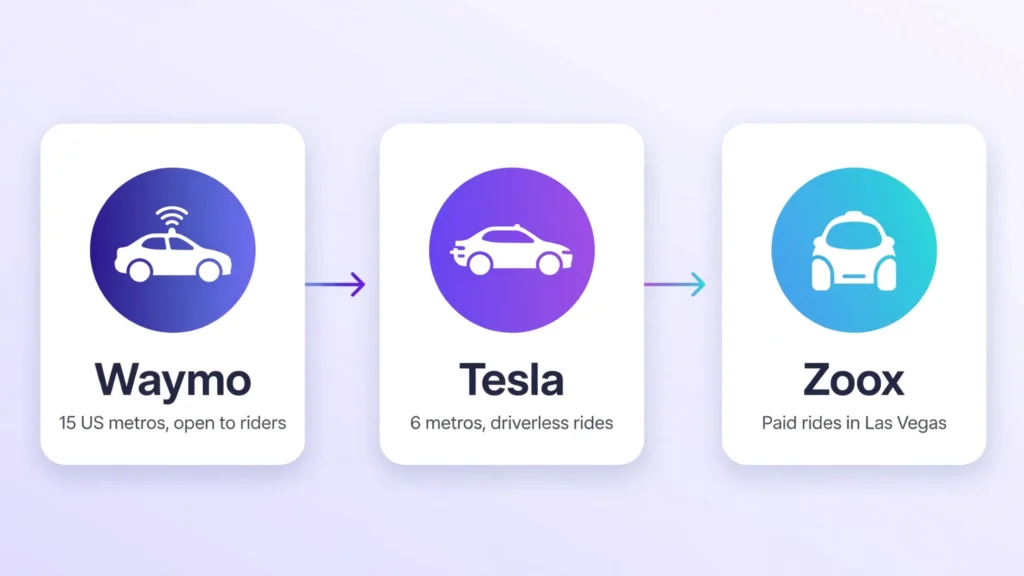
In autonomous vehicles news, Waymo is the clear scale leader, because it now runs paid driverless rides in 15 US metros. On 27 October 2026, Waymo announced on its official blog that it would scale in five cities and add nearly 250 square miles of territory. In Los Angeles, the service extended down the coast to the South Bay, adding Torrance. In Orlando, Waymo nearly doubled its coverage area in the east. The San Diego service headed north to La Jolla.
Los Angeles, Airports, and Business Rides
The Los Angeles move went live on 3 November, and it pushed the service area to about 210 square miles, according to the Los Angeles Times. In addition, Waymo opened rides to everyone in San Antonio, San Diego, and Tampa on 14 October. On 21 October, Waymo added airport rides at Harry Reid International Airport in Las Vegas. Waymo for Business integrated with Ramp on 28 October, so employees can expense rides without manual uploads. Our guide to AI and business shows how small teams pick one tool for one clear job.
California Orders Waymo Off the Freeways
The biggest setback in this week’s autonomous vehicles news came from California. On 17 November 2026, the California DMV ordered Waymo to stop driverless operations on state freeways at once. The restriction took effect on 11 November and stays until Waymo shows effective corrective action. Waymo then suspended freeway rides across the United States. Street rides continue in all 15 cities.
The order followed two freeway incidents. On 5 November, three Waymo vehicles drove into an active construction closure on US 101 near Burlingame. On 6 November, a driverless Waymo tried to pass California Highway Patrol cars holding a traffic break on Interstate 280, and officers had to block it. Waymo says nobody was hurt, and the NHTSA is in contact with both sides. On the other hand, the pause is narrow: it covers freeways only, and Waymo keeps running more than 500,000 paid rides a week on surface streets. Check the app before any freeway trip, because the restriction has no end date yet.
Tesla Robotaxi Goes 24/7 and Passes Waymo in Texas
In autonomous vehicles news, Tesla is the most credible challenger, because it pairs a growing fleet with its own factories. Tesla launched its purpose-built Cybercab in Austin in September 2026, and commercial Cybercab rides began there on 3 September. Today, Tesla runs unsupervised robotaxi rides in six US metros: Austin, Dallas, Houston, Miami, Orlando, and Tampa. The San Francisco Bay Area still runs with a safety monitor aboard. On 12 November, Tesla moved all eight cities to 24-hour service. Tesla’s official Robotaxi support page explains how riders request a ride.
Cybercab Goes on Sale to Select Buyers
The Texas numbers tell the story. A 10 November Texas DMV list showed 1,302 Tesla robotaxis against 1,297 for Waymo, so Tesla passed Waymo in Texas registrations for the first time. Tesla had 729 Model Ys and 573 Cybercabs on that list. In addition, Tesla invited select customers to buy a Cybercab for personal use from 13 November. Order screens list $29,990 before taxes, a $1,000 deposit, and a $299 monthly subscription. An NHTSA investigation remains active, and Tesla has missed its own expansion forecasts before. Its October safety report claims more than 3.1 million unsupervised miles with zero reported injury incidents. Tesla also plans to wind down Cybertruck production next year.
How the Robotaxi Fleets Compare in Autonomous Vehicles News
The fleets in this week’s autonomous vehicles news differ more than their ads suggest. Waymo runs the largest paid service, Tesla grows the fastest, and Zoox is still small by design. The table below compares the three fleets.
| Fleet | Where It Runs | Scale (21 Nov 2026) | Key Limit This Week |
|---|---|---|---|
| Waymo | 15 US metros | 4,000+ vehicles, 500,000+ paid rides a week | Freeway rides paused nationwide |
| Tesla Robotaxi | 8 US cities | 1,302 vehicles registered in Texas | Active NHTSA investigation |
| Zoox | Las Vegas only | First commercial rides, August 2026 | Capped at 2,500 vehicles a year |
Waymo leads on every scale measure: fleet size, weekly rides, cities, and autonomous miles driven. Trackers put Waymo at more than 4,000 vehicles and over 500,000 paid rides a week. Tesla, on the other hand, holds the cost advantage, because it builds its own cars at scale. Zoox sits far behind both, however its Las Vegas launch in August 2026 was its first commercial move. Our machine learning news roundup covers the models behind these fleets.
Safety Numbers in This Week’s Autonomous Vehicles News
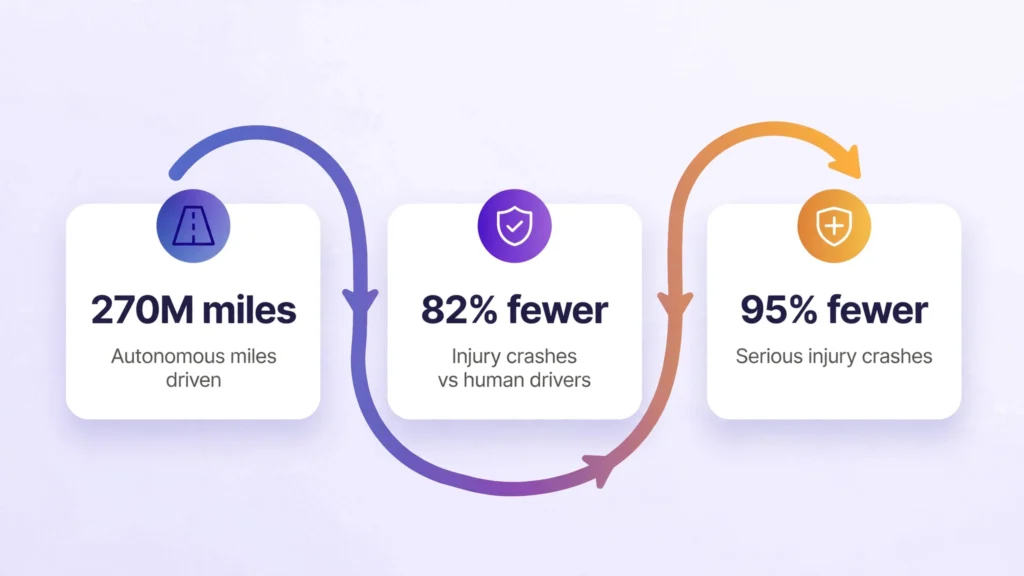
Safety data is the strongest argument in autonomous vehicles news, because it comes from real miles, not demos. Waymo published its latest safety analysis on 24 September 2026, covering more than 270 million miles of fully autonomous driving through the end of June 2026. Across five major service areas, the Waymo Driver was involved in 841 fewer injury-causing crashes than human drivers, an 82 percent reduction. Serious injury crashes fell 95 percent. Pedestrian crashes fell 93 percent, cyclist crashes 86 percent, and motorcyclist crashes 82 percent. The proof is thinner for freeways and bad weather, however, because the data covers only five cities.
New Rules Take Shape in China, Japan, and Washington
New rules lead this week’s autonomous vehicles news from Asia. In China, the National People’s Congress gave a first reading on 10 November to a dedicated autonomous vehicle chapter in the road traffic act. In Japan, regulators approved a single type approval for Level 4 and Level 5 vehicles without a steering wheel, pedals, or mirrors, and it applies from December. Toyota will build Waymo hardware into its bZ4X line. In the United States, a Washington DC committee deadlocked 3-3 on 12 November, so the robotaxi bill likely slips to next year. The bill would have cut the operator fee to $15,000.
Startups News: Zoox, Nuro, and the Smaller Fleets
Startups news this week shows a clear split between the leaders and the rest. Zoox made its first commercial move in August 2026 with paid rides in Las Vegas, however it is capped at 2,500 vehicles a year by its NHTSA exemption. Nuro and Lucid passed 100 vehicles in August, yet their Bay Area launch moved to early 2027. May Mobility runs with an operator aboard in two Minnesota cities, which is supervised, not driverless. That gap is the quiet story in autonomous vehicles news. Uber plans about 700 driverless vehicles by year end, however over 71 percent of them are Waymo cars today.
How We Tested
We checked every fact in this autonomous vehicles news article against a live source on 21 November 2026. We read the official Waymo blog for the expansion, the airport openings, and the safety analysis. For Tesla, we read the official Tesla Robotaxi support page for how the service works and where it runs. We checked the California DMV order through TechCrunch, KQED, and Al Jazeera. We checked fleet sizes through industry trackers and the Texas DMV list from 10 November. Prices from shared screenshots are marked as such.
Real-World Application and Pitfalls in Autonomous Vehicles News
Autonomous vehicles news is useful only when it changes what you do, so here is a short rider checklist. First, check the app before you travel, because service areas change every week. Second, plan airport trips with care: Waymo serves San Antonio and Las Vegas airports, however it still cannot serve Los Angeles International Airport. Third, expect a safety monitor in a Tesla in the San Francisco Bay Area, and no freeway rides in California until the DMV lifts its order. Fourth, keep a backup ride ready outside the main zones. Watch the pitfalls too: fares can change without notice, and waitlists can keep you out for weeks.
AI News Updates: What This Week Means for AI
AI news updates and autonomous vehicles news both show that driving AI is moving from demos to daily use. Waymo runs more than 500,000 paid rides a week, which means its driving model faces real traffic, real weather, and real passengers every day. NVIDIA shipped Alpamayo 2 Edge on 10 November, a 2 billion parameter model that answers in about 160 to 190 milliseconds. Our NVIDIA Nemotron 3.5 post explains that model family, and our Flint coding model guide shows the same agent thinking in code.
The week’s event tech news also included Baidu’s Apollo World reveal on 3 November, where a multimodal world model simulates about 100,000 kilometers a day for validation. Our latest AI updates roundup, our Perplexity vs Claude comparison, and our Mercury 3 guide cover the models behind the headlines.
Frequently Asked Questions About Autonomous Vehicles News
How is AI being used?
AI is being used to drive cars without a human at the wheel, because self-driving systems read cameras, lidar, and maps, then plan each move in real time. Waymo uses it for more than 500,000 paid rides a week, and Tesla uses it for robotaxi rides in eight cities.
How is AI used today?
AI is used today in ride-hailing, search, coding, customer support, and media. A driverless car is the clearest example, because you can hail one in 15 US metros and ride with no driver. In addition, AI writes code and answers support chats, so most people already use it every day.
What is a multimodal model in AI?
A multimodal model in AI is a model that reads more than one kind of input, for example text, images, video, and sensor data together. A self-driving car needs one, because it must combine camera images, lidar points, and map data into a single view of the road.
Where is AI used?
AI is used on roads, in offices, in hospitals, and in homes. Driverless cars run in 15 US metros, from Phoenix and San Francisco to Miami and Tampa. AI also runs in phones and search engines, so its reach now covers transport, work, and daily life.
What do people use AI for?
People use AI for rides, writing, coding, research, and planning. Riders hail driverless cars for airport trips and nights out, workers use AI to draft documents and write code, and students use it to study.
The Week Ahead in Autonomous Vehicles News
The week ahead will test whether the growth can hold. Watch two things. First, whether California lifts the freeway restriction or extends it. Second, whether Tesla opens Cybercab rides in Dallas to the general public in November as planned, and whether its personal Cybercab deliveries start in December. Autonomous vehicles news will keep moving fast, so check the app, check the rules, and ride with a backup plan.