
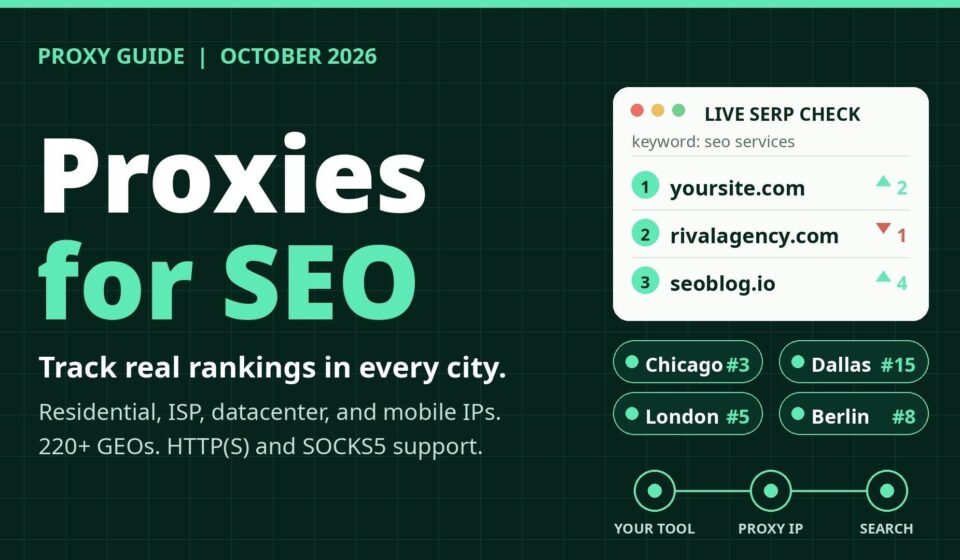

Proxies for SEO route your tool traffic through other IP addresses, so your rank tracker, crawler, or scraper can check results from many places at once. Search engines personalize results by location and limit how many queries one IP can send. A good proxy setup fixes both problems in one move.
The problem is simple: your ranking data is only as honest as the IP behind it. One office IP shows you one city, one device profile, and one throttled view. Then CAPTCHA triggers and IP blocking cut your checks short. So teams make budget decisions on partial data.
The quick fix is to match the proxy type to the workflow before you spend anything. First, use residential IPs where trust and location accuracy matter. Then, use datacenter IPs where speed and volume matter. Finally, test one small workflow before you scale.
This article explains what these proxies do and how the four main types differ. It also gives a safe workflow, a checklist, honest limits, and answers to common buyer questions.
Key Takeaways
- A proxy server hides your real IP and routes SEO tool requests through addresses in your target cities and countries.
- Residential proxies suit rank tracking and SERP checks, because search engines trust home IPs more than datacenter ranges.
- Datacenter IPv4 and IPv6 proxies suit bulk scraping and data collection, because they run faster and cost less per request.
- Match the type to the workflow first, then compare each proxy provider on pool size, geo targeting, protocols, and support.
What Are Proxies for SEO?
A proxy server sits between your tool and the website you visit. Your tool sends its request to the proxy first, and the proxy forwards it from its own IP address. So the site sees the proxy IP, not your office IP.
That detour changes what your data looks like. First, location based search results become testable, because you can pick an IP in your target city. Also, IP rotation spreads requests across many addresses, so one IP never sends a suspicious burst.
Most SEO proxies speak three protocols. HTTP proxies handle normal web requests, and HTTPS proxies add encryption for secure pages. SOCKS5 proxies pass almost any traffic type, which is why scrapers prefer them. You will see SOCKS5 proxies for scraping in almost every serious data setup.
Why Rank Tracking Needs Proxies for SEO
Rank tracking looks simple: you type a keyword, and a tool reports a position. However, that position changes by city, by device, and by language. A keyword can rank third in Chicago and fifteenth in Dallas on the same morning. So a tracker that checks from one location reports one local truth, not your market truth.
Volume creates the second problem, because a serious tracker checks thousands of keywords every day. Search engines watch for that pattern from a single address. Then rate limits slow the checks, CAPTCHA triggers interrupt them, and repeated abuse gets the IP blocked. Proxies for keyword rank tracking spread those checks across a pool, so each IP behaves like a normal user during SERP monitoring.
Accuracy creates the third problem. Personalized results follow the history and location of the IP. Clean IP addresses with no history return neutral results. That is why the honest answer to why use proxies for SEO starts with data quality, not with price.
The 4 Types of Proxies for SEO
Every proxy type trades trust against speed and price, and no type wins every workflow, so read this section as a matching exercise.
Residential proxies: trusted IPs for accurate checks
Residential proxies route requests through real home connections from internet providers, and search engines trust those addresses. So residential proxies for SEO give you the most natural view of a results page, and that trusted IP quality comes with precise targeting by country, city, and provider.
Rotation is their second strength: rotating proxies change your IP per request, per few minutes, or per session, and sticky sessions hold one IP for multi-step checks. However, residential traffic costs the most. Proxy-Seller lists a residential pool of 47M+ IPs across 220+ locations, with rotation by time, request, or sticky session.
ISP proxies: stable IPs with datacenter speed
ISP proxies are static residential proxies: an internet provider assigns the address, but a datacenter hosts the connection. You keep one IP for days or weeks. Requests still travel at datacenter speed, up to 1 Gbps on Proxy-Seller’s ISP plans. That mix suits daily rank tracking, account-safe automation, and geo targeted ad checks.
The datacenter vs residential proxies debate misses this middle option. In the residential vs ISP proxies choice, trust stays high on both sides, but ISP proxies for SEO add a stable session. Teams that shortlist residential and ISP proxies from one provider can test both styles before committing a full budget.
Datacenter IPv4 and IPv6 proxies: speed for bulk work
Datacenter proxies come from server farms, not from homes. IPv4 proxies use the classic format that every site accepts, and IPv6 proxies use the newer format. Proxy-Seller lists IPv6 pools above 1.2 million unique IPs, starting at $0.02 per IP.
Speed and price make datacenter IPs the bulk workhorse. Which proxy is best for web scraping? For public pages with light defenses, datacenter wins on cost per finished page. Still, search engines recognize datacenter ranges faster than home ranges. So save datacenter IPs for web scraping, web crawling, and price monitoring, and keep residential IPs for SERP checks. The IPv4 vs IPv6 proxies choice then becomes simple: IPv4 for compatibility, IPv6 for cheap scale.
Mobile proxies: results the way phone users see them
Mobile proxies route traffic through real carrier networks on 4G and 5G connections. Most searches happen on phones, so mobile results differ from desktop results. Mobile proxies for SEO testing show you the layout, ads, and local pack a phone user sees. Proxy-Seller sources its mobile pool from carriers across 20+ countries, with targeting by country and city. Mobile IPs also rotate naturally, because carriers reassign them often. However, mobile traffic costs more, and speeds vary by carrier, so most teams use mobile proxies for spot checks, not for bulk collection.

Proxies for SEO: 7 Practical Use Cases
The workflows below cover most paid proxy usage in SEO teams, and each names its best-fit type.
1. Proxies for rank tracking and SERP checks. Proxies for SERP tracking need many locations at steady volume. Residential IPs return the most accurate local positions, and ISP IPs return almost the same accuracy with stable sessions. So agencies mix both: residential for weekly deep checks, ISP for daily tracking.
2. Competitor research without revealing your IP. Competitor research means visiting rival sites and rankings without revealing your own address. Proxies for competitor research let you compare prices, landing pages, and ad copy across markets in one pass. Pair that view with our guide to Ahrefs alternatives for SEO research for a clean second data source.
3. GEO testing and local SEO. Search results change at city level, so GEO testing needs IPs inside the exact market. Geo targeted proxies route your GEO-specific SERP checks through that city, and you see the same local pack and map results as a customer there. Proxies for local SEO also make local SEO testing repeatable before an international SEO launch.
Proxies for SEO: Data Collection and Monitoring
4. Web scraping and data collection. Scrapers collect prices, reviews, listings, and search pages at scale. Proxies for web scraping spread those requests, and proxies for data collection keep the pipeline running when one IP slows down. Datacenter IPs carry the bulk load, and residential IPs handle guarded pages.
5. Link building research at scale. Link building teams check thousands of prospect sites and backlink profiles. Proxies for link building research keep those checks fast and location neutral. Backlink monitoring also benefits: you can verify that a placed link still renders in the target country.
6. Ad verification and price monitoring. Ads change by location, device, and time of day. Proxies for ad verification show your team the exact ad a user in another city sees, including competitor ads on your brand terms. Proxies for price monitoring run the same trick on retailer pages, so your prices stay honest in every market.
7. AI search visibility checks. AI answers now cite sources and shift by region and language. Proxies for AI search visibility let you ask the same question from many locations and compare which brands each answer names. Our Perplexity vs Claude comparison shows how much two AI tools differ on one question, and location checks widen that gap further.
How to Choose Proxies for SEO by Workflow
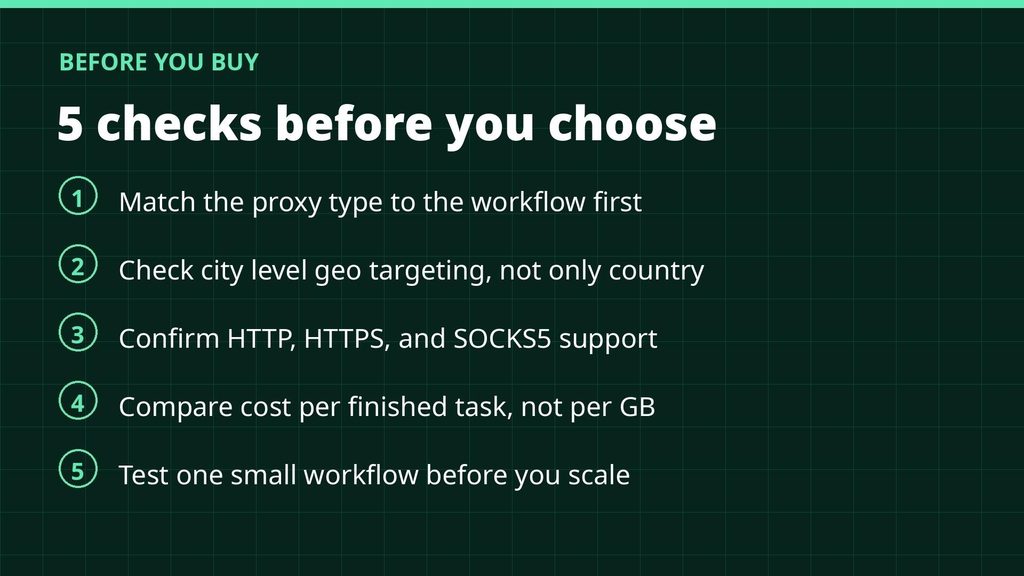
Start with the workflow, not with the brand. The best proxies for SEO for a scraping pipeline will waste money inside a rank tracker. So list your top three jobs first, then match each one to a type above. This is how to choose a proxy for SEO in practice: workflow first, brand last.
First, check geo targeting depth. Country targeting is the minimum for international work, and city targeting is the real requirement for local SEO, because rankings change inside one metro.
Then, check protocols and tool fit. Your stack needs HTTP, HTTPS, or SOCKS5 support, and most tools accept all three. Also, check rotation control: per request, timed, or sticky session. Finally, check the dashboard: separate lists per client, fast exports, and renewal without a support ticket.
One provider that covers all four types in one dashboard is Proxy-Seller. Its site lists residential, ISP, datacenter IPv4 and IPv6, and mobile proxies across 220+ GEOs, with HTTP(S) and SOCKS5 support. Ai Blitzo readers can use the code AIBLITZO15 for 15% off any purchase. Treat it as one shortlist option, and test it against your own checklist before you scale.
Price models differ, so compare cost per finished task, not cost per gigabyte or per IP. A cheap pool that fails half your checks costs more than a pricier pool that finishes cleanly. Also, ask how each provider sources its IPs: ethically sourced pools protect your brand.
A Safe Workflow for Proxies for SEO
A careful setup protects your accounts, clients, and data quality. This is how to use proxies for SEO safely, step by step.
- First, define one workflow and one success measure, such as accurate ranks for 200 keywords in three cities.
- Then, pick the matching proxy type and buy the smallest useful plan.
- Also, separate lists by client and workflow, so one blocked list never poisons another job.
- Next, pace your requests, and respect each site’s terms and robots rules.
- Then, verify accuracy weekly against a manual check from the same city.
- Finally, scale the workflows that pass, and cut the ones that fail twice.
Automation helps once the manual version works. Teams can borrow the guardrails in our guide to AI automation workflows that pay off, because SEO automation fails like business automation fails: too much volume, too little checking. Keep a human review step for data that drives client budgets.
Honest Limits
Proxies solve location and volume problems, not every SEO problem. First, a proxy cannot fix thin content, weak links, or a slow site. Your rankings still depend on the page itself.
Also, proxies carry rules and risks. Some sites forbid automated access in their terms, and your team owns that legal and ethical call, not the provider. Cheap pools recycle abused IPs, so a bargain plan can return worse data than no plan at all. Finally, search engines keep improving bot detection, so every setup needs regular accuracy checks.
Costs also scale with ambition, so budget for the markets that drive revenue first, and sample the rest.
Proxies for SEO: FAQs
Q: What is a proxy for SEO?
A proxy for SEO is a proxy server that routes your SEO tool traffic through a different IP address. Rank trackers, crawlers, and scrapers use that IP to check search results, visit pages, and collect data as if the request came from another user or another location.
Q: Why do SEO tools need proxies?
SEO tools need proxies because one IP address can only send a limited number of search queries before search engines slow it down, show CAPTCHAs, or block it. Proxies spread those requests across many IPs and locations, so tools keep collecting accurate ranking and page data.
Q: Which proxy type is best for rank tracking?
Residential proxies are usually best for rank tracking, because their IPs come from real home connections and search results look natural and location accurate. ISP proxies rank close behind for daily tracking, because they keep one stable IP with datacenter level speed.
Q: Are residential proxies better for SERP tracking?
Yes, residential proxies are usually better for SERP tracking when accuracy matters most, because search engines trust home IP addresses more than datacenter ranges. Datacenter proxies still win on speed and price for bulk SERP data, so many teams use both.
Q: How do proxies help with competitor research?
Proxies help with competitor research by letting your tools visit competitor sites and search results from many locations without revealing your own IP address. You can compare rankings, ads, prices, and page changes across markets in one clean pass.
Q: Can proxies help check search results in other countries?
Yes, proxies with location targeting route your searches through IP addresses in the target country or city, so you see the same rankings, ads, and local results that a user there sees. Providers such as Proxy-Seller offer targeting across 220+ GEOs.
Q: How much do proxies for SEO cost?
Prices vary by proxy type, volume, and billing model. Residential proxies usually sell by traffic, datacenter IPv4 and IPv6 proxies usually sell per IP, and Proxy-Seller lists residential plans from $3.5 per GB and IPv6 from $0.02 per IP on its site. Readers can also use the code AIBLITZO15 for 15% off any Proxy-Seller purchase.
The Bottom Line
They turn guesswork into measured local data. Match the type to the workflow: residential for trusted SERP checks, ISP for stable daily tracking, datacenter for bulk collection, and mobile for phone-first results. Then test small, verify accuracy weekly, and scale only what passes. That discipline, not pool size, decides whether proxy data improves your rankings or just inflates your reports.
Run an SEO, AI, or SaaS tool that helps teams work this clearly? Write for Ai Blitzo: real editors, fast replies, and your work in front of people who actually use these tools.