

By Zarirah Asif | UK AI Biosecurity Lab Updated October 25, 2026
The UK AI Biosecurity Lab is the world’s first dedicated AI biosecurity organisation, according to the UK government. It will use frontier AI to spot biological threats earlier and to speed up vaccines, treatments, and other medical countermeasures for pandemic preparedness. The government announced it on October 24, 2026, as part of a National AI Biosecurity Initiative.
The problem is sharp. AI now speeds up real science, and it also lowers barriers to harmful biological work. A model that helps a researcher design a vaccine can also help a bad actor understand a pathogen. So governments cannot just celebrate AI progress and ignore AI risk.
The fix the UK chose is an institution, not a press release. It will bring AI talent and biology talent under one roof, with public money and private model access behind it. That structure matters more than the headline number.
This article explains what the lab is, where the money comes from, and who does what. Then it separates what the announcement proves from what it only promises. Finally, it gives you five questions to ask about any AI safety announcement.
Key Takeaways
- The UK government announced the UK AI Biosecurity Lab on October 24, 2026, backed by £100 million in public funding.
- OpenAI and Anthropic together commit up to £200 million, but that money arrives as compute and model credits, not cash.
- The lab will operate as an independent non-profit, with a scientific advisory committee and partners across government, academia, and industry.
- Its first jobs are early detection of biological threats and faster medical countermeasures.
- No director, location, start date, or success metric was announced, so the lab is a funded plan, not yet a working institution.
[IMAGE: uk-ai-biosecurity-lab-images/featured-biosecurity-lab-16×9.jpg (featured image, 16:9) | Alt: “UK AI Biosecurity Lab: the new UK lab using frontier AI to detect biological threats”]
What Is the UK AI Biosecurity Lab?
The UK AI Biosecurity Lab, called AIBL, is a new UK institution for AI and biosecurity. The government announcement says it will harness frontier AI to strengthen biosecurity. In plain terms, it will build practical tools that help the UK understand, prevent, detect, and respond to biological threats.
Its mission has two clear first jobs. First, it will build capabilities for early detection of emerging biological threats. Second, it will accelerate vaccines, treatments, and other medical countermeasures. Those two jobs cover both sides of biosecurity: see the threat sooner, and respond faster once you see it.
First, the lab will work with partners across the UK system. It will support national biosecurity centres and the life sciences industry. Partners include the UK Health Security Agency, the Animal and Plant Health Agency, and the Defence Science and Technology Laboratory. It will also work with the Medicines and Healthcare products Regulatory Agency to prepare for health emergencies and to inform rules for AI-designed medicines.
Still, structure matters here. AIBL will operate as an independent non-profit lab. The government designed it to move with the speed of a frontier AI and biology company. A scientific advisory committee will support it, but further details will follow, so its power and independence remain unproven.
UK AI Biosecurity Lab Funding: What the £300 Million Really Means
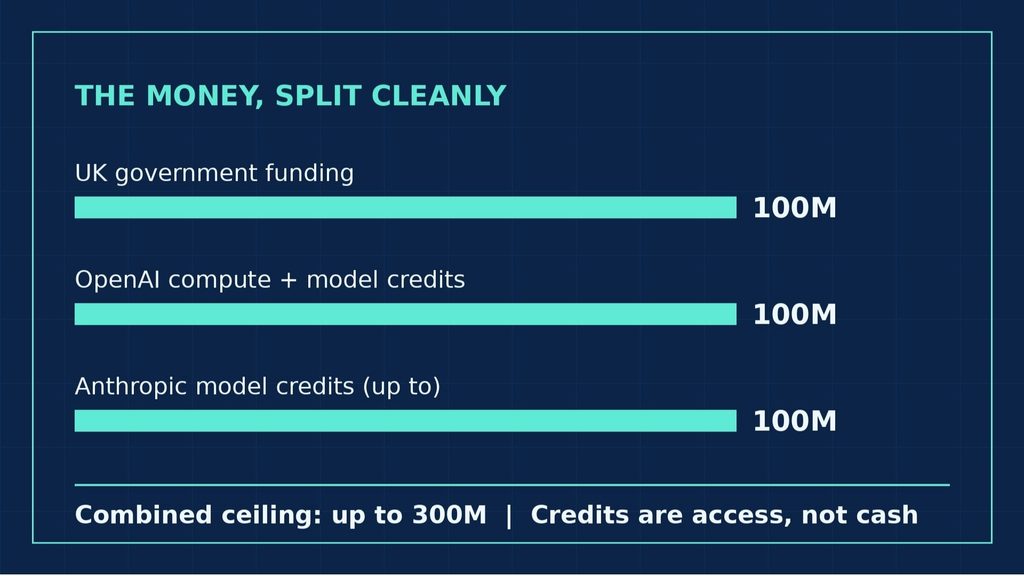
However, headlines say £300 million, but that number mixes two very different kinds of money. First, the government provides £100 million in public funding. Second, OpenAI and Anthropic commit up to £200 million in company support. The total reaches £300 million only if the companies deliver the full “up to” amount.
So the company bucket needs a closer look. OpenAI will provide £100 million in compute and model credits, plus trusted access to its most capable relevant models through its Rosalind Biodefense programme. Anthropic will provide up to £100 million in model credits, trusted model access, and dedicated technical support. So the companies give access to their models and compute, not cheques for staff salaries or lab buildings.
As a result, that distinction changes how you should judge the announcement. Model credits buy model time. They do not hire biologists, rent labs, or buy equipment on their own. The £100 million in public money must cover the real-world costs, or the government must add philanthropic funding later. According to the announcement, AIBL will draw on both public and philanthropic funding over time, but it names no philanthropic donor yet.
The wider package adds more context. The lab sits inside a £165 million National AI Biosecurity Initiative: £100 million for the lab plus £65 million for biological surveillance and countermeasures. Beyond that initiative, Reuters framed the wider government package at around £600 million, including £120 million for the UK AI Security Institute. So the lab is one piece of a larger bet, not a standalone spend.
For a business reader, the lesson is simple. Always split a headline number into cash, credits, and promises. Cash pays people. Credits rent models. Promises need a date. The announcement gives you all three, but it labels only some of them clearly.
Why the UK AI Biosecurity Lab Exists Now
First, timing explains a lot. AI capabilities jumped fast in 2026, and biosecurity sits right where capability meets risk. The same models that read biology papers, predict protein shapes, and draft experiment plans can also lower the skill barrier for harmful work. The government states this tension openly in its announcement. AI creates unprecedented opportunities for discovery, and it also changes the biological risk picture.
The UK also plays to a strength. It already runs an AI Security Institute that tests frontier models, built in 2023. A biosecurity lab extends the same playbook into a specific risk area. Instead of trying to outspend the United States and China on raw model training, the UK builds evaluation and defence capacity. That choice fits a smaller country with strong science and strong institutions.
Meanwhile, politics plays a part too. The announcement landed just before the UK Budget, when ministers wanted a clear security story. AI Minister Kanishka Narayan called the lab a major global institution that brings world-leading scientific expertise together to protect people from emerging biological threats. Chancellor John Healey framed the wider package as a British approach to AI that defends the national interest and spreads AI growth across the country.
There is also a practical trigger. Frontier labs now offer trusted access programmes for defensive biology work. OpenAI launched Rosalind Biodefense in May 2026 to sponsor trusted developers building defensive life sciences applications. That programme gave the government a ready-made partner channel. So the lab did not appear from nowhere. It formalizes partnerships that already existed in looser form.
UK AI Biosecurity Lab Partners: Who Does What
Partnerships sit at the centre of this lab, so each partner deserves a clear line. OpenAI supplies compute and model credits plus trusted access through Rosalind Biodefense. Anthropic supplies model credits, trusted model access, and dedicated technical support. Google DeepMind scientists and biosecurity experts will partner on research, and they will look to provide trusted access to frontier Gemini models and specialized science models. Base camp Research, a UK AI life sciences company, will provide its AI-biology models, capabilities, and technical expertise.
Also notice the careful language: OpenAI “will provide” its share, Anthropic provides “up to” its share, and Google DeepMind “will look to” provide access. Weight those commitments differently.
Government partners bring the operational side. The UK Health Security Agency handles health protection. Animal and plant disease falls under the Animal and Plant Health Agency. The Defence Science and Technology Laboratory brings defence science. Together, they connect the lab to the agencies that act during a real biological emergency. So that network is the lab’s real asset.
The business parallel is worth noting. We see the same partnership pattern in AI automation workflows whenever a company buys a tool but still needs people, process, and data around it. The model is only one input. The system around it decides the result. Likewise, any team comparing AI models should ask what access terms, support, and exit options come with the model, not just how smart it looks in a demo.
What the UK AI Biosecurity Lab Will Not Do Yet
Here is what the announcement does not give you. First, it names no director. Second, it names no location. Third, it gives no start date. Fourth, it sets no success metric. A lab without those four facts is a funded plan with a name, not a proven institution.
The announcement also leaves the lab’s full role and remit unclear. BBC reporting noted that full details still need to emerge. That gap is normal for a Budget announcement, but it limits what you can conclude. You cannot judge hiring quality, research priorities, or publication rules from a launch page.
Then, model access raises a second limit. The lab depends on private companies for its most powerful tools. If a company changes its access policy, raises credit prices, or restricts a model, the lab’s work changes too. Trusted access sounds strong, but with no contract terms published, independence remains a design goal, not a demonstrated fact.
Also, a third limit concerns measurement. Early detection sounds great, but how will the public know if it works? The announcement promises capabilities, not targets. It does not say how many threats the lab should detect, how much faster countermeasures should arrive, or how often it will publish results. Without targets, success becomes a matter of opinion, and opinion favours whoever writes the press release.
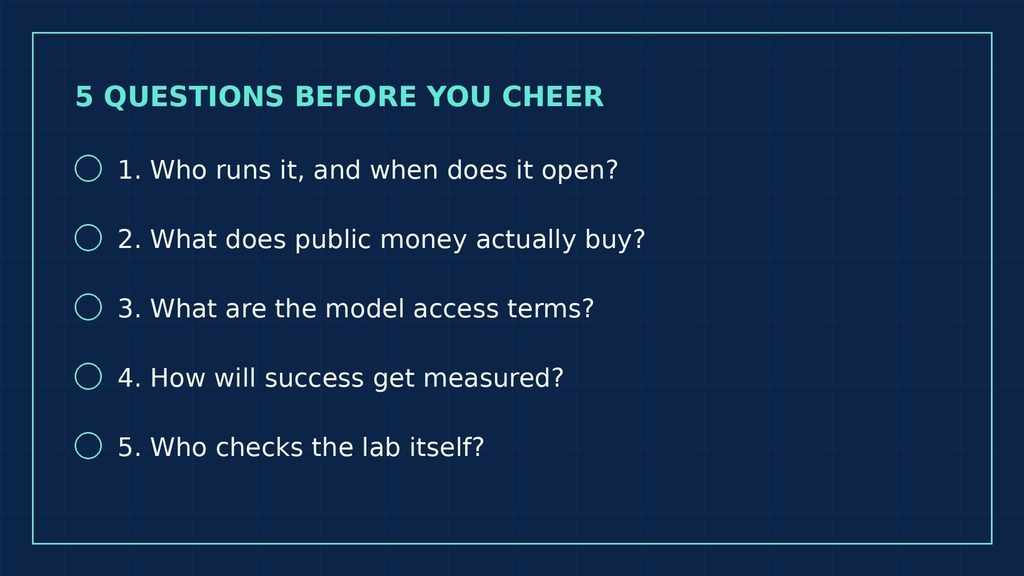
UK AI Biosecurity Lab: 5 Questions to Ask Before Cheering
- Who runs it, and when does it open? A named director and a start date turn a plan into an institution. Until then, treat the lab as a promise with funding attached.
- What does the public money buy? Ask how much of the £100 million goes to staff, labs, and data, versus administration. Credits cannot answer that question.
- What are the model access terms? Ask whether access is guaranteed, for how long, and under what conditions. “Trusted access” needs a contract behind it.
- How will success get measured? Ask for detection targets, response-time targets, and a publication schedule. A lab that never publishes results cannot earn public trust.
- Who checks the lab itself? Ask how the scientific advisory committee gets chosen, what power it holds, and whether it can criticize the lab in public. Independence needs teeth.
These questions also work for any AI safety announcement, not just this one. A vendor that welcomes them probably has answers. A vendor that dodges them probably has a headline instead.
Honest Limits
Four caveats keep this article accurate. First, most of the figures here come from the UK government announcement and company commitments, not from independent audits. Treat the £300 million total as a ceiling for combined support, not as cash in hand. Second, the lab is still being established, so claims about its future impact are projections, not results. Third, partner contributions use different wording, so do not treat every “up to” figure as guaranteed. Fourth, US readers should read this UK institution as a policy model and a warning signal, not as a service they can use directly.
The wider lesson still holds. AI safety now has institutions, budgets, and partners, not just principles. That shift matters for every business that uses AI, because rules, tests, and expectations will follow institutions. Teams that build testing for non-deterministic AI applications into their work today will adapt faster when those expectations arrive.
UK AI Biosecurity Lab: FAQs
Q: What is the UK AI Biosecurity Lab?
The UK AI Biosecurity Lab, called AIBL, is a new UK institution that will use frontier AI to strengthen biosecurity. It will build practical tools to help the UK understand, prevent, detect, and respond to biological threats. Its first jobs are early detection of emerging threats and faster vaccines, treatments, and other medical countermeasures.
Q: How much funding does the UK AI Biosecurity Lab get?
The lab gets £100 million in UK government funding, plus up to £200 million in company commitments from OpenAI and Anthropic. The company share arrives as compute and model credits, not cash. Together, the government funding and company commitments reach up to £300 million.
Q: Are AI model credits the same as cash?
No. Model credits buy access to a company’s models and compute. They do not pay for staff, laboratory space, or equipment on their own. The £100 million in public funding must cover those real-world costs, unless philanthropic funding arrives later.
Q: Who partners with the UK AI Biosecurity Lab?
OpenAI and Anthropic provide model credits and trusted model access. Google DeepMind and Base camp Research partner on research and AI for science tools. Government partners include the UK Health Security Agency, the Animal and Plant Health Agency, and the Defence Science and Technology Laboratory.
Q: When will the UK AI Biosecurity Lab open?
No opening date was announced. The government said it is establishing the lab, and it named no director or location yet. So the lab is a funded plan for now, not a working institution with a public launch date.
Q: What will the UK AI Biosecurity Lab do first?
Its initial delivery will focus on two tasks. First, it will develop capabilities that enhance early detection of emerging biological threats. Second, it will accelerate the development of vaccines, treatments, and other medical countermeasures.
Q: Why does the UK need an AI biosecurity lab?
AI speeds up legitimate biology research, and it also lowers barriers to harmful biological work. The government says increasingly capable AI systems create new biological risks. The lab aims to build defensive capability at the same speed as offensive capability, so the UK can spot threats earlier and respond faster.
The Bottom Line
The UK AI Biosecurity Lab is a serious idea with a real budget and a missing middle. The idea is sound, the budget is real, and the missing middle is governance: a director, a location, a start date, and success metrics.
So judge the lab by those missing pieces, not by its headline. For example, if it hires strong leaders, publishes results, and sets measurable targets, it could become a model other countries copy. If it stays a logo and a funding line, it will teach a different lesson: that AI safety announcements are cheap, while AI safety institutions are hard.
Finally, watch the hires first. They will tell you more than any Budget speech.
Know AI news, SEO, automation, or SaaS tools well enough to explain them this clearly? Write for Ai Blitzo: real editors, fast replies, and your work in front of people who actually use AI tools.
About the Author
Zarirah Asif is an SEO writer who writes about industry trends, digital marketing, technology, and content strategies for brands. She specializes in creating engaging, informative, and SEO-friendly articles that deliver value to readers. Her goal is to help brands improve their online visibility through quality content and effective SEO practices. Connect with her on LinkedIn to learn more about her work and professional journey.