


Quick Answer: What is B2B SaaS? It is cloud software that one business sells to another business on a recurring subscription. Instead of buying a license and installing software, a company pays a monthly or annual fee and uses the tool in a browser. Salesforce, HubSpot, Slack, and QuickBooks Online are common examples, and the global market is estimated at $434.4 billion in 2026.
If you have asked what is B2B SaaS, you are not alone. The term shows up in job posts, sales calls, and software ads, yet few people explain it in plain words. As a result, many beginners buy the wrong tool or pay for features they never use. This guide fixes that problem with the meaning, real examples, live prices, and five proven facts.
Business software used to arrive in a box: a company paid once and installed it on its own servers. Today, most business tools live in the cloud, and companies rent them by the month.
What Is B2B SaaS, in Plain Words?
What is B2B SaaS, in plain words? It joins two ideas. B2B means business to business, so the buyer is a company, not a single shopper. SaaS means software as a service, so you pay a subscription instead of buying a license. Put them together and you get the b2b saas meaning: cloud software that a vendor hosts and sells to other companies for a recurring monthly or annual fee.
Four traits define every B2B SaaS product. First, the buyer is a business, so several people often weigh in. Second, the vendor hosts the software, so nothing gets installed on company computers. Third, the customer pays on a plan, usually monthly or yearly. Fourth, the tool serves a team, so different people get different levels of access.
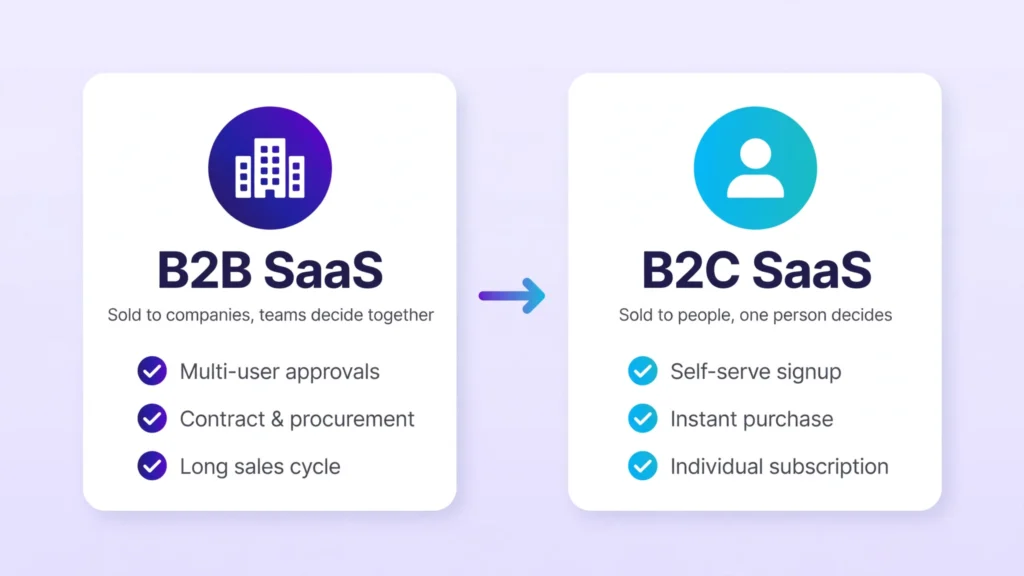
B2B SaaS vs B2C SaaS: What Changes for Buyers
The buyer is the biggest difference, and it shapes what is B2B SaaS for every team. In B2B SaaS, a team buys the tool, IT reviews security, and a manager approves the budget. In B2C SaaS, one person buys for personal use, often in minutes, with no approval chain at all.
| Factor | B2B SaaS | B2C SaaS |
|---|---|---|
| Buyer | A company or team | One person |
| Decision | Several stakeholders, IT review | One person, fast choice |
| Pricing | Per seat, often annual | Flat monthly price |
| Support | Onboarding, account manager | Help center, chat |
| Examples | Salesforce, HubSpot, Slack | Netflix, Spotify, Duolingo |
Price also works in a different way. A B2C app usually shows one price for every user. A B2B tool often charges per seat, so a team of ten pays ten times the single-user price. In addition, many B2B vendors add onboarding fees and annual contracts, so the monthly figure is rarely the full cost. Smart buyers always ask for the total first-year cost before they sign. Customization differs too: a consumer app looks the same for every user, while a B2B platform bends to fit each customer.
5 Proven Facts That Explain What Is B2B SaaS
Learn the five facts that shape every good decision before you compare tools.
Fact 1: The Market Is Huge and Still Growing
The B2B SaaS market is far bigger than most beginners expect. For example, Grand View Research values the global market at $395.3 billion in 2025 and estimates $434.4 billion in 2026, with growth to $931.5 billion by 2033. Mordor Intelligence gives a higher estimate of $492.34 billion for 2026. Either way, businesses keep moving more work into rented cloud software each year.
Fact 2: Salesforce Pioneered the Model in 1999
Salesforce, founded in 1999, is widely credited with pioneering the B2B SaaS model through its cloud CRM. Before Salesforce, companies bought CRM licenses and ran them on their own servers. Salesforce flipped the model by hosting the software and charging a subscription instead. To understand what is B2B SaaS in practice, look at that flip: the vendor runs the servers, and the customer only logs in. Since then, almost every major business software category has followed the same path, and that is why CRM remains the flagship B2B SaaS category.
Fact 3: Free Tiers Are Real, but Seats Add Up Fast
Most leading B2B SaaS tools offer a free tier, and it is a fair way to test a product. HubSpot CRM, for example, costs $0 for up to two users and 1,000 contacts, with no expiry date. However, the free tier ends quickly once a team grows: five people on HubSpot Starter pay $20 per seat per month at list price, or $100 a month before any add-on. Always multiply the per-seat price by your real headcount before you judge a tool as cheap.
Fact 4: Annual Billing Is the Norm Above the Entry Tier
Entry tiers often allow monthly billing, but higher tiers usually demand an annual contract. Salesforce Starter Suite, at $25 per user per month, is the only Sales Cloud edition you can pay for month to month. Every edition above it, from Pro Suite at $100 to Max at $550, is billed annually. HubSpot follows the same pattern: Sales Hub Professional costs $90 per seat per month on annual billing, plus a required $1,500 onboarding fee. Because of this, the monthly number on a pricing page can hide a five-figure yearly commitment.
Fact 5: AI Features Now Sit Inside the Core Product
AI is no longer a separate add-on in most B2B SaaS tools. Salesforce builds AI into its Core edition and above, HubSpot adds AI helpers across its hubs, and Slack, Zoom, and Asana all ship AI summaries inside the tools teams already use. For beginners, the question is not whether a tool has AI, but whether its AI saves your team real time.
Real Prices Checked Today: Salesforce vs HubSpot
If you still wonder what is B2B SaaS pricing in real numbers, the table below gives the answer. We checked both vendors on their official pricing pages on 27 November 2026, and the figures are list prices in US dollars.
| Vendor and plan | List price | Billing | Free option |
|---|---|---|---|
| Salesforce Starter Suite | $25 per user, per month | Monthly or annual | Free Suite at $0 |
| Salesforce Pro Suite | $100 per user, per month | Annual only | 30-day trial |
| Salesforce Core | $195 per user, per month | Annual only | 30-day trial |
| HubSpot Free CRM | $0 | No expiry | 2 users, 1,000 contacts |
| HubSpot Starter | $20 per seat, per month | Monthly or annual | Free CRM tier |
| HubSpot Sales Hub Professional | $90 per seat, per month | Annual billing | $1,500 onboarding fee |
Check the official Salesforce Sales Cloud pricing page and the official HubSpot CRM pricing page to see the source figures. The Grand View Research B2B SaaS market report lists the 2026 estimate of $434.4 billion used above. Therefore, remember the real lesson: the onboarding fee and the annual contract matter more than the headline monthly price.
How to Pick Your First B2B SaaS Tool
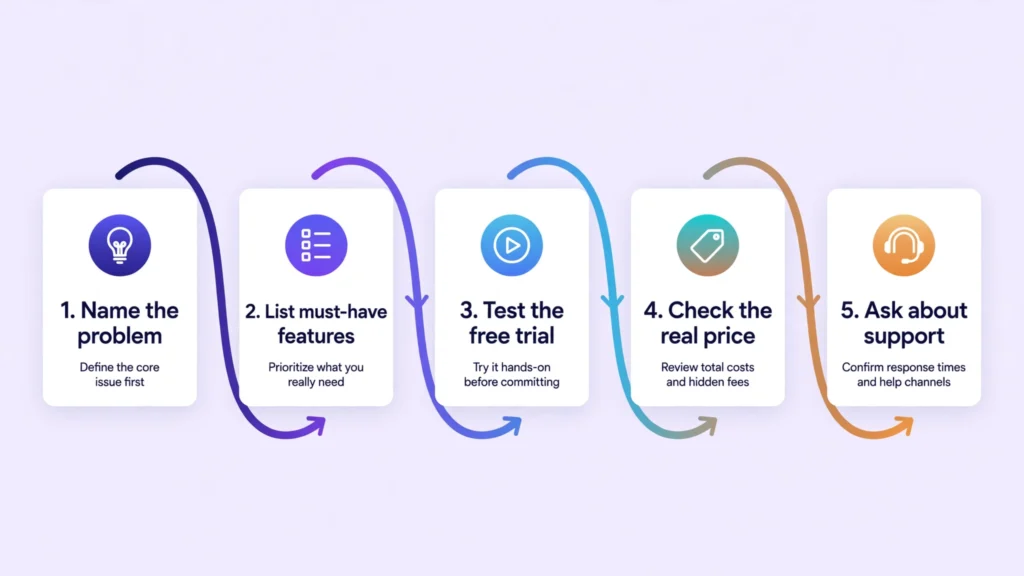
Every vendor claims to do everything, so choosing well starts with knowing what is B2B SaaS for your team. Work through these five steps in order.
First, name the problem in one sentence: a tool that fixes slow invoicing is a different purchase from one that fixes lost leads. Next, list the features you must have, and keep the list short. A b2b marketing funnel tool, for example, must track leads from first click to closed deal. Then test the free trial with real data, not demo data, because a trial only proves value on live work. After that, check the real price, including seats, onboarding, and the annual contract. Finally, ask about support before you buy, since slow support costs more in lost time than it saves in fees.
Small teams should also settle the saas management platform question early: who owns the tool, tracks renewals, and removes unused seats? Many small businesses pay for tools nobody opens, so a simple spreadsheet of subscriptions, owners, and renewal dates prevents waste. Our guide to small business apps lists useful picks that pair well with a first CRM.
How We Tested
To verify what is B2B SaaS pricing today, we read the official pricing pages for Salesforce Sales Cloud and HubSpot CRM on 27 November 2026. We also read the Grand View Research and Mordor Intelligence reports to confirm the 2026 estimates, and we added the buyer checklist and the live price table that rival guides skip.
Real-World Application and Pitfalls
A small marketing agency with six staff offers a useful example. The team started on HubSpot Free CRM, added Starter seats at $20 each as it grew, and kept its total CRM cost under $150 a month for the first year. Because the team tested with real client data, it found the reporting limits of Starter before paying for Professional. In contrast, a common pitfall is buying the top tier first: a team pays for AI features it never opens, then blames the tool when the budget runs out.
Another pitfall is ignoring the exit cost. A team that knows what is B2B SaaS also knows its exit cost, because b2b software contracts often renew automatically, and exporting data can take days. Before you sign, ask three questions: how do we export our data, what happens at renewal, and what does cancellation cost? The answers belong in writing, not in a sales call. Our Ahrefs alternatives guide shows how the same pricing logic applies to SEO tools, and our agentic AI coding tools guide covers AI products in the same stack.
Frequently Asked Questions
What is a B2B SaaS company?
A B2B SaaS company builds cloud software and sells it to other businesses on a subscription. Salesforce, HubSpot, Slack, and Workday are classic examples. The company hosts the product, while the customer pays a recurring fee and uses the tool in a browser.
What does B2B SaaS mean?
People who ask what is B2B SaaS usually want the plain meaning: business-to-business software as a service. The buyer is a company, the software lives in the cloud, and the customer pays a monthly or annual subscription.
What is B2B software?
B2B software is any software sold to businesses rather than consumers. B2B SaaS is one type of B2B software, the type you rent online and pay for on a plan. Older B2B software ran on company servers, while B2B SaaS runs in the cloud and updates itself.
What is SaaS and B2B?
SaaS is the delivery model: software you access online and pay for as a service. B2B is the customer type: one business selling to another business. Combine them and you get B2B SaaS, which is cloud software sold to companies on subscription. B2C SaaS sells the same model to individual consumers.
How much does B2B SaaS cost?
Costs range from $0 on a free tier to $550 per user per month at the top of Salesforce Sales Cloud. Most small teams pay $20 to $100 per seat per month, plus onboarding fees on higher tiers. People who ask what is B2B SaaS pricing should get the total first-year cost first.
What Is B2B SaaS Worth to Your Team?
What is B2B SaaS, in one line? It is rented business software that lives in the cloud and grows with your team. The model won because it removes servers, updates, and big upfront license fees, and it lets a small team use the same class of tools as a large company. Therefore, start with one problem and one trial, not a full stack: pick one problem, test the free tier with real data, and check the full first-year price before you commit. To plan your next step, read our guide on AI searchability. Related guides: Perplexity vs Claude and Flint coding model.

