
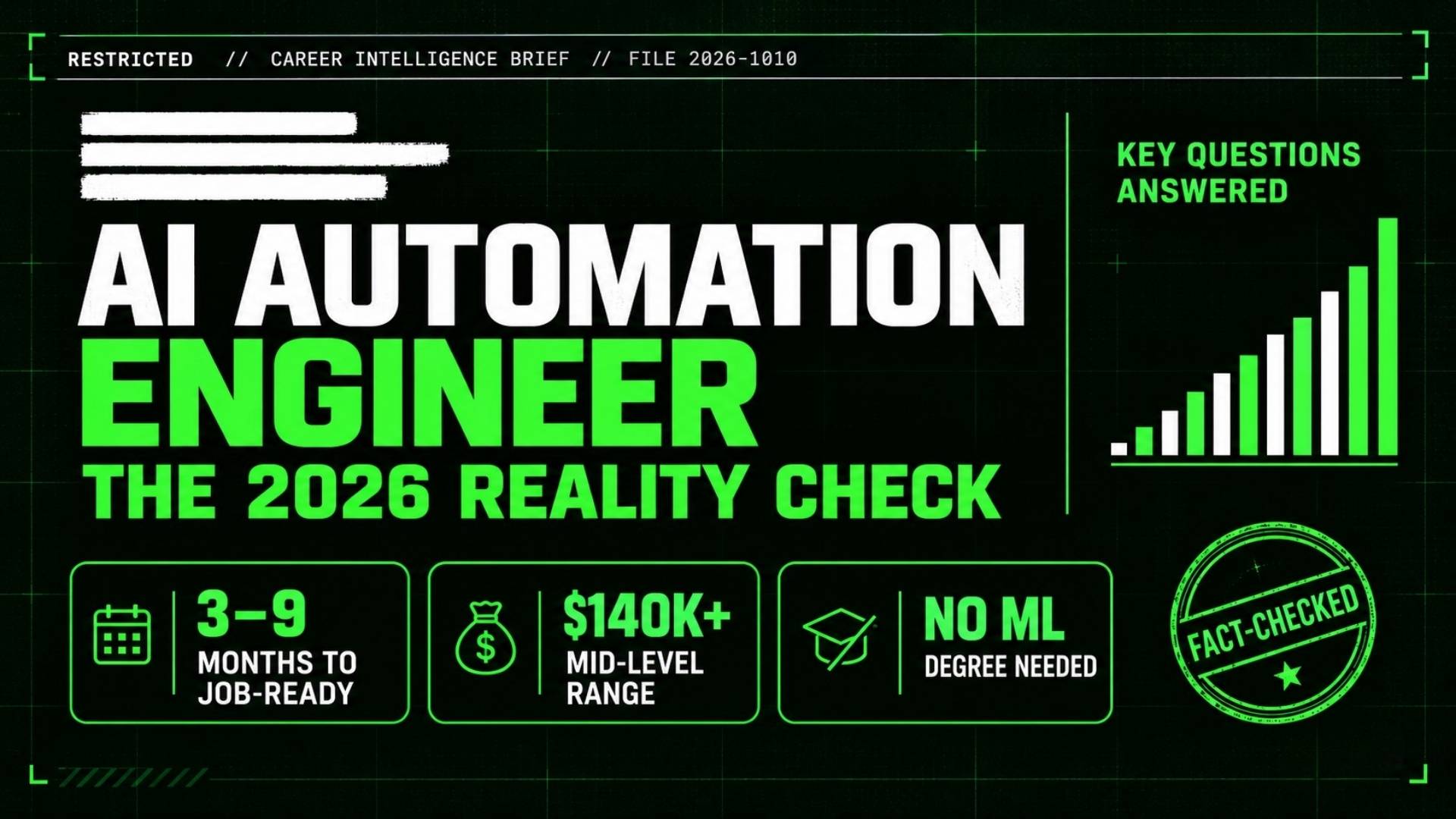

Quick answer: An AI automation engineer builds end-to-end business workflows that mix fixed rules with language-model steps. Real 2026 US postings expect light scripting, solid API skills, and production-ready systems not full ML degrees. Mid-level total pay commonly lands between $140k and $190k, and the people getting hired show working projects with measurable ROI.
If you’re searching for an AI automation engineer role after seeing the title appear in job boards, you already know the uncertainty is real. What you don’t know yet is whether this is a distinct, reachable path or just re-branded RPA with extra marketing.
By the end of this article you’ll know exactly what the job is day to day, how it differs from AI engineer and RPA roles, the skills that actually appear in postings, a realistic 3–9 month road map, the portfolio projects that get interviews, and current US salary ranges built from 2026 job data and production patterns, not vendor claims.
What an AI Automation Engineer Actually Does
The core of the role
An AI automation engineer designs and ships end-to-end automation that combines fixed rules with language-model steps so a business process runs without constant human intervention.
System integration and workflow orchestration
You map a process such as invoice handling, lead routing, or support triage. You decide which steps stay deterministic and which need judgment. Then you wire APIs, tools, and models so the whole flow executes reliably.
How it differs from classic RPA (AI Automation Engineer)
Classic RPA stops when the input is messy text or an unexpected exception. AI workflow automation continues by letting a model read the email, classify it, extract fields, or draft a reply inside the same pipeline. This shift from pure rule-based bots to cognitive automation is driving the broader AI automation growth we’re seeing across industries.
Where AI agents fit
AI agents sit further along the spectrum. In a fixed workflow the engineer still decides every branch. In agentic AI workflows the model chooses the next tool or step within guardrails the engineer sets. Most production systems mix both: a multi-step agent handles the variable middle while deterministic steps and human-in-the-loop checks keep the edges safe.
The coding vs no-code reality
Visual platforms handle most triggers and connectors. Scripting (usually Python or JavaScript) appears when you need custom data transformation, structured outputs, or error handling the platform cannot express. Employers care more about whether the automation is production-ready—logged, monitored, and measurable for ROI than about the exact percentage of code.
A concrete daily example (AI Automation Engineer)
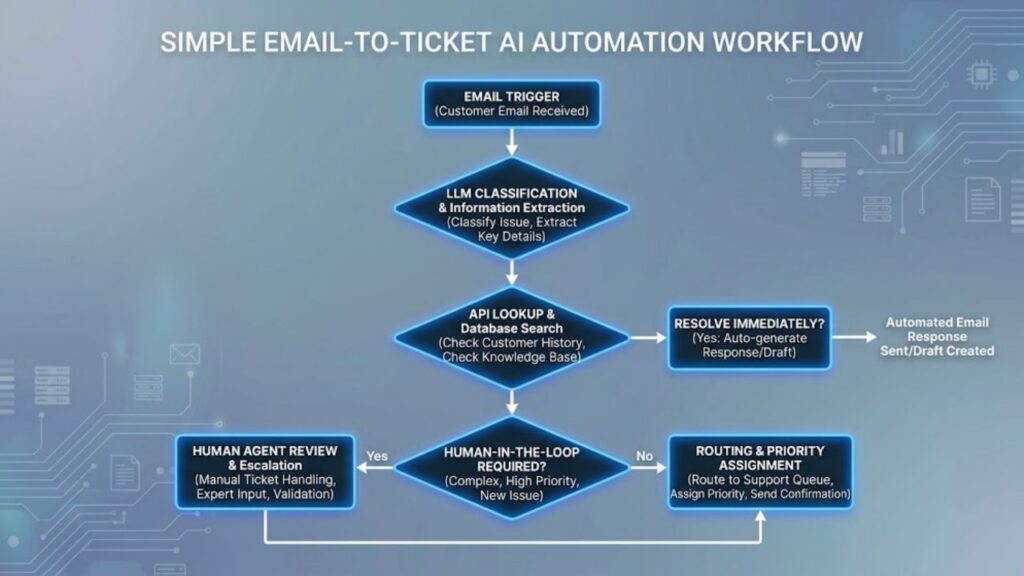
A support ticket arrives by email. The workflow extracts the customer ID via API, uses a model to classify urgency and intent, checks the knowledge base, and either auto-replies or routes the ticket with a draft. That single flow is business process automation with AI. It is not model training, not pure RPA, and not an unconstrained agent. It is my daily job.
AI automation engineer vs AI engineer
An AI engineer usually ships features that call models chat interfaces, recommendation systems, or RAG applications. An AI automation engineer ships complete business processes that use models as one step among many.
AI automation vs RPA (AI Automation Engineer)
Traditional RPA developers build bots that follow fixed screen or API paths. They excel when every case is predictable. The moment input becomes unstructured text or the next action depends on judgment, pure RPA breaks. AI automation adds model steps inside the same orchestration layer so the process keeps moving.
AI agent developer (AI Automation Engineer)
An AI agent developer focuses on systems where the model decides the sequence of tools and steps. Many AI automation engineer roles now include limited agent work, but the primary deliverable remains a reliable, measurable workflow rather than an open-ended autonomous system.
Most 2026 US postings sit in the middle: fixed orchestration with selective tool use / tool calling and occasional multi-step agents.
Skills That Appear in Real 2026 US Job Postings
Core technical skills
Job postings analysis shows these AI automation engineer skills most often:
- Process mapping and the ability to identify automation ROI
- API integration and JSON data transformation
- Prompt engineering and structured outputs
- Function calling and basic agent patterns
- Error handling, retries, and human-in-the-loop design
- Monitoring and observability
Advanced but rising skills
Vector databases and RAG for automation appear when the workflow needs company knowledge.
How much Python is enough
Python shows up in most postings, but the required depth is modest enough to write custom nodes, handle authentication, and transform data. Full machine-learning pipelines are almost never required.
Soft skills that matter
Translating messy business requests into technical scope and communicating measured results back to non-technical stakeholders appear repeatedly.
Tools Stack What to Master First
Start here
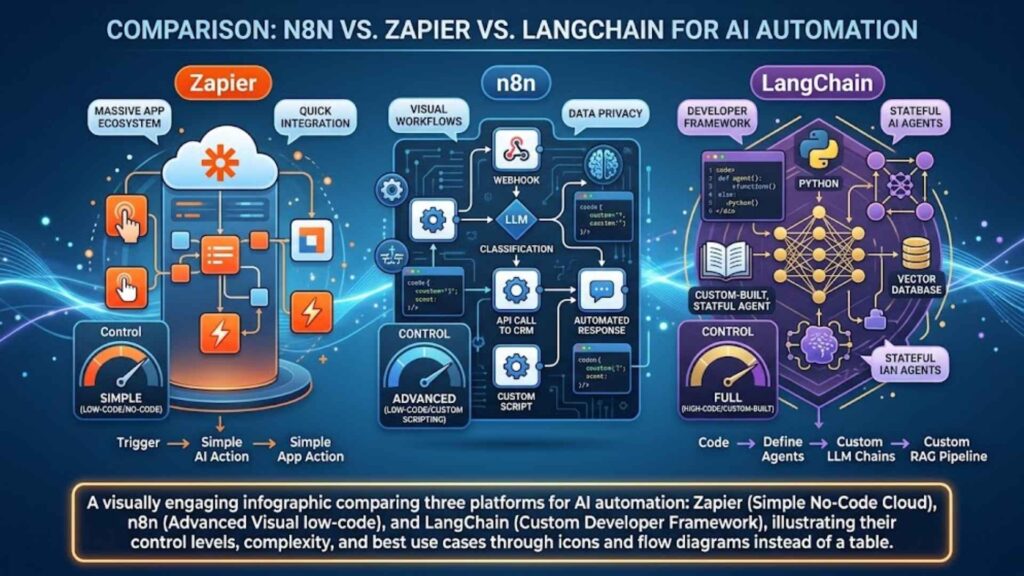
Start with n8n AI automation. It is open-source, self-hostable, supports custom code nodes, and has strong native support for LLM nodes and agents. Learn the self-hosted vs cloud trade-offs early. For a deeper look at how n8n bridges traditional automation with AI-native capabilities, see how n8n workflow automation transforms business.
Add these next
Add one mainstream no-code / low-code platform (Zapier or Make) for simple connectors. Then learn enough LangChain (or LangGraph) to structure multi-step agent logic when the visual layer is not enough.
What stays secondary
UiPath and classic RPA platforms still appear in enterprise postings, but they are secondary for most new AI automation engineer roles. The stack that gets interviews is n8n + LLM APIs + light Python + solid API skills.
Realistic Learning Path and Timeline
How to become an AI automation engineer
If you already write scripts or manage systems, a focused AI automation engineer road map takes 3–5 months of part-time work. Pure business or operations backgrounds should plan on 6–9 months.
Phase 1 (4–6 weeks)
Master one workflow platform (n8n recommended). Build five simple automations that include at least one LLM step and one error path.
Phase 2 (4–6 weeks)
Add API integration, structured outputs, and basic prompt chaining. Ship two production-style flows with logging and human-in-the-loop checks.
Phase 3 (4–8 weeks)
Build portfolio projects that include measurable ROI, monitoring, and at least one agentic pattern. Document everything.
Entry level AI automation engineer candidates succeed when they show shipped workflows rather than certificates.
Portfolio Projects That Get Interviews (AI Automation Engineer)
Hiring managers ignore generic chatbot demos. They want production-ready AI workflows with clear before-and-after numbers.
Strong project examples
- Support email classifier + draft reply system with confidence thresholds and human approval. Measure time saved per ticket.
- Lead enrichment and scoring pipeline that pulls data from multiple APIs and updates a CRM. Track conversion lift.
- Invoice or document extraction flow using RAG against internal templates, with validation steps and error queues.
- Multi-step research agent that gathers data, summarizes, and posts a structured report, complete with cost and latency monitoring.
Each project should demonstrate error handling and retries, human-in-the-loop design, and ROI measurement.
US Salary Ranges and Remote Reality
Current pay bands
AI automation engineer salary data is still noisy because the exact title is new. Broader automation engineer roles sit around 108k–120k median total pay. Roles that emphasize AI agents and LLM orchestration commonly land between $140k and $190k total compensation at mid-level, with senior seats reaching $210k+.
Remote opportunities
Remote opportunities exist but remain competitive. Many postings still prefer hybrid in major metros. Demonstrated production workflows often outweigh formal degrees for entry.
How to Get Hired (AI Automation Engineer)
Resume and positioning
Match your resume language to real AI automation engineer jobs. Lead with the workflows you shipped and the metrics they delivered.
Common interview questions
- How you decide between fixed workflow and agentic patterns
- How you handle model failures or drift in production
- A concrete example of measuring automation ROI
- Trade-offs between self-hosted and cloud tools
First 90 days
Ship one or two high-visibility automations that save measurable time or reduce errors, document them, and leave the systems observable.
FAQ
Do I need to code to become an AI automation engineer?
Yes, at least basic scripting. Visual platforms cover most connectors, but real postings expect enough Python or JavaScript for custom transformations, structured outputs, and edge cases.
How long does it take? (AI Automation Engineer)
With existing technical experience, 3–5 months of focused work is realistic. Pure business backgrounds usually need 6–9 months.
Is this different from an AI engineer role?
Yes. An AI engineer builds model-powered features. An AI automation engineer builds complete business processes that use models as one reliable step.
Are certifications worth it?
Rarely as a primary signal. Employers care more about portfolio projects that show production-ready workflows and measured results.
What salary can I expect in the US?
Mid-level packages that emphasize LLM orchestration commonly sit between $140k and $190k total compensation. Location and production ownership move the number more than the title.
The role is real, the barriers are lower than the hype suggests, and the people getting hired are the ones who can show working systems that save time or money. Build those systems, document the results, and start applying.
Ready to map your first production workflow or audit an existing process? Contact us and we can talk through the practical next steps.