


By Zarirah Asif | Machine Learning News Updated Nov 20, 2026
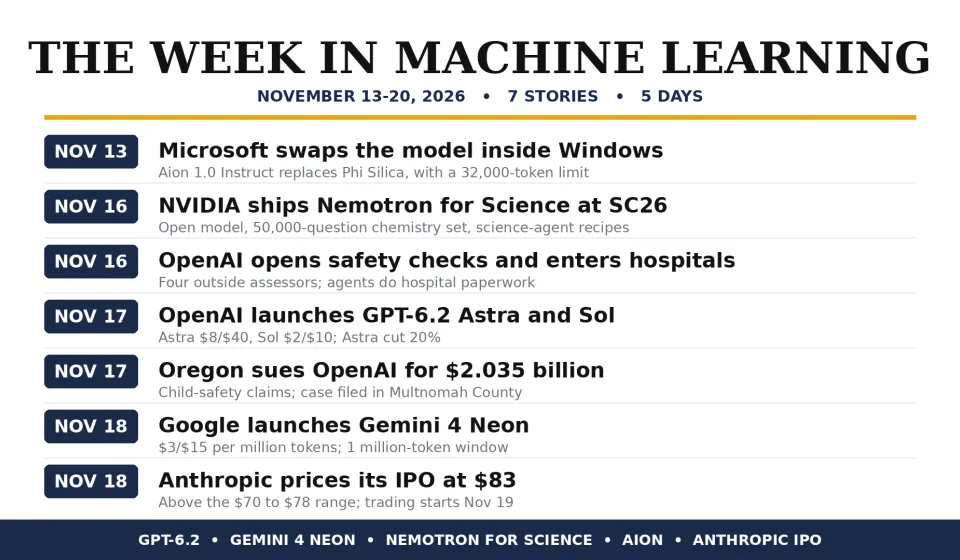
Machine learning news this week boils down to one sentence: the best models got cheaper and faster, while the law and the stock market caught up with them. OpenAI shipped GPT-6.2 Astra and Sol on November 17, Google followed with Gemini 4 Neon on November 18, and NVIDIA turned its SC26 keynote into a science-agent stack on November 16.
The flood is the problem. Most summaries of machine learning news mix vendor claims with verified facts, so readers get hype first and evidence second. People who build with these tools need to know what shipped, what it costs, and what is still only a promise.
Read the dates and the prices first. Every item below carries its announcement date and its source, and every price comes from the vendor that set it. If a claim had no source, we left it out.
This roundup covers November 13 to 20, 2026, in the order the news broke. It is part of our regular ai news updates. You also get the model launches, the hardware, and the safety and legal news.
Key Takeaways
- OpenAI launched GPT-6.2 Astra ($8/$40) and Sol ($2/$10) on Nov 17. Astra costs 20% less than GPT-6 Astra.
- Google launched Gemini 4 Neon on Nov 18 at $3/$15, with a 1 million-token window and four thinking levels.
- NVIDIA used SC26 on Nov 16 to ship Nemotron for Science and unveil the Rubin HPC GPU, due in 2028.
- OpenAI signed four outside safety assessors on Nov 16 and pushed computer-use agents into healthcare the same day.
- Anthropic priced its IPO at $83 on Nov 18, above its $70 to $78 range. Oregon sued OpenAI for $2.035 billion on Nov 17.
Machine Learning News: OpenAI Ships GPT-6.2 Astra and Sol
OpenAI launched GPT-6.2 Astra and Sol on Tuesday, November 17, 2026. Astra is the frontier model for complex professional and scientific work. Sol is the everyday model for coding and agent workflows. Both arrived in ChatGPT Work and Codex for paid users. Both are also on the API as gpt-6.2-astra and gpt-6.2-sol.
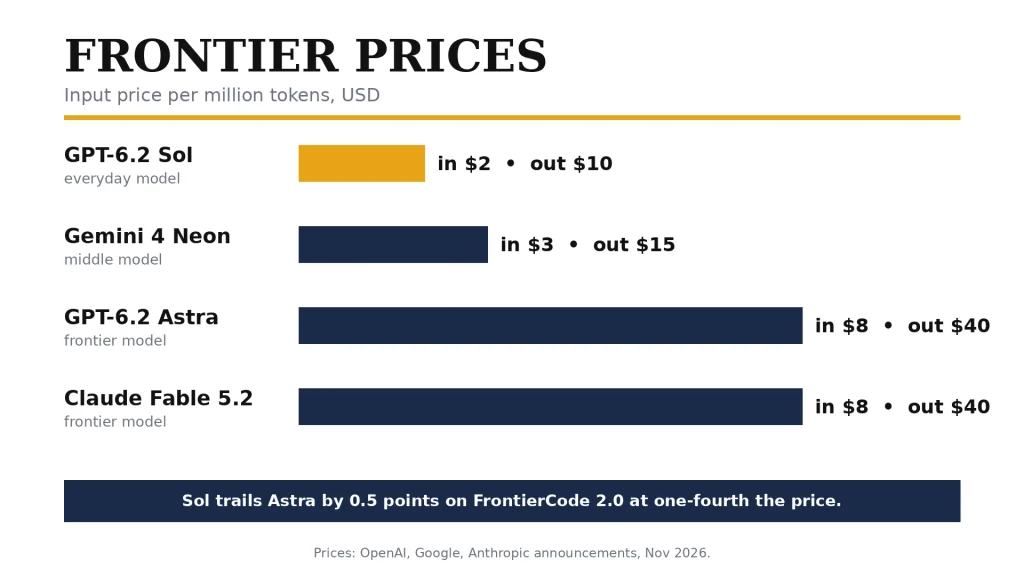
The prices tell the story. Astra costs $8 per million input tokens, $0.40 cached, and $40 per million output tokens. That is still 20% below GPT-6 Astra. Sol keeps GPT-6.1 Sol pricing: $2 for input, $0.10 cached, $10 for output. Astra now matches Claude Fable 5.2 at $8/$40.
OpenAI says Astra scores 5.2 points above GPT-6 Astra on Agents’ Last Exam. Astra costs less than a third as much on that test. Sol also trails Astra by just 0.5 points on FrontierCode 2.0 at one-fourth the price. Those are OpenAI’s own benchmark claims, not independent tests, so treat them as the vendor’s case rather than a verdict. Both models also ship with tighter safeguards for high-risk cybersecurity help. Read the full announcement in OpenAI’s GPT-6.2 launch post.
For most teams, Sol is the practical pick. Astra fits long professional jobs where the extra quality pays. If you followed GPT-6.1 Terra, this release replaces that generation in Work and Codex.
Google Answers With Gemini 4 Neon
Google also introduced Gemini 4 Neon on November 18, 2026, one day after GPT-6.2, in a week packed with ai model updates. Neon also sits between Carbon, built for the heaviest long-running jobs, and Hydrogen, built for fast everyday work, with a 1 million-token window and four thinking levels. Teams can also dial reasoning up or down per task.
Neon costs $3 per million input tokens, $0.15 cached, and $15 per million output tokens. Google also says cost per task runs 32% below Carbon. Google also reports that Neon scores 61 on the Artificial Analysis Intelligence Index at its highest thinking level. That puts it third overall, behind larger, slower models. It also ranks first on the Coding Agent Index at 58.6. Those numbers come from Google and Artificial Analysis, not from our own tests.
Neon is also rolling out in the Gemini API in Google AI Studio and Android Studio. It is also in Gemini for business, in Antigravity, and in the Gemini app for Pro and Ultra users. Read the full announcement in Google’s Gemini 4 Neon post. That pattern runs through machine learning news this week: every lab now ships a cheaper, faster middle model within days of its flagship.
NVIDIA Turns SC26 Into a Science-Agent Stack
NVIDIA used the SC26 supercomputing conference in Chicago on November 16 to aim its whole stack at science agents. The company introduced Nemotron for Science. It brings together the Nemotron 3.5 Super VL open model, the LitmusBench v0.2 chemistry dataset of nearly 50,000 questions, and post-training recipes for building science agents.
The model and the dataset are also available now on Hugging Face. NVIDIA says Lila Sciences and Terray Therapeutics already use the model. That is the part of this week’s machine learning news you can test today, while the hardware is still two years out.
The Rubin HPC GPU, with more than 50,000 CUDA cores, is still expected in 2028. The Vera Rubin NVL72 system also swept every MLPerf Training v6.1 test in its debut. On the DeepSeek-V3 training test, it scaled from 256 to 1,024 GPUs at about 97% efficiency. Training time also fell from 16 minutes to about 4 minutes.
NVIDIA also showed a DGX Spark HPC Developer Kit for local debugging.
OpenAI Opens Its Safety Checks and Moves Into Hospitals
November 16 was also the day OpenAI opened its safety work to outsiders. The company also signed Apollo Research, METR, Transluce, and Goodfire for embedded assessments. The assessors also get access to some internal models, training processes, and staff. They can publish findings after OpenAI redacts them.
Outside researchers quoted in coverage called the access too narrow. OpenAI said no standards for embedded evaluations exist yet.
The same day brought a bigger practical change. OpenAI also published computer-use agents for healthcare teams. They click, type, and switch applications the way a human admin would. Physician reviewers rated 99% of 325 evaluated clinical tasks as safe, so errors were unlikely to plausibly harm patients. The demo also covers MRI prior authorizations and EHR inbox work. Pilots also run at CVS and Cigna, with more than 20 ChatGPT healthcare plugins. The demo also used synthetic patient data, not real records.
The healthcare push is the most concrete use case of the week. Agents now do paperwork inside real hospital software. For background, see our earlier piece on Sam Altman and AI cybersecurity risks and how OpenAI trains offline.
Microsoft Swaps the Model Inside Windows
Microsoft announced on November 13 that Aion 1.0 Instruct will replace Phi Silica as the on-device language model for Windows. Aion 1.0 Instruct has 2.3 billion parameters, down from Phi Silica’s 3.8 billion. Its input limit rises from 3,500 tokens to 32,000 tokens. It also expands beyond NPUs to supported GPUs, including NVIDIA RTX cards and AMD RDNA4 cards.
The rollout runs in stages. A standalone test package is also available now at aka.ms/tryaion. Microsoft plans an Insider rollout in early December, with retail devices in late January 2027. Most developers need no changes, because the swap happens behind the scenes. Apps with highly custom prompts or custom LoRAs will need work, because Aion behaves differently.
Every Copilot+ PC gets a smaller model with a much longer memory, and local AI reaches desktop GPUs for the first time on Windows. That is why it sits next to our best AI tools guide and our work on AI and automation for small business.
Anthropic Prices Its IPO at $83, Above the Range
Anthropic priced its IPO at $83 per share on Wednesday, November 18, according to Reuters. (Machine Learning News) That is above the $70 to $78 range in its prospectus. The offering also raised about $81 billion and valued the company near $1.5 trillion. That also makes it the largest listing on record. Trading began Thursday, November 19, on Nasdaq under the ticker ANT. The offering also covered 980 million shares, up from the 825 million originally planned.
Pricing came after a volatile autumn for AI stocks. The final $83 price landed above the range the company published on November 10.
Anthropic filed its S-1 on October 26, 2026. The filing also showed first-half 2026 revenue of $16.3 billion. This is the first IPO by a major frontier-model lab. Its first weeks of trading will set the tone for every AI company that follows it to market.
Oregon Sues OpenAI for $2.035 Billion
Oregon Attorney General Dan Rayfield filed suit against OpenAI on November 17. The case sits in Multnomah County Circuit Court, and the state seeks at least $2.035 billion. The complaint says OpenAI misled parents about ChatGPT’s safety for children. It also says the company marketed the chatbot to minors despite known risks, which would violate Oregon’s Unlawful Trade Practices Act. It also cites failures in age checks and parental alerts, and says teen safeguards were easy to bypass.
The $2.035 billion is still the amount sought, not a fine or an award, and the case has not been decided. The suit opened Rayfield’s Keeping Kids Safe initiative. More actions will follow, his office says.
California also recommended state-set AI safety standards, independent testing, and emergency shutdown authority, although those are recommendations, not enacted law. Security firm Wiz also found two malicious Microsoft agent-framework packages on PyPI carrying a credential sealer. Both were removed.
What This Week Means for Your Work
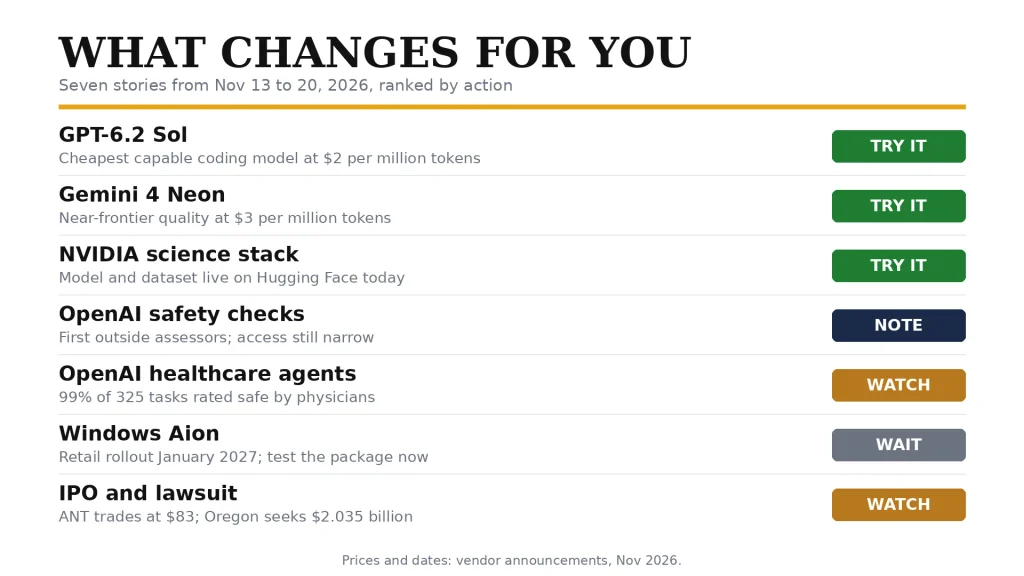
If you build with APIs, test Sol and Neon side by side first, before you switch anything. Vendor benchmarks are not your workload. The price gap between Sol at $2 and Astra at $8 can change what a product costs to run.
If you follow marketing ai news, the price war is the story. Cheaper tokens also change what content, support, and ad workflows cost to automate. The labs now compete on cost per finished task rather than on raw scores alone.
If you run Windows apps, test Aion now, because the January retail date is close. Custom prompts are the part most likely to break, so test those first. And if you follow tech industry news today, the IPO and the lawsuit are the two numbers to watch: one values the industry, the other prices its risks.
Bottom Line (Machine Learning News)
This week in machine learning news gave builders cheaper models, researchers new science tools, and the industry its biggest IPO and one of its biggest lawsuits. The models are the easy part to use. The prices, the safety checks, and the court
cases decide what they cost in practice. We will update this roundup if any of these numbers change. If you tried one of
these models this week, write for us and share what you found.
If you are new to this week’s launches, start with Sol and Gemini 4 Neon rather than the flagship models. In our reading of the week’s announcements, the cheaper models cover most everyday work, and you can compare their answers on a real task from your own workflow before you pay for the top tier. Keep one eye on the Anthropic IPO and the Oregon lawsuit too, because both could change prices and access in the coming months, so check the official announcements before you commit to any single provider.
Machine Learning News: FAQs
Q: What is the future of artificial intelligence?
The future of artificial intelligence points toward agents that act on their own, smaller models that run on devices, and tighter rules around safety and data. This week showed all three at once: OpenAI and Google shipped agent-ready models, Microsoft moved AI onto Windows devices, and Oregon sued OpenAI over child safety. No single prediction is safe, so the honest answer is that capability is moving fast while rules and courts move slower.
Q: How fast is ai advancing? (Machine Learning News)
AI is advancing fast enough that two frontier models launched in two days this week: GPT-6.2 on November 17 and Gemini 4 Neon on November 18. Prices fell at the same time: OpenAI cut Astra by 20%, and Google priced Neon at $3 per million input tokens. New models now arrive monthly, not yearly, and each one costs less per task than the last.
Q: How will ai continue to grow in 10 years?
AI will likely keep growing through agents that run multi-step work, models that run on local devices, and AI built into science, healthcare, and business software. NVIDIA’s science-agent stack and OpenAI’s healthcare agents show the direction: AI moves from chat windows into tools that do jobs. Regulation, lawsuits, and safety testing will shape how far and how fast that growth goes.
Q: What ai can do today? (Machine Learning News)
Today’s AI can write and review code, draft documents, answer questions from your files, run multi-step agent workflows, predict how DNA changes affect cells, control robots, and help with hospital paperwork. This week alone, models added cheaper coding, 1 million-token context windows, and computer-use agents that click through real healthcare software. Every one of these tools still needs a human to check its work.
Q: What is ai used for?
AI is used for coding, writing, customer support, marketing, data analysis, scientific research, healthcare administration, robotics, and business automation. Companies use it to cut routine work, and researchers use it to test ideas faster. This week’s news shows the same spread: hospitals, courts, chip labs, and Windows PCs all had AI stories in five days.



[…] sits far behind both, however its Las Vegas launch in August 2026 was its first commercial move. Our machine learning news roundup covers the models behind these […]